Archive

Tag Archives: national gallery london

After visiting ‘The Tomb of the Unknown Craftsman’ (see previous post) I notice that Alain de Botton

http://www.guardian.co.uk/commentisfree/2012/jan/20/art-museums-churches

has come out with some thoughts on this theme, in the characteristically lazy thought patterns of the right wing philosopher. It is all here: the thunderous definition of the norms of his peers as ‘common sense’, as axiomatic truths. Truths that are the unsubstantiated opinions of a particular subset of self-regarding British society. The traditionalist demands for a paternalistic set of beliefs given, like Moses’ tablets, down to the undeserving heathen. One tires of the Oxbridge educated using their highly trained ability to construct arguments with little meaningful research, so confident in their command of process that they ignore the content bit. De Botton turns a feeble search for contemporary spirituality into a tired, and embarrassingly ill-informed attack on ‘Modern Art’

“The problem is that modern museums of art fail to tell people directly why art matters, because modernist aesthetics (in which curators are trained) is so deeply suspicious of any hint of an instrumental approach to culture.”

This is such piffle it is difficult to know where to start, Let us put to one side for the moment one underlying theme here; the impossible idea that art is ‘autonomous’, that contemporary art has no relationship, intentional or inferred, to the world that it reflects and tries to represent; hermeneutics anyone? The vagueness of the pejorative terms ‘modern museums’ and ‘modernist aesthetics’ is equally ludicrous and impossible to define, do we assume Modernism begins when? 1850/ 1863/ 1907?

Has he been to either tate recently, noticed the thematic hang, and seen the numberless hordes of students and schoolchildren being put through their paces?

“And what is the mood of this grid?” as I saw a group of primary school children being asked in front of a Whiteread drawing.They were busy doing Key Stage Three National Curriculum Art and Design I expect:

“They learn to appreciate and value images and artefacts across times and cultures, and to understand the contexts in which they were made. In art, craft and design, pupils reflect critically on their own and other people’s work, judging quality, value and meaning.”

What can de Botton mean by ‘instrumental approach to culture’

“To have an answer anyone could grasp as to the question of why art matters is too quickly viewed as “reductive”. We have too easily swallowed the modernist idea that art that aims to change or help or console its audience must by definition be “bad art” – Soviet art is routinely trotted out here as an example – and that only art that wants nothing of us can be good. Hence the all-too-frequent question with which we leave the modern museum of art: what did that mean?”

Think of the big shows on in London in the last year or so:

Gerhard Richter or Pipilotti Rist. Just walk round Mike Nelson’s installation: ‘The Coral Reef’, Alain and tell me that this is not art with an informing imperative, with points to make about our approaches to art, society and emotional response. Has he been to Grayson’s installation at the British Museum?

What none of this art does though, is didactic, single issue tub thumping, neither does the presentation follow such banalities. Each of the shows above, laid out a clear range of possible ways for the viewer to understand them, from the purely canonical and chronological via contemporary thought, right through to the overtly emotional response. After seeing these shows we had a fair idea what the artist was about, what the curators thought the artist was about and what we, the viewers, thought it was all about (not always the same thing)

“Christianity, by contrast, never leaves us in any doubt about what art is for: it is a medium to teach us how to live, what to love and what to be afraid of. Such art is extremely simple at the level of its purpose, however complex and subtle it is at the level of its execution. Christian art amounts to a range of geniuses saying such incredibly basic but extremely vital things as: “Look at that picture of Mary if you want to remember what tenderness is like”; “Look at that painting of the cross if you want a lesson in courage”; “Look at that Last Supper to train yourself not to be a coward and a liar”. The crucial point is that the simplicity of the message implies nothing whatsoever about the quality of the work itself. Instead of challenging instrumentalism by citing the case of Soviet art, we could more convincingly defend it with reference to Mantegna and Bellini.”

Does De Botton genuinely believe that Christian art is consistently “simple at the level of its’ purpose.” Has he ever looked at it?

Parmigianino: 'Madonna and Child with St John The Baptist and St Jerome', 1527. oil on canvas

At the Mannerist art in, say, the National Gallery, at the very curious knowing figure of the young Christ striding away from his mother in Parmigianino’s Madonna and Child with St Jerome? Or, think of the curiosities involved in Leonardo’s iconographically radical composition for ‘The Virgin of the Rocks’, including for the first time, the figure of the very young John the Baptist.
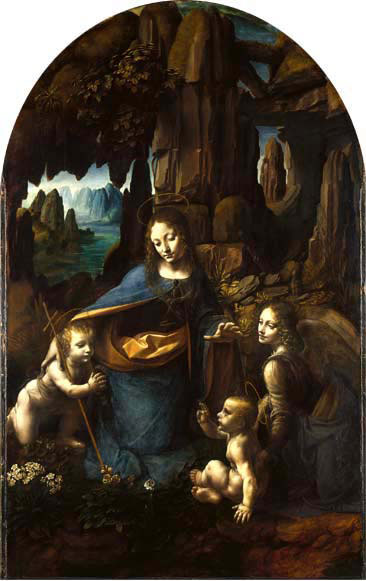
Leonardo da Vinci: 'The Virgin of the Rocks', 1491--9/ 1506-8. oil on canvas

Or what about the relationships depicted in Leonardo’s ‘Madonna and Child with St Anne,

Leonardo da Vinci: 'The Virgin and Child with Saint Anne and John the Baptist', 1499-1500, charcoal and chalk on paper

complex and oddly frightening, a great deal more than maternal tenderness going on here, and certainly not an image that anyone would recommend for a mother and baby workshop.

Very few of the thousands of other Madonna and Childs that litter Western art contain tenderness by the way, the premonition of pain and sorrow perhaps, the weight of the future, the glory of redemption occasionally; very little about tenderness. Equally, the iconographic intention of most Last Suppers is to reinforce the lessons of the Eucharist and the Semitic qualities of Judas, usually by painting a lot of slightly bored looking young men (one with darker skin and a hooked nose), a large amount of tablecloth and an awful lot of legs.

It might be worth pointing out again the role of context here; context at the time of making and now, and to consider how we appreciate that change in context. Look at for example, the art produced in direct response to the Council of Trent (the Catholic Church’s attempt to visually upstage insurgent Protestantism in the late 16th Century) if you want art that was designed to be consistently simple in message.

Santa di Tito: 'The Vision of St Thomas Aquinas', 1593, oil on canvas

Apart from being dull, it is still incomprehensible, visual language and iconography changes over time: in how it is depicted and how it is understood. De Botton seems to want an art that is utterly static; autocratic icons.

I have taught the History of Western Art for many years, it is rare for the Christian message to be obvious to contemporary viewers. ‘Who was Judas?” I get asked that sort of question quite often and in nominally Christian educational establishments. Yet somehow or another, we live in a world of considerable emotional literacy, think of the nuances of our responses to reality TV, to soaps and to 24 hour news. A world which has lost the basic Christian narrative, has also also lost the multilayered complexity of Christian imagery. My point is that the complexity of art is still apparent to students, although the didactic Christian message does not come across unless it is explained, didacticism it is not necessarily inherent in an image.

To give another example. I have shown Caravaggio’s ‘Supper at Emmaus’ (the earlier one in the National Gallery) to most age ranges.
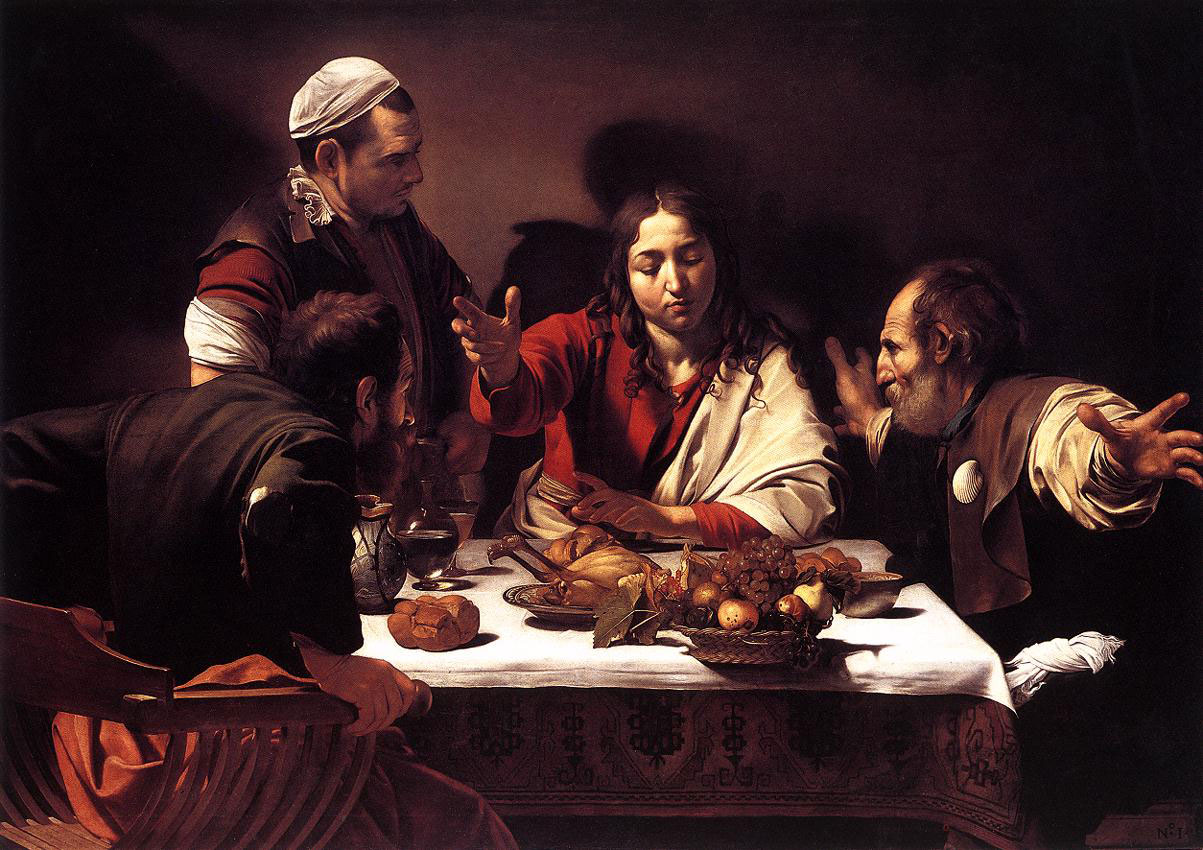
Caravaggio: 'The Supper at Emmaus', 1601, oil on canvas

Very few identify the central figure, even fewer know the story. It is by the way, the sudden re-discovery of Christ alive after the crucifixion and disappearance of the body. We see the instant realisation of the risen Christ/ mankind’s redemption in the gestures and faces of the two disciples, possibly Cleopas and Peter. They recognise Christ from his gesture, first seen of course at the Last Supper, or rather seen in paintings of the Last Supper by artists and viewers of art. Art is a language, it uses particular forms in particular groupings that comment simultaneously on the portrayed narrative and the process of portrayal. Ie art has always been about art,

Look at the role of light in this work, the brightly lit fruit still life in the foreground is also a vanitas piece

Caravaggio: 'The Supper at Emmaus' 1601, oil on canvas detail

(see the rot in the grapes and apple) think of what that might be about in such a story, and why the dark shadow underneath as the bowl appears to fall through the picture plane into our laps. Or, notice the cast shadow of the innkeeper that makes a halo over Christ, but why a black halo? All this without mentioning the role of the artist himself. Many, many layers of meaning going on here. Show this image to people under 30 or so, they usually assume that the central figure is female. But armed with a few other images of Caravaggio’s self portraiture and you can guarantee some fascinating insights into the public portrayal of the self, and some very skilful unpicking of the vast range of themes on offer. Even to the extent that one small boy explained that this was a painting about fishing, and therefore, boasting.

“See that man on the right, with his arms stretched out, he’s telling the others that he caught a fish and it was thiiiis big!”

In fact, I find that students find more complexity and relevance in contemporary art than they do in paintings ”about men in dresses waving their arms about”. Tracey Emin’s ‘Bed’, although ‘Everyone I Have Ever Slept With’ usually strikes a closer chord.

Hirst: 'Mother and Child Divided' 1993, multi media

Or, more obviously Hirst’s ‘Mother and Child Divided’ (a new Madonna and Child perhaps), parent and offspring forever divided from each other and themselves

The simplicity that de Botton is after is a chimera; it has never been there, it only exists in propaganda, advertising posters and the lazy minds of paternalistic ‘philosophers’. We live in an ambiguous world and have done since the collapse of feudalism, the rise of capitalism and the art that reflected it. Art is ambiguity; that is why it is interesting.

I think I have to go and lie down in a darkened room now, perhaps I’ll re-read Lucy Lippard’s ‘Six Years: The Dematerialisation of the Art Object’ to calm me down; it’s awfully good you know.
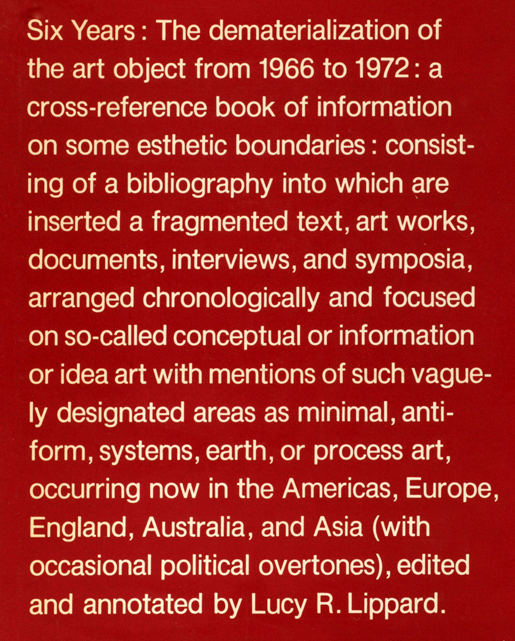
Lucy Lippard 'Six Years: The Dematerialization of the Art Object. 1966-72'

Peter Paul Rubens: 'A View of Het Steen in the Early Morning', 1636. Oil on Oak. Oil on oak.131 x 229.cm. National Gallery, London

“Shrines to me embody the essence of what I do. I put significant artefacts in a special place for us to contemplate upon…As humans I think how we look at art has developed from the way we look upon gods, altars and relics in shrines and sacred spaces”

Grayson Perry wall text from ‘The Tomb of the Unknown Craftsman’ British Museum.

 My memory of Catholic worshippers in front of shrines, is that they (usually women) either make a quick bob, cross themselves and move on or, they kneel for a long time in silent contemplation, sometimes accompanied by quiet recitation. The characteristics of Room 29 of the National Gallery, London, in front of the Rubens ensemble (the two Judgements of Paris and Het Steen) are movement and discussion. Everyone is transit, pairs and groups stop, point and discuss key features. I suppose it depends on what our relationship with the gods might be – amused tolerance, or wariness perhaps

Cavafy wrote about that relationship:

One of Their Gods

When one of them moved through the marketplace of Selefkia 

 just as it was getting dark— 

moved like a young man, tall, extremely handsome, 

with the joy of being immortal in his eyes, 

with his black and perfumed hair— 

the people going by would gaze at him, 

 and one would ask the other if he knew him, 

 if he was a Greek from Syria, or a stranger. 

But some who looked more carefully 

 would understand and step aside; 

and as he disappeared under the arcades, 

 among the shadows and the evening lights, 

going toward the quarter that lives 

only at night, with orgies and debauchery, 

with every kind of intoxication and desire, 

they would wonder which of Them it could be, 

and for what suspicious pleasure 

he had come down into the streets of Selefkia 

from the August Celestial Mansions.

C.P. Cavafy, Collected Poems. Translated by Edmund Keeley and Philip Sherrard. Edited by George Savidis. Revised Edition. Princeton University Press 1992)

 Or, do we in the North still feel Judaeo Christian awe, respect and fear? Is perhaps this constant movement a form of penance, moving between the Stations of the Cross?

The Gallery is unusually quiet this afternoon, the visitors mostly elderly. Sometimes when I am here in front of this Rubens collection, it is the landscape that draws attention, today it is the two sets of nudes.

 “I’ve got to have a sit down; it tires you out all this lot”

I suppose that, as an individual devotee in front of an icon, it’s visual representation is not important. St Cecilia is St Cecilia or St Luke is St Luke is St Luke. You need to check that you are standing in front of the right one, you make your obeisance and the job is done. Equivalently, you walk the rooms of the National Gallery, glance at the labels to check, genuflect and walk on.

 The elderly couple on the bench next to me have been here for some time. He is asleep and she has been reading the index of a large London A to Z, with apparent interest, since she sat down. Every now and then, she will turn to a different section of the maps as though to check what she has read. She is wearing a bright red fleece with ‘Nike, Just Do It’ written on it. The winged, wreathed, youthful Greek goddess of victory spurs on this tired figure, draped in contemporary leisure wear, to greater feats of cartographic research as her companion, firmly in the drowsy hall of Somnus (from Ovid), slips further under the influence of Morpheus .

 Cavafy wrote ‘One of Their Gods’ in 1917, thinking about that and the Greek Pantheon around me, leads to other responses to classicism. In ‘Quattro Centro’ way back in the 1930’s, Adrian Stokes (the art critic and painter) inspired by travels through Italy, made a distinction between carving and modelling. Art that has been ‘carved’ appears to work into the medium, (any medium, not just stone) to find new forms and imagery. As opposed to art that has been ‘modelled’, ie adding and moulding together that which is already known. Het Steen is clearly ‘modelled’; you can see how Rubens has worked his vast knowledge of pictorial space, of the hairy roundness of large vegetal forms, of the role, direction and intensity of light sources across a grand plane. A modelled space, his shaping hands have smoothed plastic forms with great sophistication and vigour.

 Two identically tall, enormously rounded, wonderfully crumpled viewers appear in front of the later ‘Judgement’. The lighting is such, that the painting and wall are lit up like a theatre set, these two are in silhouette and seem to outdo Rubens’ nudes with the plump pear shapes of their lower halves. But, it is the exact line across the top of these viewers heads and the almost exactly similar shapes of those heads that is most striking.

Hypnos has released his hold on my companion, he wakes up

“Come along then dear, we can’t sit here all day enjoying ourselves”

 People stand for a regulation amount of time in front of each painting, then briskly move on to the next. It reminds me of that early Twentieth Century diet fad called Fletcherism, (after Horace Fletcher, splendidly nicknamed ‘The Great Masticator’) when eaters had to chew each mouthful of food 32 times before swallowing; looking at paintings and 32 chews seem to share the same level of enjoyment.

 Or, perhaps we should view Perrys’ description of significant artefacts from a more utilitarian, economic, even traditionally Marxist standpoint. I suspect that Perry, like me, believes that the primary significance of these objects should come from their manufacture by artists. Their value comes from the shaping eye and hand (carving or modelling) of the maker and a complex relationship with context. I suspect that for the majority of viewers in museum, the significance of these works, their value, is primarily monetary. In essence when visiting a museum we are worshipping objects that matter because they are worth something, quite a lot of financial something. We are genuflecting in front of capital, validated by culture no doubt, but ultimately this constant foot traffic moves between the Stations of Croesus, genuflecting in front of shrines to celebrity cults and the goddess Verisimilitude.

 Two young boys with padded jackets shrugged down over their shoulders have started to recreate the dance from Thriller, worshipping a different sort of cultural icon, one of Them from the August Celestial Mansions; time to go.

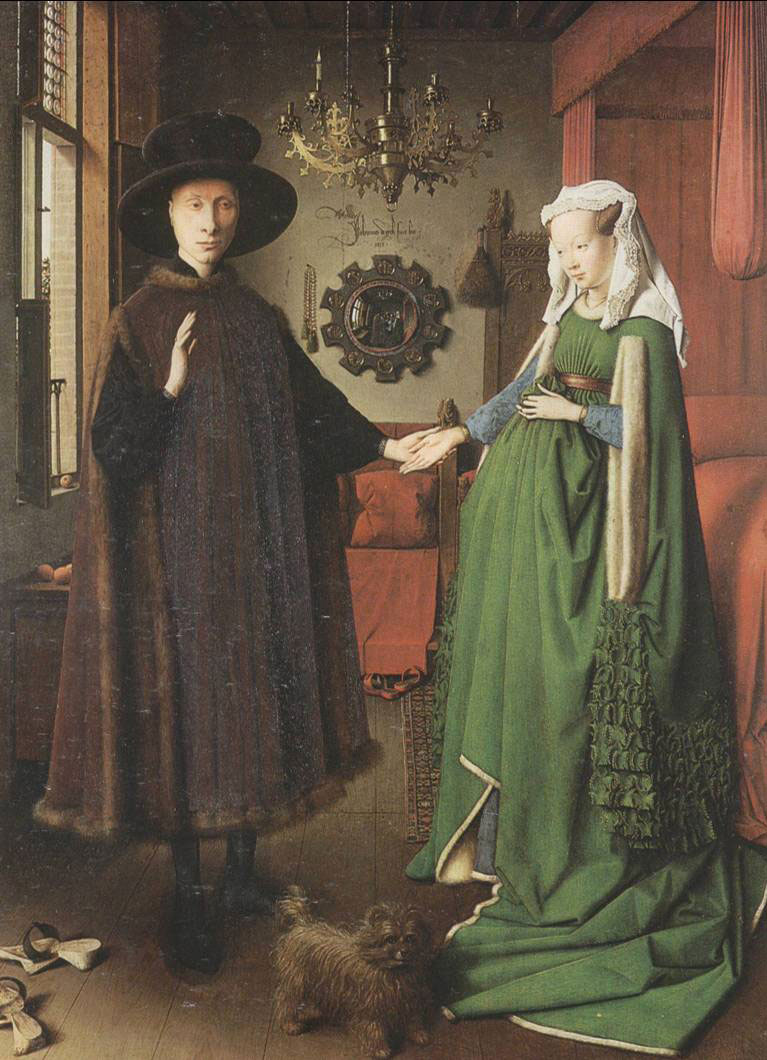
Jan van Eyck: 'The Arnolfini Portrait', 1434, oil on panel. National Gallery, London

I’m stood in front of Van Eyck’s Arnolfini Portrait in the National Gallery, London, wondering why viewers queue so quietly to look at this image, and make such small gestures with their fingers, rather than run, talk loudly and wave as they do in front of others.

We, the viewers, seem to be caught in the doorway, or so the mirror tells us, although the composition might lead one to think that we are slightly closer to the couple. Are we, the internal spectators in our reflected complementaries, are we actually participating? Is there anything about the behaviour of the Arnolfini’s that makes any connection with us, apparently there in the room with them? They seem completely self-sufficient. We are anonymous witnesses, of the right social standing perhaps, but not active participants. Timeless witnesses perhaps with “a distinctive access to the content of the picture” as Richard Wollheim put it. Our access though is not to all areas. This is an, apparently, formal painting, as internal spectators we are not allowed through the velvet rope to the VIP area. The Arnolfini’s might defer to the court of Phillip the Good that is socially above them, but it doesn’t look as though they are going to let the future get away with too much familiarity. As far as they are concerned, they own the future, we will never be allowed beyond the door.

Our role in looking at this painting now, is not a passive one, (as Linda Siddel reminds us in, ‘Jan Van Eyck’s Arnolfini Portrait: Stories of an Icon’, Cambridge University Press, 1993) nor was it when it was made. Ultimately, this is a painting about relationships, between people of different ranks, of different genders, between people and things. It is a painting that stands at the beginning of capitalism, I’m sure that van Eyck was no more aware of social/ cultural/ political or economic change than any other literate and aware participant in the upper ranks of Northern European society. But, the relationship between these people tells us, at the end of capitalism, where we have come from. It doesn’t tell us through some complex arcane code known only to initiates, it tells us through the ways in which people and things interact. We understand these interactions by looking at them; something artists are good at doing.

Jan van Eyck: 'The Arnolfini Portrait' (detail), 1434, oil on panel. National Gallery, London

The figures in the doorway are clearly not a threat and they are known to the dog at least; it is not in guard dog mode. In the same way, the curled sleeping acceptance by the dog in Titian’s ‘Venus of Urbino’, tells us of the probable status of that viewer.

Titian: 'The Venus of Urbino', 1538, oil on canvas. The Uffizi. Florence.

The Brussels Griffon in the Arnofini painting, a small expensive breed, indicates the notions of defence and power that a larger dog might display without the actuality

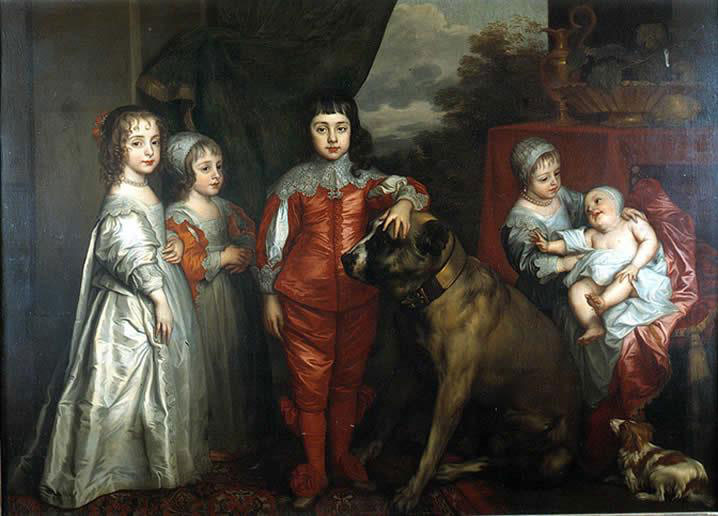
Anthony Van Dyck: 'The Children of Charles 1', 1637, oil on canvas. The Royal Collection

(Van Dyck’s portrait of the young Charles the Second with his hand on an enormous mastiff springs to mind) . It is a contemporary and ironic reworking of theme of guard dog; it is quite literally a toy.

Look at the Arnolfini dog’s mouth, it has the semblance of a smile (Jack Thomas in ‘Arnolfini: Reflections in a Mirror’, one of the many fictionalisations of the painting, devotes chapter 27 to the dog, calling it Hendrik). That turning up of the left hand side of the dog’s mouth, makes the viewer aware of the other mouths on show.

Along with strong verticals, the other dominant compositional arrangement in this painting is the upward curve of their joined hands. In his analysis of pictorial composition at the Bauhaus, Paul Klee made much of this type of arrangement. Lines or forms moving upward in an image move from ‘very bad’ to ‘very good’, in an arc points ideally related in tension create equilibrium, therefore harmony. A general shape we could call, simply, a smile.

Look at her mouth, on her left, the side closest to us, there is a highlight where the cheek meets the lips. They are a very cute, pursed pair of lips, idealised like much of her face; the eyebrows in particular. But look further at that mouth, the highlight can also be read as a smirk, her eyes might be solemn, fixed on a blank middle distance, but that is not a solemn mouth, she is thinking about something less elevated. Look again at his expression, look at his mouth, surprisingly full and sensual when you really examine it closely. Look at his eyes, they are, like hers, staring blankly. But, there is a turn to his left, towards her, in the position of those eyes. He is trying unsuccessfully, not to look at her. If you look carefully, he is not as old as that pallor might make one think at first, a pallor emphasised by all that ultra-fashionable black clothing. They are both pale, presumably underlining that, although they make money through trade, they are not artisans. His face is clear and relatively youthful, no lines, or fat or jowls,

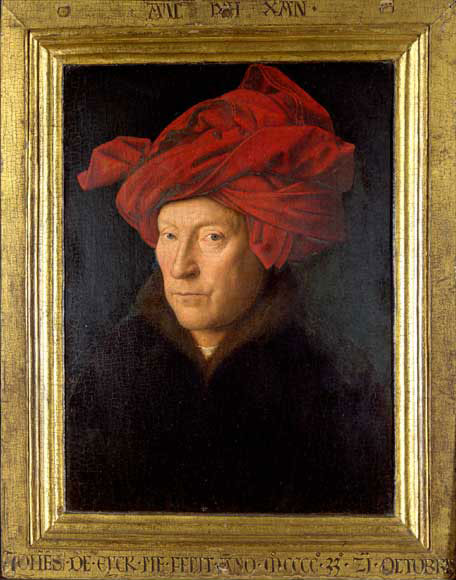
Jan van Eyck: 'Portrait of a Man' 1433, oil on panel. National Gallery, London

compare with the man in the red turban to your left to see evidence that van Eyck can paint older male faces with great accuracy. Despite the need for formality and solemnity the eyes, of the Arnolfinis his in particular, appear to be sliding towards each other. This is a couple who can’t wait for everyone to leave the room.

Craig Harbison champions such an approach (in Chapter 4 of the ‘The Play of Realism’), like most other academics he over-determines the exactitude of the iconography, although I think his basic point stands: that there is a keen personal as well as a legal and financial relationship here. Ffor confirmation, look at the red cloth on the edge of the bed, see how it echoes the diagonal folds of her green dress and makes the parallel vertical folds of the hanging, potent, thrusting red bolster that much more emphatic.

A visual image, these are not literary, textual mysteries. This painting is far more straightforward than the professionals give it credit for. The details you are looking for, are those you would expect to look for when seeing a painting of two people entering some sort of relationship. These representations have the mass, and presence of figures, this is after all one of the earliest, full figure, standing double portraits of ‘ordinary’ people, therefore they relate to each other in the ways we might expect.

We respond then to the content, two people, but to come back to my original point, why do we respond in this particular manner?

“The entirely eccentric position of the central vanishing point reinforces the impression of a representation determined not by the objective lawfulness of the architecture, but rather by the subjective standpoint of a beholder who has just now appeared; a representation that owes its especially “intimate” effect in large part to this very perspectival disposition” (Erwin Panoksky: Perspective as Symbolic Form’, page 69)

If you are still not sure, watch how viewers behave in front of it. They stand, usually in couples, their poses unconsciously mirror those represented, like people falling into step as they walk together, or more likely people starting to adopt the accent of those to whom they are talking, and this painting does talk to us.

Peter Paul Rubens: 'A View of Het Steen in the Early Morning', 1636. Oil on Oak. Oil on oak.131 x 229.cm. National Gallery, London

Whereas, watch viewers in front of that other personal favourite: Het Steen, a grand painting about land and reward. Viewers walk about in front of Het Steen, they make gestures they speak loudly, I can always hear what they say in front of Het Steen, never the quiet confidences, the whispered exchanges about what they are witnessing in front of the Arnolfini portrait.

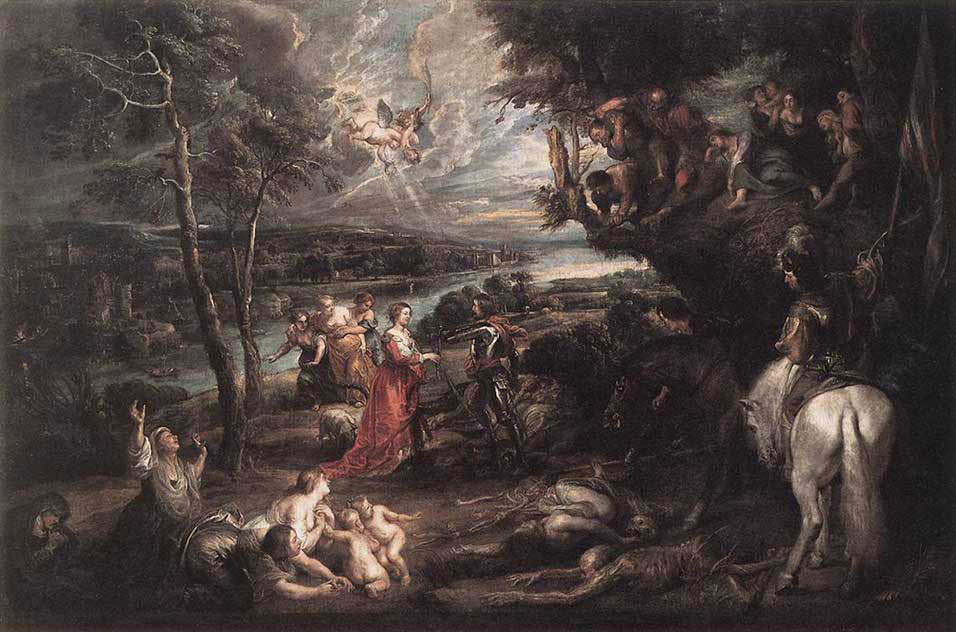
Peter Paul Rubens: 'Landscape with St George and the Dragon', 1630, oil on canvas. The Royal Collection

On first sight, I thought that the two blasted oaks in the newly exhibited Rubens: ‘Landscape with St George’ at Tate Britain were closely related to the foreground clump in Het Steen. On sitting in front of the latter, I think probably not.

Peter Paul Rubens: 'A View of Het Steen in the Early Morning', 1636. Oil on Oak. Oil on oak.131 x 229.cm. National Gallery, London

From a generic stock of trees perhaps, but not the same. In Het Steen the trees are sturdy/ healthy, whereas, deliberately/ iconographically in the St George they are all peeling bark and thinness. That Flemish bent silver birch – with a bend to the right – seems surprisingly unconvincing today, particularly when compared to the carefully painted fruiting tree with the weeping tendency in the centre.

Stock Figures

Unlike St George and the Princess, these stock figures (the carter and passenger and the hunter) look suitably lumpen and graceless. Even more so in comparison to the apotheosis of St James 1st, in Rubens’ Banqueting House ceiling in Whitehall. Gestures and poses derived from Michelangelo and others would clearly have no place in such a personal landscape.

Peter Paul Rubens: 'The Apotheosis of James 1st'. The Banqueting Hall, Whitehall

Thinking further about stock figures: in Trafalgar Square in a parallel line to the front of the National Gallery, as I came in there was, counting from the left:

An amplified violinist playing either ‘If You Were the Only Girl in the World’ or possibly ‘Don’t Fence Me in’, not easy to tell

An entirely silver man

A Charlie Chaplin

A man dressed in Union Jacks held on by rubber bands and sellotape, his thematic purpose was unclear

An entirely gold man

A Shrek, or rather a fat man in ordinary clothes with a beer can in one hand wearing a green rubber Shrek mask

Two young men playing noodling jazz on a double bass and a saxophone, no tune was obvious here.

All the dressed figures stood on wheeled tool boxes. These metallic men seem to have their iconography relatively fixed: the all over spray; a non-descript hat; the plain slightly industrial clothing; often with mock rubber bare feet; always a very large nose. They seem to have no relation to, for example, the Tin Man from the Wizard of Oz, what is their ultimate derivation I wonder? When I first saw them, many years ago in front of the Pompidou centre, these figures where completely static, living statues. Now, they make sweeping arms movements to beckon in children to stand next to them and be photographed. They have moved, as it were, from skills based activity to a form of celebrity; proximity rather than admiration is the current role of the viewer, although no one wants to stand next to the increasingly belligerent Shrek.

Het Steen

In front of the painting I keep coming back to a different version of that question: there must be more to our interest/ enjoyment in the painted representation of depth than admiration of skill, of a magic trick. It is always enjoyable to find a specific skill, but once you have seen it a few times the trick becomes less entrancing; not so here, painted depth always seems to excite. It must be more than just the daydreaming of an internal spectator, walking the illusory fields that holds the eye? More than the urban enjoyment of a lost rural scene? More than the joy of looking at something celebrated by others?

An animal or bird is always aware of what is above its horizon, that’s why dogs can react so strongly to hot air balloons, and a few dirigibles floating in this Flemish dawn would not look out of place. Something floating just on your skyline is threatening, think of small birds looking out for birds of prey. Do we delight in representations of a clear horizon because of some sort of atavistic pleasure: our way is clear, we dominate the land in the same way that we dominate the pictorial space?

“Daddy, can I do some drawing and draw the Mona Lisa?

When you get home you can

I don’t want to go home”

Or am I just overcomplicating something very simple? The reactions of my fellow viewers seem straightforward: the colours harmonise in a pleasant manner, the view looks nice and we like a view for the same reason we like the painting of a view: ‘it takes us out of ourselves’.

Two very young Spanish boys are running around the bench and choosing which section to jump on, chasing each other round a safe landscape I suppose; time to go.