Archive

the Picture Plane

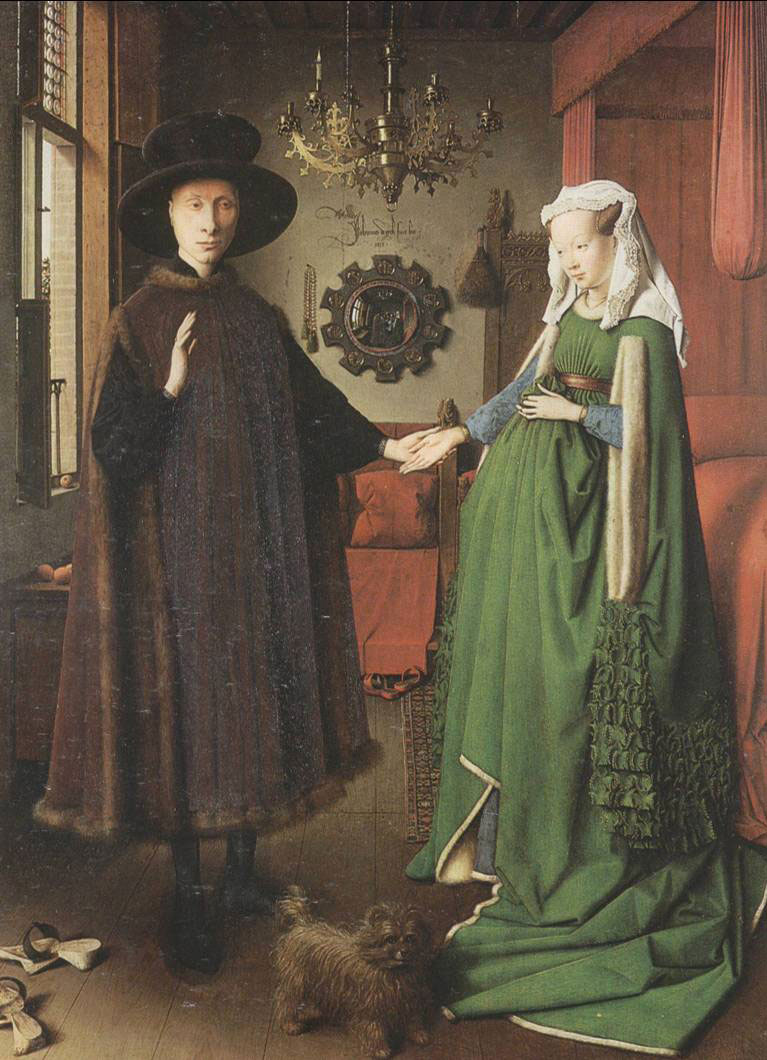
Jan van Eyck: 'The Arnolfini Portrait', 1434, oil on panel. National Gallery, London

I’m stood in front of Van Eyck’s Arnolfini Portrait in the National Gallery, London, wondering why viewers queue so quietly to look at this image, and make such small gestures with their fingers, rather than run, talk loudly and wave as they do in front of others.

We, the viewers, seem to be caught in the doorway, or so the mirror tells us, although the composition might lead one to think that we are slightly closer to the couple. Are we, the internal spectators in our reflected complementaries, are we actually participating? Is there anything about the behaviour of the Arnolfini’s that makes any connection with us, apparently there in the room with them? They seem completely self-sufficient. We are anonymous witnesses, of the right social standing perhaps, but not active participants. Timeless witnesses perhaps with “a distinctive access to the content of the picture” as Richard Wollheim put it. Our access though is not to all areas. This is an, apparently, formal painting, as internal spectators we are not allowed through the velvet rope to the VIP area. The Arnolfini’s might defer to the court of Phillip the Good that is socially above them, but it doesn’t look as though they are going to let the future get away with too much familiarity. As far as they are concerned, they own the future, we will never be allowed beyond the door.

Our role in looking at this painting now, is not a passive one, (as Linda Siddel reminds us in, ‘Jan Van Eyck’s Arnolfini Portrait: Stories of an Icon’, Cambridge University Press, 1993) nor was it when it was made. Ultimately, this is a painting about relationships, between people of different ranks, of different genders, between people and things. It is a painting that stands at the beginning of capitalism, I’m sure that van Eyck was no more aware of social/ cultural/ political or economic change than any other literate and aware participant in the upper ranks of Northern European society. But, the relationship between these people tells us, at the end of capitalism, where we have come from. It doesn’t tell us through some complex arcane code known only to initiates, it tells us through the ways in which people and things interact. We understand these interactions by looking at them; something artists are good at doing.

Jan van Eyck: 'The Arnolfini Portrait' (detail), 1434, oil on panel. National Gallery, London

The figures in the doorway are clearly not a threat and they are known to the dog at least; it is not in guard dog mode. In the same way, the curled sleeping acceptance by the dog in Titian’s ‘Venus of Urbino’, tells us of the probable status of that viewer.

Titian: 'The Venus of Urbino', 1538, oil on canvas. The Uffizi. Florence.

The Brussels Griffon in the Arnofini painting, a small expensive breed, indicates the notions of defence and power that a larger dog might display without the actuality

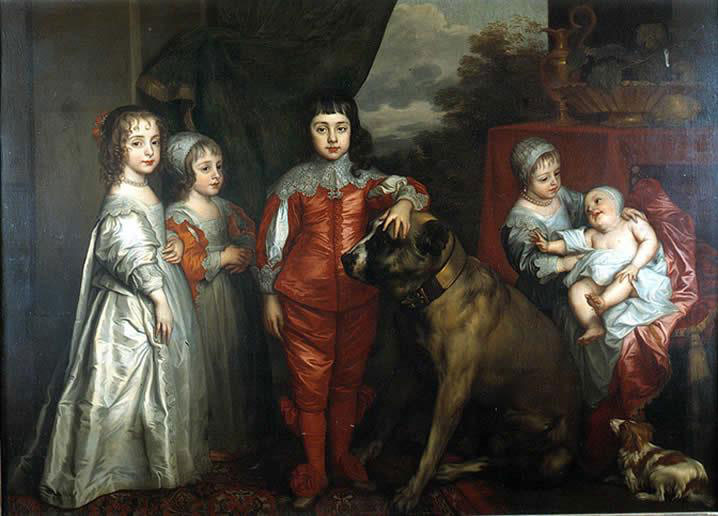
Anthony Van Dyck: 'The Children of Charles 1', 1637, oil on canvas. The Royal Collection

(Van Dyck’s portrait of the young Charles the Second with his hand on an enormous mastiff springs to mind) . It is a contemporary and ironic reworking of theme of guard dog; it is quite literally a toy.

Look at the Arnolfini dog’s mouth, it has the semblance of a smile (Jack Thomas in ‘Arnolfini: Reflections in a Mirror’, one of the many fictionalisations of the painting, devotes chapter 27 to the dog, calling it Hendrik). That turning up of the left hand side of the dog’s mouth, makes the viewer aware of the other mouths on show.

Along with strong verticals, the other dominant compositional arrangement in this painting is the upward curve of their joined hands. In his analysis of pictorial composition at the Bauhaus, Paul Klee made much of this type of arrangement. Lines or forms moving upward in an image move from ‘very bad’ to ‘very good’, in an arc points ideally related in tension create equilibrium, therefore harmony. A general shape we could call, simply, a smile.

Look at her mouth, on her left, the side closest to us, there is a highlight where the cheek meets the lips. They are a very cute, pursed pair of lips, idealised like much of her face; the eyebrows in particular. But look further at that mouth, the highlight can also be read as a smirk, her eyes might be solemn, fixed on a blank middle distance, but that is not a solemn mouth, she is thinking about something less elevated. Look again at his expression, look at his mouth, surprisingly full and sensual when you really examine it closely. Look at his eyes, they are, like hers, staring blankly. But, there is a turn to his left, towards her, in the position of those eyes. He is trying unsuccessfully, not to look at her. If you look carefully, he is not as old as that pallor might make one think at first, a pallor emphasised by all that ultra-fashionable black clothing. They are both pale, presumably underlining that, although they make money through trade, they are not artisans. His face is clear and relatively youthful, no lines, or fat or jowls,

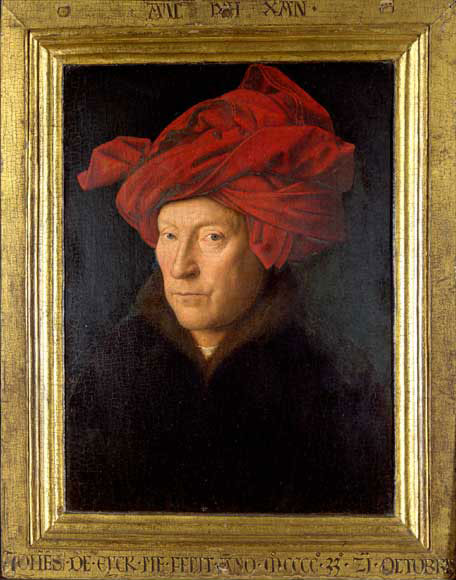
Jan van Eyck: 'Portrait of a Man' 1433, oil on panel. National Gallery, London

compare with the man in the red turban to your left to see evidence that van Eyck can paint older male faces with great accuracy. Despite the need for formality and solemnity the eyes, of the Arnolfinis his in particular, appear to be sliding towards each other. This is a couple who can’t wait for everyone to leave the room.

Craig Harbison champions such an approach (in Chapter 4 of the ‘The Play of Realism’), like most other academics he over-determines the exactitude of the iconography, although I think his basic point stands: that there is a keen personal as well as a legal and financial relationship here. Ffor confirmation, look at the red cloth on the edge of the bed, see how it echoes the diagonal folds of her green dress and makes the parallel vertical folds of the hanging, potent, thrusting red bolster that much more emphatic.

A visual image, these are not literary, textual mysteries. This painting is far more straightforward than the professionals give it credit for. The details you are looking for, are those you would expect to look for when seeing a painting of two people entering some sort of relationship. These representations have the mass, and presence of figures, this is after all one of the earliest, full figure, standing double portraits of ‘ordinary’ people, therefore they relate to each other in the ways we might expect.

We respond then to the content, two people, but to come back to my original point, why do we respond in this particular manner?

“The entirely eccentric position of the central vanishing point reinforces the impression of a representation determined not by the objective lawfulness of the architecture, but rather by the subjective standpoint of a beholder who has just now appeared; a representation that owes its especially “intimate” effect in large part to this very perspectival disposition” (Erwin Panoksky: Perspective as Symbolic Form’, page 69)

If you are still not sure, watch how viewers behave in front of it. They stand, usually in couples, their poses unconsciously mirror those represented, like people falling into step as they walk together, or more likely people starting to adopt the accent of those to whom they are talking, and this painting does talk to us.

Peter Paul Rubens: 'A View of Het Steen in the Early Morning', 1636. Oil on Oak. Oil on oak.131 x 229.cm. National Gallery, London

Whereas, watch viewers in front of that other personal favourite: Het Steen, a grand painting about land and reward. Viewers walk about in front of Het Steen, they make gestures they speak loudly, I can always hear what they say in front of Het Steen, never the quiet confidences, the whispered exchanges about what they are witnessing in front of the Arnolfini portrait.


Peter Paul Rubens: ‘A View of Het Steen in the Early Morning’, 1636. Oil on Oak. Oil on oak.131 x 229.cm. National Gallery, London

Four girls are sitting on the bench in front of Het Steen (part of a school group, Year 11 at a guess). One is sketching in an A6 book with a big red ribbon on it. They debate whether it is really annoying, or not, that different galleries have different policies for taking photographs. They fall to looking at Google Maps on their phones.

“No, look, we are here right”

“No but like, what’s that bit there?”

In ‘The Art of Describing’, Svetlana Alpers describes Northern landscape paintings as a mapping of terrain rather than the (Italian) representation of an idealised scene. She usually holds Rubens up as an example of Italianate influence and in Het Steen the foreground, with its stock figures and grand, illuminated house fits this description well. In the mid/ background though, the raised mound on the horizon acts more as destination than vanishing point. In that sense, you feel you could walk or ride in your cart along one of a series of well-established routes to the central church tower that just pierces the sky (the Cathedral of St Rombout in the town of Malines). Like the Google Map directions, you half expect a hovering blue arrow to point to an area of trees and then, disconcertingly, relocate the whole image through 90 degrees when you tilt the phone too much.

“I actually like the curves in it; I could really imagine rolling down that hill”

“It reminds me of that time we had to go on a cross country run and we got lost and had to ring up your mum”

“Shall we go now?”

“I can’t, my legs are stuck to the seat”

Alpers further characterises the fundamental differences between ‘Italian’ and ‘Northern’ pictorial space. As we know, Italian art after Alberti/ Brunelleschi  works with a mathematically defined, illusory box existing behind a transparent picture plane. It is the relationship of forms to the vanishing point and to the static, monocular viewer whose visual cone that plane bisects, which brings all this art into play. The fundamental intention is to create a unified, harmonious space between the viewer’s eye and the centrally defined infinity.

Whereas, she says, in Northern art forms are arranged in aggregation, the eye rests in a series of discrete movements around the pictorial space, movement defined by each composition, not by mathematical convention. We see each aggregation sequentially, not in one whole look. Italian represents something already known, usually known in words, Northern art is the act of describing existing objects and places through making images.

The Turner Prize at the Baltic

I have recently been to Newcastle to see the Turner Prize exhibition at the Baltic. Karla Black was the outstanding artist for me, although it was clear that the insider, with his modish re-working of early Modernism would win. This theme was all over The Venice Biennale this year; a clever bit of positioning by Martin Boyce. I had been looking forward to seeing George Shaw’s work, to seeing his paintings as real objects, rather than digital images or print.  I was surprised to find them disappointing, perhaps a comparison with Het Steen will begin to describe why.

Shaw does not, strictly speaking, make landscape paintings of a Coventry housing estate. He makes paintings of his photographs of a Coventry housing estate. That distinction is important. Look at his images and you see a visually sophisticated eye at work; an eye that is clearly well trained in photographic technique: framing; cropping balancing, depth of field; viewpoint. So that when he comes to make; ‘Resurface’ for example, a lot of the decisions have already been made. There is a formal cohesion to them, a unity that denies the tentative snapshot nature of the subject.

George Shaw: ‘The Resurface’, 2010, enamel on board

If we take one key image to stand in for the whole of his display: ‘Resurface’. Like all the others, it tends to symmetricality, look at the orthogonal created by the ‘On/ No’ device on the tarmac. This is not the sudden, deliberately non picturesque, glance of Pissarro for example. It is not, despite the advance publicity, the aggregated contents of a described landscape. If you base your pictorial space so firmly on Albertian principles, your audience will make certain assumptions; we are all familiar with these traditions, there are no real surprises anymore.

The Bin Enclosure and Art

Arranging bin sheds/ garages in this way cannot be called transgressive; we are not being challenged by the composition, rather, we are being reassured. ‘Resurface’ is a great topic, what should the housing association that owns this area of Tile Hill North do with these old sheds? Knock them down and build something useful? Wicker bin enclosures seem very a la mode these days, and the bin enclosure is a real problem for contemporary social housing design. George Shaw shows an institution not getting to grips with issues; slap on new coat of paint, put new tarmac down and ignore it.

Shaw’s paintings speak to something very appealing to the large crowds visiting the Baltic. These images seem to place themselves on a continuum that runs from the Haywain at one end, to ‘All Things Bright and Beautiful’ at the other. We can recognise ourselves and our lives in these small familiar scenes, as far as this audience is concerned there is a substantial, and affirmative process at work. The Lords of High Culture have recognised us and thought us worthy; “God has seen everything that he had made and behold, it was very good”. But note that the hymn (Words: Cecil Alexander: ‘Hymns for Little Children’ 1848. Melody: 17th Century English folk tune arranged by Martin Shaw, 1915)  continues:

‘The rich man in his castle, 

The poor man at his gate, 

 He made them, high or lowly, 

And ordered their estate.’

Look at ‘Resurface’ and the receding planes, directly parallel to the picture plane: the sheds/ a fence at the left on a scrubby grass verge/ leafless trees/ a house and in the far background more trees. These trees indicate Tile Hill Wood, one of the last remnants of the Forest of Arden, a nature reserve since the 1930’s, now rather overgrown with holly. The setting for Shakespeare’s ‘As You Like It’, pastoral romance and courtly love, all ending happily amongst the rich and powerful: Orlando carves poems to Rosalind on trees, Coventry youth paint their names on brick walls. Apart from the neatness of the interconnections that you would expect from a successful contemporary fine artist, there is an underlying nostalgia: warm and softening. We feel comforted, we accept our lot and go home thinking of British sitcoms.

The Raleigh Chopper Mk 1

In this cosy glow, we wonder whether the internal spectator for this work could perhaps be the proverbial man out walking his dog, a man who had once who been a 1970’s youth on a Raleigh Chopper bike (first released in the UK in Christmas 1969, made in Nottingham) when these sheds were in their prime. Tile Hill North was a post war estate, a new utopian future, open plan with views and walks to the surrounding woods. Employment from the new Massey Ferguson factory turning out tractors: new forms of housing and new forms of agriculture and new ways of treating nature for new futures. What we see now is entropy and ennui, decay has been unsuccessfully resurfaced, the structures themselves have not been re-worked, just given new double yellow lines to keep them in their place.

Peter Paul Rubens: ‘A View of Het Steen in the Early Morning’, 1636. Oil on Oak. Oil on oak.131 x 229.cm. National Gallery, London

Back to Het Steen

By and large Het Steen is descriptive, a specific place at a specific time of day and year: although it is redolent of ownership. We can see that through viewpoint, a raised position familiar from Patinir and earlier Flemish landscape painting. In this later work we are either an all-seeing God, or possibly a presumed absolute Stuart monarch, or perhaps we are seeing the landscape from the square crenelated tower you can just see to the right of the house: a reworking of the exact topography to emphasise the notion of ownership. Such a reworking displays the extent, the scale of the land that comes with the manor of Het Steen.

Shaw also re-presents and describes a particular landscape with a strong underlying narrative, why was seeing Shaw’s actual paintings unfulfilling? After all, in reproduction his works look very fine indeed. But the real things seem diminished, they were either too small, lacking the power that scale should bring in this context. Or, they were too large and could perhaps been bright jewels; elegant and perfect. Each approach in direct and telling visual contrast to the actuality. In fact the paintings lie very flat to the wall, dull of surface and demanding very little for the eye.

‘Resurface’ and the painted surface

It is the painting as object that matters in this context, and the surface quality in particular. In Het Steen we see a grand statement, as an object it is a glorious thing, of a piece with what it represents. The paint surface is layered and, despite the best efforts of the National Gallery lighting scheme, lively, vital, light catching on the foreground trees and the vertical fold of the hunters sleeve for example.

In common with the lack of clarity between their pictorial space and their subject, Shaw’s paintings have a muddy, unclear set of tonal values, based in ‘Resurface’ on a sharp Viridian green. Every single mention of George Shaw must, by legal decree I assume, talk at length about the medium he uses. Again a brilliant USP: Humbrol enamel. The reader immediately thinks of craft practice; obsessive hobbyists in adolescent bedrooms; that soft nostalgia again. Enamel lacks the apparent depth of oil paint, there are no evident layers of varnish in Resurface and the shine sits on top of the surface. Oil paint appears to contain tangible highlights as well as reflect light through different textures; those layers of glaze/ varnish and consistency present forms of depth to the viewer. Enamel can’t really contain texture, it just provides a uniform shine, again thematically suitable, but as interesting as looking for a long time at the surface of an Airfix model or perhaps the gleam on a slightly muddy Mark 2 Raleigh Chopper. It is interesting how much the digital version provides the depth that is missing in the object.

The four GCSE artists have gone, I now realise that during the twenty minutes, at least, I heard them on the bench, not one of the girls said ‘Oh My God’, or it’s diminutive ‘OMG’. These things ought to be noted.

Beside me in bulky tweed called, I think, a covert coat, and balancing a rather fine Brown Derby hat on his knee, a man keeps consulting first one mobile phone from the left pocket, then the right. After a while he calls from one of them.

“Hello, Hello, I’m trying to get hold of Gerrard…I came in just after one to meet him…it’s now after 3…it’s all very interesting, but I don’t know what happened to our rendezvous”

I leave him surrounded by huge numbers of French children with clipboards. Our tweed clad gent is talking about ordering a meal from M and S, he places his hat on his head to protect him from youthful Gallic indifference.

Peter Paul Rubens: 'A View of Het Steen in the Early Morning', 1636. Oil on Oak. Oil on oak.131 x 229.cm. National Gallery, London

Alberti defined seeing a painting as looking through a window but, you can look out of or into a window. Looking at pictorial space is a reciprocal process. Norman Bryson (‘Vision and Painting’, page 96) points out that the viewer’s space, on this side of the picture plane, has differed over time. The dramatic liturgical theatre of Byzantine Christendom; you approached the image in a full architectural setting with aural context. You moved from devotional icon to icon in a set pattern, at a particular time of the year, according to prescribed physical ritual accompanied by prescribed sounds and of course smells, incense etc. The contested piazza of the Renaissance self; always measuring, always calculating proportion, always negotiating a better deal with God. The pure white cube of the fiercely convinced, Protestant communicant. The contingent world of the modern being, a fluid range of virtual selves, constantly subject to a vast choice of undifferentiated stimuli.

Perhaps I was aware of this as I took my usual place in the National Gallery, on the bench before Het Steen on a Friday evening. Perhaps it was because, on leaving the Leonardo exhibition, I had seen Professor Martin Kemp (the international authority on da Vinci) in the Gents, prepping himself for his evening talk. He was dressed in a blinding white, collarless linen frock coat, buttoned to the neck. The neckline was giving him problems and took time to adjust – much fiddling and staring into the mirror. I last saw him, in the flesh, at a talk some 8-10 years ago. He seems curiously ageless, although his hair, then a dazzling black, now has shades of deeper red; we know he’s worth it. Outside, he is greeted by attendant young women in flowing dark tailoring, they whisk him away to bathe his brow in perfumed oils; aah the life of the eminent art historian.

Perhaps it was because the Leonardo show was so crowded (only a three hour queue to buy a day ticket, time quickly lost in explaining the processes of Christianity to a puzzled Malaysian Economics student struggling with terminology in the exhibition hand-out). An exhibition crowded with a certain class of person, fragrant is the term I think, modulated voices and modulated décolletage on show as well; parties to go to I suppose.

Perhaps this was why I was more than usually aware of others as I sat in front of Rubens’ joyful autumn.

A Study of Hand Gestures in Front Of Het Steen

Older hands are often clasped behind the back, male tending to one hand holding the clenched other. Female hands seem to be relatively open. Younger hands tend to hold digital devices in front or to the side, or carry bags, handbags or labelled shopping bags.

A couple walk past, constantly changing their hand grasp with each other, sometimes fully entwined fingers, sometimes laid palm in palm, sometimes holding little fingers as though they are about to pull a wishbone. They read the label, ignore the painting.


“It’s very nice, this landscape, quite a size, but just a bit big for our lounge”

Two women, middle aged, one in a pale pink cardigan, the other all in black. They are clearly absorbed by the painting and keep making paired movements, each pushes her hands together from a height about nose level and moves them down to about the waist, mostly whilst pointing to the carter and the house.

Three very small Japanese women/ girls (difficult to tell) make small dabbing movements as they point upwards to the painted sky; dab, then circular movement, dab, then circular movement. They stop, hold up their phones, standing like the three graces (two facing the work, one away from it) they each consult their mobiles, this uplights their faces with a delicate blue glow. Whatever they find, it returns them to the painted sky, more very careful anti clockwise gestures, this time with thumb and forefinger; precise and in a single plane.

The digital light from the three graces glowed briefly across the silver birches in the paintings foreground. The painted highlight on those top branches is frontally lit, as though a film crew had rigged up towers and put full spots –no coloured gels – onto the upper parts, prior to some swooping camera shots across the plain. But the sun, pale straw yellow, but yellow nonetheless, comes from the right hand horizon behind the trees. That the sun is low is clear from the sight and intensity of the shadows cast by trees in the midground; surely the trees should be in silhouette and dark at the top?

Young couple in matching anoraks stand with an arm around each other’s back. With her other hand, she takes out her chewing gum, examines it, rolls it between her fingers and pops it back in her mouth.

White haired, large middle aged man to equivalent companion, pointing with fleece clad arm whilst sat on the bench.

“Frank, what’s that building”

Frank gets up, looks at the label, waves his arm slowly in front of the painting in a horizontal manner

“It’s Birmingham”

A very large class of students appears, to draw the right hand Judgement of Paris, all hats and boots and tights. They carry A3 black sketchbooks, Seawhite’s finest held in front of them like protective shields, or perhaps devices to declare their allegiance. Time to go.

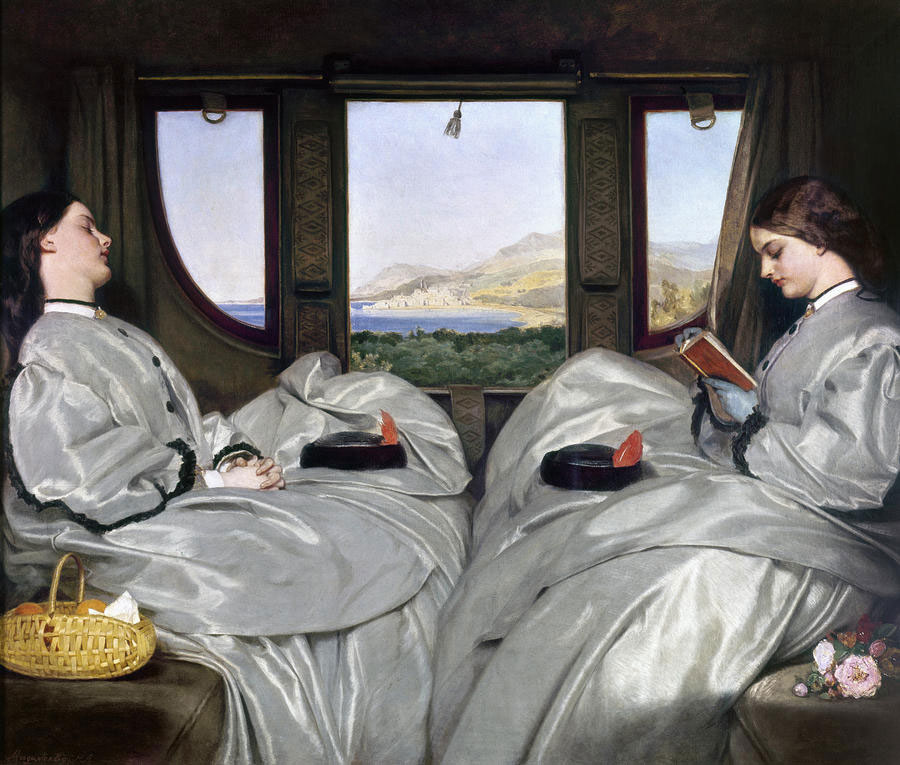
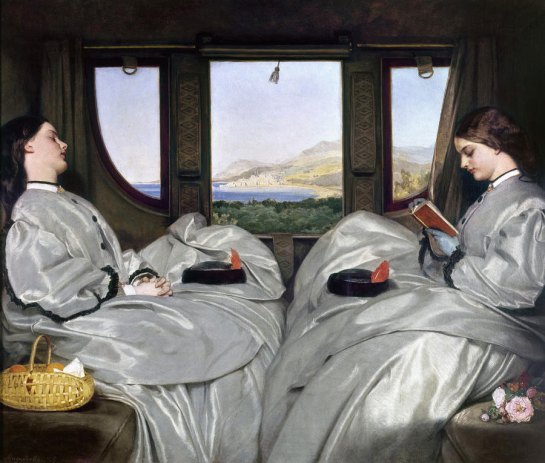
Augustus Leopold Egg: ‘The Travelling Companions’, 1862 oil on panel. 65 x 79 cm. Birmingham Museum and Art Gallery

To Birmingham to see the ‘Lost in Lace’ exhibition, I would highly recommend it, some fascinating textile work, beautifully curated by Professor Lesley Millar. Also to the multicultural festival outside the Museum, threatened by the appalling English Defense League, staging ‘a static march’. A static march involves drunk, shaven headed uglies bussed in to stand outside pubs shouting, whilst wrapping themselves in the Union Jack and, oddly, the Star of David; anti-Muslim activists getting together apparently. Strange for those of us who marched against similar far right thugs in the 1970’s, I remember the largest shouts then were viciously anti-Semitic.

Next to the Rotunda, before you go into the Lost in Lace exhibition, is a small collection of original Victorian lace that puts the later work in a very useful context. On my way across the space I came across this painting, by the wonderfully named Augustus Leopold Egg. I had previously thought about ‘The Travelling Companions’ in relation to Eric Ravilious’ ‘Train Landscape’ (see ‘Railing Against It’ in previous posts) and notions of the Internal Picture Plane. I think it is worth looking at again.

Egg was part of the circle around Dadd , Egg knew Holman Hunt well, though not as a formal member of the Pre Raphaelite group. ‘The Travelling Companions’ is a relatively late Egg painting and contains some affinities with the PRB aims, in the care of the observation work for example, but it doesn’t share Hunts exact, opaque technique and tiny brushwork. Neither does this have the ponderous, thumping morality of Egg’s earlier work, eg his triptych, ‘Past and Present’, 1858. As you might expect from a friend of Dickens, there is still a didactic nature to ‘The Travelling Companions’.

It is smaller than reproductions lead you to imagine (653 mm x 787 mm) and, painted in 1862, very much at home amongst the Victoriana of the Birmingham Museum & Art Gallery,

The companions themselves are almost identical, their symmetricality is stressed by the position of us the viewer; directly between them. They are wearing identical but, given the amount of cloth, presumably handmade dresses. It reminds me of a set for a photo shoot in which one half of the carriage has been cut away to fit in the crew and the camera. In the original Victorian carriages the bench seats were parallel, so our viewing position is either from outside or just inside the opposite window. A later image by Tenniel for ‘Alice through the Looking Glass’, clearly based on Egg, demonstrates that there was some sort of external running board used by conductors.

John Tenniel: ‘Alice on the Train’, engraving, 1872

Are we in that position? Judging by the lack of framing furniture, we can assume not. Are we then a fellow passenger, standing to leave? Again there is nosupporting evidence, the train is not arriving anywhere for example. Neither is there room for us as a potential passenger, those huge grey silk dresses squeeze out any other occupants. This is a private, almost domestic space, oddly for such a dislocated experience as travel. We see from a formal rather than an obviously anecdotal position. We see the inside of the carriage and the view beyond from the authorial voice; we are being shown something for a reason.

That exact symmetrically immediately demands a sort of spot the ball/ what’s the difference approach from the viewer, the precision of the technique allows the viewer to make those sort of observations. The obvious differences are:

  1. 1.    The view outside
  2. 2.    The women, who are they?
  3. 3.    One reading/ one sleeping The book versus dream
  4. 4.    The hats
  5. 5.    The gloves, or lack of
  6. 6.    The basket/ flowers
  7. 7.    The hair

Where are they going? Where have they come from? The triptych of the internal picture plane (the carriage window), it is exactly parallel to the picture plane itself. The framing of the view allows us to think of this secondary picture plane in pictorial terms, although Egg was not a landscape painter. Technically it both provides visual interest and relieves the claustrophobia of the small hot carriage; by doing so of course it reinforces the closed nature of this small dark space. That view also explains the lighting; it comes from the opposite set of windows.

The internal picture plane is a familiar device, probably Northern European in origin. The view through a window in Ghent, or fruit trees in a garden and sky beyond; a framed view that refers to images; the act of looking at and through them in the Albertian sense. That interest develops, when van Eyck placed a mirror on the back wall of the painted space in the Arnolfini Portrait, how did that extra pictorial space affect the image perceptually and intellectually? Velasquez immediately springs to mind. Enough of the surface of this painted area, within the bounds of the work, needs to be visible for it to be called an internal picture plane; it needs to be more than an object or an attribute. That plane has to create imaginary pictorial depth that is probably analogous to, but in some way separate from, the homogenous space of the major picture plane that must surround and enclose it for this pictorial element to work. The new space inside, as it were, the existing pictorial space, has to be at least as powerful as the original. It has to be a convincing fiction that keeps all the characteristics of a convincing fiction (autonomy, agency etc), whilst living within another fiction, hence the enjoyment in painting paintings within paintings.
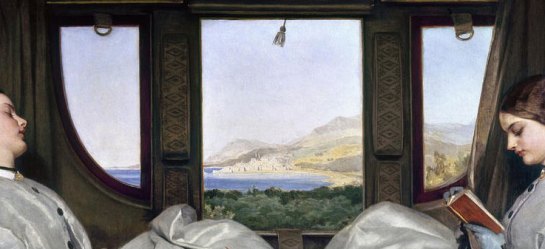
Augustus Leopold Egg: ‘The Travelling Companions’, 1862. Detail

Note that the view inside our view of ‘The Travelling Companions’ is entirely static, the only sense of movement is in the slight sway of the tassel. The view is different through each panel. The curtain on the right has been slightly drawn to shade the book. The blue of the sky on the right is a shade or two deeper than in the other two panels. The curve of the outside window panels echoes the curves of the two girls, on the left the sleeper is just a little more slumped, her window is free of curtain so we get the full 45 degree curve and a small, almost abstract residue of horizontal sea with a slight froth of land on top.

There is a small white town on the edge of the bay, on the land that points like an arrow toward the left hand panel. This is apparently a view of Menton, on the border between France and Italy. Given that the composition of the painting features the crumpled border between two figures and a clear vertical axis, are we meant to assume something here? Menton had only just moved from the control of Sardinia to France, though there seems no obvious reference to this, nor that the city is famous for its lemons, nor that menton is the French for chin. Nor, oddly that Webb Ellis, the ‘inventor of Rugby’ was living in the town at the time Egg made this painting and died there ten years later. Also, and tangentially relevant, in 1892, Charles Spurgeon, died there. Spurgeon the British Baptist preacher was the most popular London minister of the nineteenth century, crowds of 6,000 came each Sunday to his Metropolitan Tabernacle.

I am not suggesting that the city in this view is a religious reference, but these people were here for a reason: TB. In 1861, James Henry Bennet, a Manchester doctor, and TB sufferer, published ‘Mentone and the Riviera as a Winter Climate’ suggesting Menton as suitable place for a tuberculosis cure. The book was very popular, the wealthy wintered here, and died here. That is the view we can see through the window, are these two suffering from TB? Clearly not, they seem the picture of health. But, that city on the shore, is it therefore a guarantor of health, of happiness? It is certainly a white city, although not quite a shining city on a hill.  Egg himself was a chronic asthmatic that was why he travelled to places like the French Riviera, although he would die from asthma in Algeria. But, from this and his other paintings, he does not seem to be an overtly autobiographical painter, Egg had visited Mentone, with Dickens and Wilkie Collins. This view is about the two girls, not necessarily about medicalised death in sunny places. Travel is though, supposed to be good for you, broaden the mind and all that.

As in any English painting, their class matters, they are in a first class compartment, we assume that, given the nationality of the artist, they are English travelers. We are looking at the upper middle class tourist moving away from the grey light of home to the bright sunlight of the south. From the later 1830s, the genre of tourism diversified, the middle class entry into a European space formerly inhabited by the elite, Egg illustrates the sudden and modern rise of mass travel. But, see how little very little attention they pay to that view, it is for us the viewer. The companions are getting their inspiration from books or from dreaming.

What is she reading, is it a popular novel? A Bible? Or similar? Or a guide book? Even close up you can’t read a title, it not a yellow backed popular novel (cost about two shillings), sold to through railway bookstalls eg WH Smiths, neither is it a Bible.

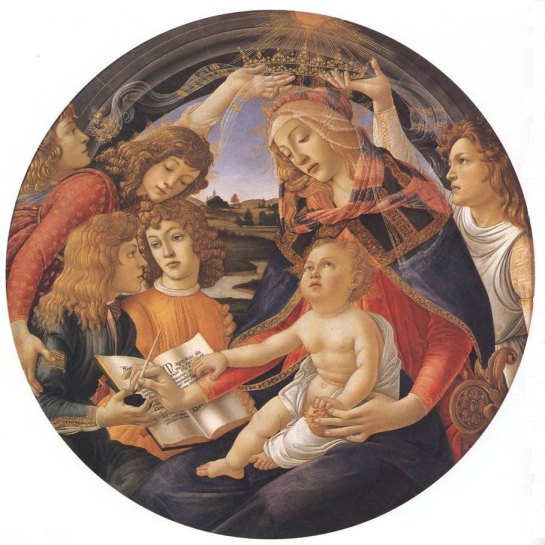
A woman reading in art has, usually, a set of meanings attached: ‘Magdalen reading’ by Rogier van der Weyden, from the 1430’s, or the Virgin Mary often in the Madonna and Child composition with Christ riffling the pages of her book. Often these images remind us that she wrote as well as read, eg Botticellis ‘The Madonna of the Magnificat’ 1483,
Botticelli: ‘Madonna of the Magnificat’, 1483

where we can see the pen and ink as well as the book. This view of women reading is a sacred search for knowledge, it would have been easy to rearrange the composition to give the reading girl a halo from the window behind, the drawing of the curtain deliberately closes down that possibility.

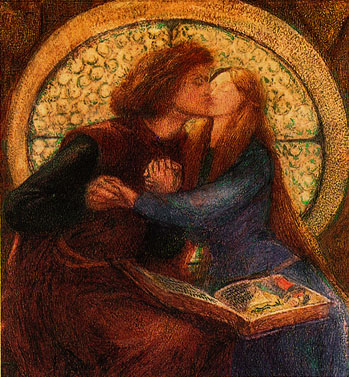
There is another result of reading, a different sort of passion that turns up in illustrations of Dante, Paolo and Francesca’s reading of Lancelot and Guinevere leads to adultery (‘that day we read no more’), for example: Rossetti’s ‘Paolo and Francesca da Rimini, 1855,
Dante Gabriel Rossetti: ‘Paolo and Francesca’, 1855

the couple have the book on their lap. But, they are a couple and these are two identical women; the identification, or the implication anyway, doesn’t fit. Neither does our reader seem stirred to any other than, at the most, contemplation. What sort of future might she be contemplating? Or what sort of past might she be reading about?

The first Murray guide was published in 1836 (A Handbook for Travellers on the Continent) and the first Baedeker in English (On the Rhine) in 1861. Murray’s, were traditionally cloth covered in a characteristic red that faded, (Baedeker copying the same colour system from 1861 onwards). They had gold writing on the upper front cover, if you look very hard at the faded red book in the painting there is an ovoid smear where that writing might sit. Murray’s were known for their quotations from Byron, ie high toned. The first Murray handbook on Northern Italy was published in 1842, written by Sir Francis Palgrave father of the Golden Treasury man, after severe criticism from Ruskin (over the correct hierarchy of Renaissance painters) that edition was upgraded in 1846; so you get some idea of the clientele. They were also expensive; apparently costing the equivalent a labourer’s weekly wage.

So, the figure on the right is reading a literary travel guide to art and architecture, a handbook that was also one of the first guides to modern travel (railways and steamships) references easily recognised by contemporaries. We might see the part drawn blind as a gentle assertion by Egg, that looking at the view would be more productive, note that the view behind the reader is a little more detailed and a little more intense. But, as an activity by a young traveller this would be seen as entirely secular, entirely praiseworthy. What would be expected in the circumstances and not really liable to any greater symbolic reading by the contemporary viewer; despite the wilder assertions I have read in some Victorian Studies circles.

Augustus leopold Egg: ‘The Travelling Companions’, 1862 oil on panel. 65 x 79 cm. Birmingham Museum and Art Gallery

The sleeping girl, dreaming into the future as the other reads about the past? Slight flush on cheek of the dreamer, significant? Like images of woman reading, sleeping women in art might lead us to where we are supposed to be.  A ‘Sleeping Beauty’, the beautiful sleeper, who would fall in love with her watcher? In classical terms, any Victorian viewer would think of Sleeping Psyche, the mortal girl watched by Eros as she sleeps. Or sleeping Ariadne, deserted by Theseus on the Island of Naxos, about to be woken by, and fall in love with Bacchus. Or, perhaps Titania waking to fall in love with Bottom:

There sleeps Titania sometime of the night,
Lull’d in these flowers with dances and delight;
And there the snake throws her enamell’d skin,
Weed wide enough to wrap a fairy in

Or that influential and rather strong poem: Keats’: ‘The Eve of St Agnes’, where Porphyro spies on the naked Madeline as she dreams of her future husband and then…

Beyond a mortal man impassion’d far
At these voluptuous accents, he arose
Ethereal, flush’d, and like a throbbing star
Seen mid the sapphire heaven’s deep repose;
Into her dream he melted, as the rose
Blendeth its odour with the violet,–
Solution sweet: meantime the frost-wind blows
Like Love’s alarum pattering the sharp sleet
Against the window-panes; St. Agnes’ moon hath set.

Is our grey dressed dreamer, thinking of this sort of heady stuff, painted and illustrated many times by the younger Pre Raphaelites? Far more likely to be shown inspired by a book of verse I would think, than just lying there with your eyes closed. The underlying theme in all these dreamers is that they are evidently watched by a male viewer, the male gaze mythologised, the male gaze that leads to sexual attack of one sort or another; ‘melting into her dream’ indeed. Is there any visual evidence to support such a reading of a girl with her eyes closed and her hands demurely clasped in her lap. Perhaps.

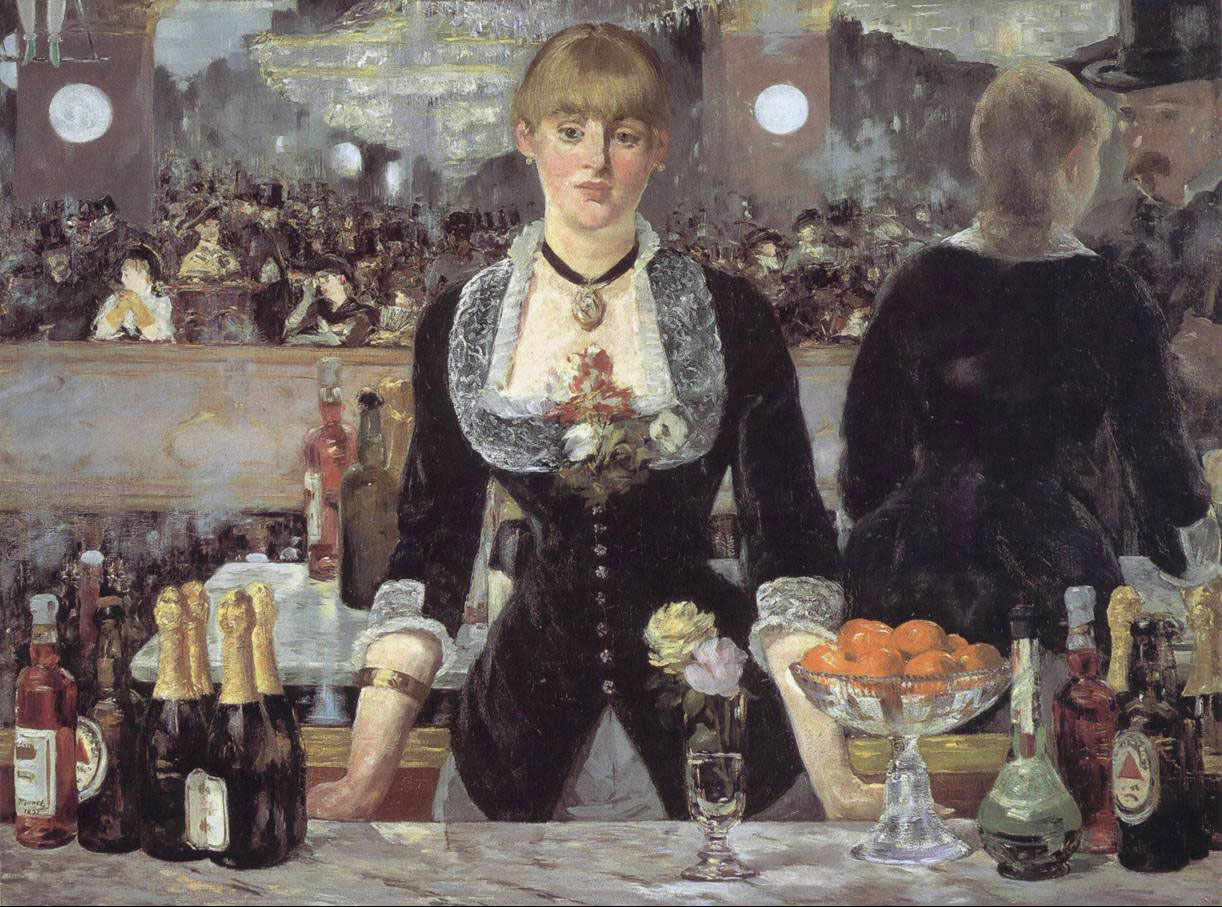
The hands, note that the reader is wearing gloves, gloves, like hats denote social class. By the way, is there any significance in the placement of the hats, both feathers facing to the right? They seem to exist in order to point to the other minor differences; a sort of signpost. Women should be seen wearing gloves at all times, and although these two fill this carriage, it is still a public space. Realist and Impressionist paintings in Paris, in a few years’ time will make this more evident, look for example at the role of the internal picture plane in other roughly contemporaneous works. For example the mirror in Manet’s ‘Bar at the Folies Bergeres’,

the barmaid’s reddened arms are contrasted with the gloved ladies seen reflected in the mirror, they have the privileged position on the balcony, Suzon the barmaid and probable prostitute does not. Bare armed, bareheaded, staring blankly into the middle distance, the grander world in the mirror is closed to her, unless of course the man we can see reflected on the right hand side is her route out and up; nothing in the rest of the painting makes that

Edouard Manet: ‘The Bar at the Folies-Bergere’, 1881-2, oil on panel

possibility seem anything other than remote.

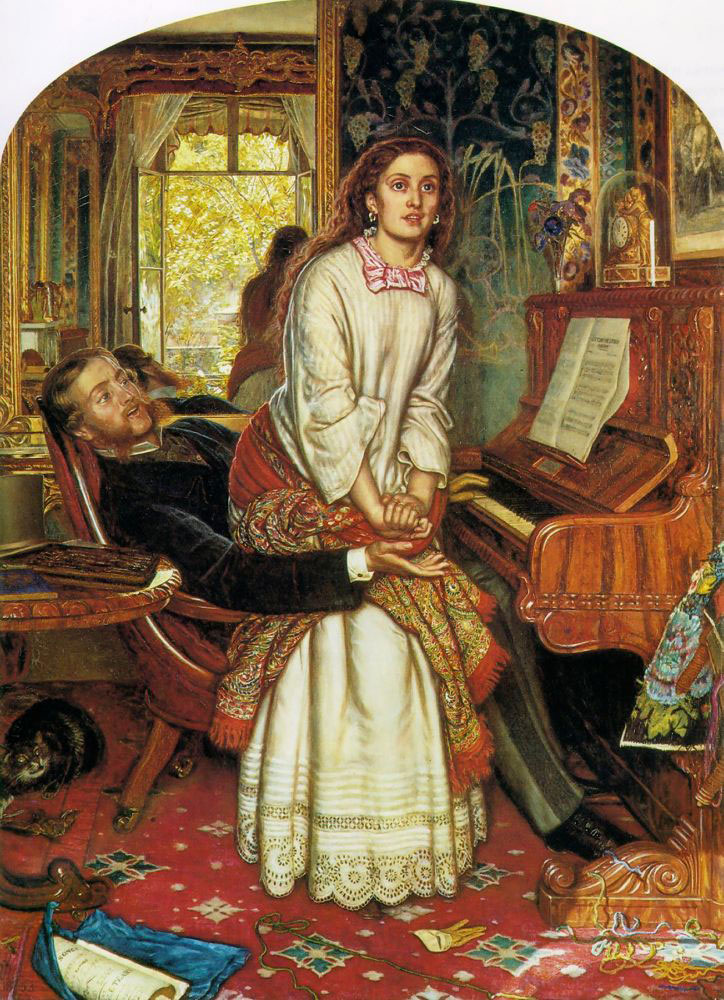
Holman Hunt uses a mirror in ‘The Awakening Conscience’, from 1853. Like the view in the Travelling Companions it introduces depth into a claustrophobic space.

William Holman Hunt: ‘The Awakening Conscience’, 1853, oil on canvas

Like the Manet, the formal relationship between the major and minor pictorial space (bar and mirror/ room and exterior garden) indicates potentialities to the viewer, even if they are not entirely revealed to the female protagonist/s. In ‘The Awakening Conscience’ the mirror reflects the garden that the trapped girl looks towards, as she begins to understand her current state. The kept woman caught, like the cat that traps the mouse under the table. The garden is the possibility of redemption. Note by the way that her un-gloved hands have no wedding ring, despite being alone in a room with a man

The removal of gloves is a licentious act, But, is our dreamer as abandoned as the kept mistress in West London rapidly on her way down the social spiral? Probably not, but there are a couple of other minor clues that all might not be well. Notice that the hair of the dreamer is looser, not quite caught up in the way that the reader seems to have arranged her coiffure. The hair of the dreamer is more noticeable in the preparatory sketch, it is less ordered and covers her ears, even so, the sleeping girls hair is still ‘en cheveux’ as the French put it?  And, if you look very carefully you will notice that the third button down from the top is undone.

Working down the pictorial space we come to the benches on which the girls sit. The dreamer has an open weave basket containing two oranges, possibly the left hand fruit is a peach, difficult to tell. There is also a crumpled piece of paper; tissue to stop the fruit bruising? Or a note? I spent a long time looking at this in Birmingham, but no,  there was no indication either way. Holman Hunt would have filled the paper with miserable song lyrics. Egg is far more subtle. The reader sits beside a perfect posy of flowers, roses possibly, but no evident thorns, the thorns of love etc. Possibly carnations, but the delicate whites, pinks and pale reds, avoiding the over prescriptive language of flowers, still do not speak of intensity or deep passion, this is grace and delicate pleasure.

 As Andrew Graham Dixon points out in (A History of British Art page 166) Egg was a Hogarthian artist, in that his narratives depend on moral choices. But, says Graham Dixon, the protagonists in an Egg painting have genuine choice, in the Hogarthian universe

‘we are all corrupt and therefore all damned inevitably. The moral of Egg’s art is that each moment of time and each human action, is full of alternative possibilities’

Are we looking at a moment of choice here? Graham Dixon would have us believe that Egg has, in effect, shown us the same woman and her two potential personalities. The clue has to be in the view, surely, what we are seeing is Egg setting up possibilities. Unlike his earlier heavily didactic work, and unlike the work of his friend Holman Hunt who, metaphorically speaking, beats you over the head with his intentions, what we have here is a painting designed to be seen on many levels.

Look at that view and the bright sunlight, note that the midground, like the train interior, is dark. There is a distance between the train and the town, we have a way to go yet. What we have here is potentials, it is up to us as modern viewers, a modernity emphasized by the means of travel and the lack of male attendants, to understand where those potentials might lead, and to choose accordingly. As the internal picture plane tells us, even a life in the sun has implications.
To the Wallace Collection to see Rubens’ Landscape with a Rainbow’ , 1636.

Peter Paul Rubens: 'Landscape with a Rainbow', 1636. Oil on Panel. The Wallace Collection, London

the companion to Het Steen. It is much less finished, look at the way the yellow blocking between the legs of the cart horses on the left has entirely covered the second horse, it has not been corrected; Rubens never got round to it. Underpainting and drawing clearly showing through.

Strong diagonal from middle right across the ground plane towards the centre. A surprisingly incoherent composition, not quite clear where the central pond begins or ends. It is in the centre of the painting, but is just a vague hole.

Very little accuracy in the trees, oak like, but without the precision of the birches and the oak in the Steen foreground. In the left mid-ground of Rainbow there is a vaguely birch like copse, some clarity in the background recession.

Carefully painted cattle and ducks, brown foreground, green mid, blue background seen from a slightly elevated viewpoint but not as high as Steen. Without the house we have less of the arrogance,, or showing off, that characterises Steen. Rainbow is far more of a genre painting about countryside activities i.e. Haymaking, bringing in the cattle, no doubt killing the ducks; activities in the Brabant. The ground plane rises relatively steeply from below our feet to a midpoint at the grown out hedgerow.

Is the rainbow a sign of the covenant, God will not break his promise? A sign of peace (relevant of course to Rubens own position), look at the way our eye is drawn from the dark right towards the brighter left. Is the rainbow a symbolic form in common with the genre figures?

In the National Gallery in front of Het Steen

Peter Paul Rubens: 'A View of Het Steen in the Early Morning', 1636. Oil on Oak. Oil on oak.131 x 229.cm. National Gallery, London

There is perhaps a compositional similarity between Steen and Rainbow, in that both have a dark diagonally composed foreground element in roughly the same place; a standard Flemish landscape component after all. The Rainbow haystack corresponds approximately with the position of the house, but only just; positions of plenty?

Looking again at the Steen foreground clump of trees, might that dominant tree on the left be a pine rather than an oak? Native pine has lower branches that come out at a 45 degree angle, in oaks they tend to be higher up and at 90 degrees to the trunk. But, it can’t be, the leaves are bulging groups of flora, not short dark needles at all.

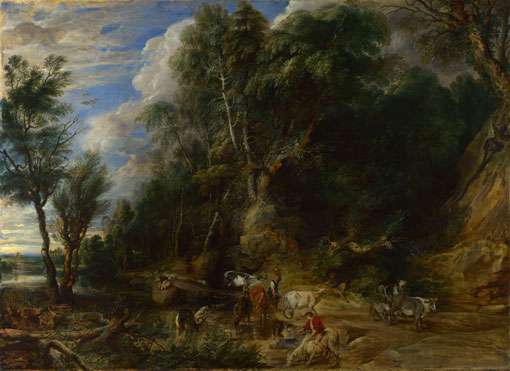
The Rainbow figures owe more to The Watering Place, 1622

Peter Paul Rubens: 'The Watering Place', 1622. Oil on Panel, The National Gallery, London

than they do to Het Steen. The Watering Place is on the opposite wall to het Steen, it is a far more finished painting than either of the two later works. Specimen pollarded willows, edged with dark glazes and trembling waves of Italianate leaves on Northern European tree trunks. Bruegel like rocks and tree formations, elevated viewpoint and the usual colour division to the composition. Genre figures including peasant with brass pitcher on head and shepherd playing flute under the tree (lots of references to Virgil: Tityrus lying under a spreading beech wooing the muse on a slender reed etc) None of that obviousness in Steen, which is an ostensibly contemporary scene in which the season is established as much through light and colour as through content. Autumn, ie harvest time, is established by content and activity rather than through depiction and observation.

It is toward the end of the day in the National Gallery. Sino-Italian day by the look of it: elegant; elderly; attenuated Italian couples and younger, plumper Chinese family groups. The elderly Italian man next to me on the bench, in light brown wool jacket, grey trousers, slip on brown leather shoes, light smell of woody eau de toilette, has been asleep on the corner seat of the bench the whole time I have been here. The colour of his jacket almost exactly matches the bottom right glazing over the underpainting of Het Steen. A woman, in folds of fine grey wool, with tumbling hair full of gold highlights and gold necklaces, re-appears to wake him up; lots of whispered Italian. Is gold an autumnal colour?

http://www.tate.org.uk/modern/exhibitions/gerhardrichter/default.shtm

There was something flat about this exhibition, why were the slightly separate exhibition of large squeegee paintings (the ‘Cage’) the most engaging works on show?

If, you decide early on that your model, your source material, will be photographs then you will be, of necessity, negotiating a narrow band of pictorial space. Noticeably, in this very large show full of some very large work, once young Gerhard had sorted out his methodology: the black and white photo; the brushed across technique; the careful grisaille in oil paint, it doesn’t change much. True there are colour works, some fully modulated, but the palette is often restricted; usually the red end of the spectrum. Nonetheless, I think we can say, after this big retrospective, that Richter’s focus is grey paintings made from flat, processed, monochromatic image. Note it’s not work about the processes of photography, unlike the Tacita Dean downstairs for example.

No matter how much he might play with it, the umbilical link between photo and manipulated image is always strong and unbroken. We see statements in paint, rather than development, no on-going narrative of the artist’s growth, none of the Romantic struggle that can make the weary viewer empathise with rooms of beautifully applied grisaille. That is why the ‘Cage’ paintings hold more interest; we can see Mr G responding to materials, each squeegee stroke depends on the paint layer below, how it adheres or how it pulls away. In these paintings, aesthetic or materials based decisions are made constantly, each one depending on the decisions made before; development, the narrative of the work and the artists’ relationship to it.

That development creates conceptual as well as narrative depth, ideas taking root in the layered surface, a form (very shallow I grant you) of pictorial depth. Whereas the photograph based work deliberately resists that form of entry, they are mirrors, literally so in one room, that reflect back your own shallowness. It is not that visual depth is denied, it wasn’t there in the first place. Is that flatness (a rather different form of flatness to the conceptually laden Greenbergian approach) therefore a suitable metaphor for approaching Richter’s work? Are we just looking at surface decoration? He vigorously refutes any meaningful depth to his Baader-Meinhoff paintings for example. Pursuing this further, in an interview with Nicholas Serota in Time Out Magazine Richter says:

“…art shows us how to see things that are constructive and good, and to be an active part of that.

NS: So it gives structure to the world?

GR: Yes, comfort, hope, so it makes sense to be a part of that”

Not far away from that other painter of the comforting decorative surface, Matisse and his armchair for tired businessmen. Can this really be the case? Do we just flatter our own reflections when we come to view Richter? Can Richter just be the new taupe? These were the questions I came away with, big retrospectives put artists work under severe scrutiny, Has Richter stood up to it?

 I have spent some time on commuter trains in Southern England recently. Apart from hearing one side of many phone conversations

“Have you still got all your biscuits left?…I haven’t coughed for two weeks, I eat an onion every night that’s whats done it…Friday tomorrow, how good is that?’

it has prompted further thought about our physical relationship to the picture plane. There is a fine image by Ravillious of a carriage that illustrates what I mean.

Eric Ravilious: ‘Train Landscape’, 1939. Watercolour on Paper

 A watercolour view from the corner of a railway carriage; the very old type without corridors, with slam shut doors and a flat, vertical sliding window. A landscape is joined up behind the three frames of the train windows, in the left hand pane, the Westbury Horse, a chalk figure carved into the Sussex downs. In the other two windows the shapes made by the hedges echo the patterns of the seat upholstery. There are possibly 4 zones here, the three windows and the empty carriage itself. The central leather strap is the key to this painting, in these old trains this belt holds down and closes the window. Above each window pane, are blind pulls that can be pulled down to entirely block out the scene. These closed windows make a distance between the artist and the view, he is secluded in this carriage and can see ancient Britain in the left hand pane; from a mechanical form of transport he observes the old method, the horse. The other two windows show Britain then but the locked window keeps it out. What it also locks out is how much Britain was changing in the first half of the twentieth century; urbanisation for example. The heavy wooden surrounds of the train windows stress privacy and the past.

We live in a different world; the young woman opposite me is half way through a long story about how her duvet caught light when she was seven. “I didn’t smoke then, still don’t now” and how her mum didn’t believe she could smell smoke. The recipient of her call clearly doesn’t believe it either, the story takes much repetition to get the details right. I leave as she is going through the look on the neighbours face when her and mother pushed the burning bed clothes out of the bedroom window.

Eric R’s painting, made just after the start of the Second World War, apart from the combination of the past (the White Horse) and a slightly romantic view of the present (the fields and the Sussex Downs) doesn’t include the war. Should art always show what is happening at the time? if yes, how should this be done, if no what are the various functions of art that we can see happening in this painting?

“Hello…Yes…On the train…Did you say Queen Mary?…No, no, no, no… If it was the Queen Mary I would have done it…no, goodbye”

Ravilous was a wood engraver and made designs for Wedgewood Pottery, engraving and pottery designs demand a hard line and sharp edged shapes. You can see this in his approach to this image, for instance on the cross hatching on the door, an engraving method to indicate tone. But there is more to it, if you look into Eric R’s life a bit you will find that he married one of his students from Eastbourne college, where he taught wood engraving. Eileen Lucy Garwood, called Tirzah, Eric taught her wood engraving and she was exhibiting her work in London galleries within a year or two; they are interesting, witty images. Sadly, she seems to have stopped completely when they got married in 1930, meaningful in itself, but there is more. One of her engravings, is called, ‘The Train Journey’ it has some strong similarities to her husband’s later image, and differences, the occupants is the most obvious comparison. Tirzah’s engraving is detailed, about human relationships and their relationship to us. The girl turning to us is thought by Olive Cook to be Tirzah.

Tirzah Garwood: ‘The Train Journey’, Wood Engraving, 1929-30

See Olive Cook

http://www.weepingash.co.uk/index.php?option=com_content&view=article&id=208%3Athe-art-of-tirzah-garwood&catid=35%3Aes&Itemid=5&limitstart=2

And also Adventures in the Print Trade

http://adventuresintheprinttrade.blogspot.com/2010/02/whats-in-name.html


Eric Ravilious: 'Train Landscape', 1939. Watercolour on Paper

The seating now, cramps the viewer/ passenger into a right angle view, it is restricted by upright seats and reflections, the glass is angled and catches the light in ways that make seeing the landscape difficult.  The windows must lean in at about 3 or 4 degrees, double glazed, they could be designed to catch everything inside, the overhead lights, reflections of self; staring blankly. Which means that I can concentrate on making the grey plastic table really squeak and listen carefully to the woman opposite detailing her night out, up to the point where ‘we drunk another go of them drinks’.


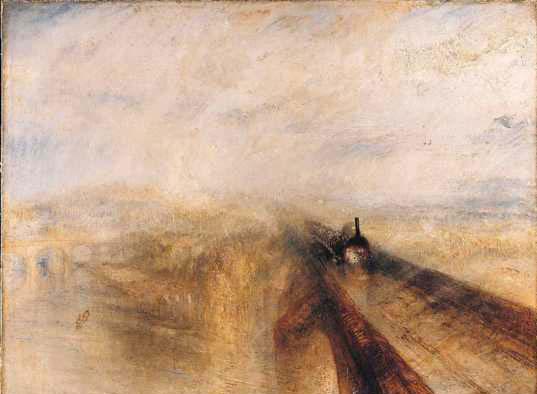
J.M.W.Turner: 'Rain, Steam and Speed, The Great Western Railway', 1844

Turner’s: ‘Rain, Steam, and Speed – The Great Western Railway’ might claim a place here, but the impulse is fundamentally different. In Turners world we are in and of the landscape, we are outside the carriage, we are a pure experiencing being. This was one of the first works of art about the artist’s direct experience of landscape. A strand that will come to dominate art about land from Turner onwards, modernity or not. Turner is supposed to have leant out of the carriage window with his sketchbook to draw the storm…

“As for the manner in which “The Speed” is done, of that the less said the better, only it is a positive fact there is a steam coach going at fifty miles an hour. The world has never seen anything like this picture”

From a Lady Simon:

“In the coach seated opposite her, was an elderly gentleman, short and stout, with a red face and a curious prominent nose. The weather was very wild, and by and by a violent storm swept over the country, blotting out the sunshine and the blue sky, and hanging like a pall over the landscape. The old gentleman seemed strangely excited at this, jumping up to open the window, craning his neck out and calling to her to come and observe a curious effect of light”

Notice the hare: speed. Notice the plough: from the old country dance “speed the plough”

It would be impossible to stick my head out of the window I am looking at.  Above is a narrow band of glass that can be tilted inwards for ventilation, thick and heavy square section better suited to a tank. Below is a broad glazed band, I’m intrigued to know why the bottom un-opening part of the window has a stick on shaded element surrounding it. Smaller black dots successively giving way to larger, then a black border. It has no obvious function as device for keeping out sunlight. Squashed into a two seat berth, parallel to the window, knees jammed against the seat in front. Turning the head through 90 degrees to look through the window squarely is uncomfortable. So, one looks at a 45 degree angle just where the upright reflection of the window seat in front bisects the view. I can just catch the reflection of the man opposite, working on his computer, balanced on the little table sticking into the six seat bay. His phone is balanced on the machine and his coffee is between his knees; a worrying placement.

Ravilious constructs his pictorial space so that we appear to be just off a central axis of symmetry, sitting on the near seat on the right. The window on the door shows a slight area of the jamb indicating the position of the viewer. But, the landscape looks, to me anyway as though we are exactly perpendicular to it, It is certainly planimetric, the downs on the horizon and the plough lines in the foreground, running parallel to the horizontal elements of the framing window.

On my morning train, a short man got on to our crowded carriage, wanting to sit in the middle seat of the six bay arrangement. He was carrying his neat black computer bag, a full length suit bag, a newspaper and a cup of coffee. His movements, as the train swayed through points and curves, were elegant, but he missed his intended seat, almost landing in the lap of several of the suited seated men. They neither looked at him, nor moved. It took some time; at last he sat and grinned happily. Throughout this choreography no one spoke or acknowledged his feat.

Eric Ravilious: 'Train Landscape', 1939. Watercolour on Paper

The painted landscape is entirely static, yet seen from a moving vehicle. Ravilious never learnt to drive, he bought a return ticket and shuttled between two stations to keep drawing the view. This would have been a steam train, note the lack of steam or suggestion of movement.

On my train this morning, the actual landscape behind my current picture plane is a combination of horizontal blur, darker towards the ground, yellow highlight at about eye level, sky above, and then clearer focus in the middle distance. The blur is not that unclear, this is a South Eastern train, they don’t go that quickly. Inside, the constant announcements are always preceded by the two tones, more reminiscent of 1970’s children’s programmes than, for example, Italian railway stations of that period: ‘binario uno’ and all.

‘Train Landscape’ was made at the start of 1940, the first year of the Second World War. Not long after Eric Ravillious made this painting, the chalk figures were covered up to prevent them being used to help enemy navigation. Ravilious became a war artist with the Royal Air Force and died during an air sea rescue in Iceland in 1942.

He painted several images of chalk figures besides the White Horse, The Long Man of Wilmington and the Cerne Abbas giant for example. The internal picture plane of Train Landscape shows simultaneous images from different time periods in the different areas of pictorial space. Ravilious divides time up like a cartoon strip, the theme of representing time past, time present and time future, featuring heavily in a heavily contested present.

Symbols of Englishness and defiance, or an evocation of the man-made in a natural setting? Almost on the railway line I use, but not quite, is another white horse. Mark Wallinger’s art commission to mark the Ebbsfleet International station in north Kent.

A giant sculpture of a white horse standing 50 metres high, but it’s not the rearing horse of Kent, this is a static figure.  According to Wallinger, Ebbsfleet marks the end of the horse-rearing downland country; this was where the Anglo Saxon heroes Hengist (Stallion) and Horsa (Horse) arrived to fight the Picts around 455 AD.

Wallinger: “I think at the back of my mind I had that Eric Ravilious painting Train Landscape (1940) looking out from a third-class railway carriage at a white horse on a distant hill.”

http://www.telegraph.co.uk/culture/art/4613060/Mark-Wallinger-the-inspiration-behind-my-horse.html

 The man behind has his head against the upright of my seat, he is breathing heavily, rustlings are coming from his paper bag. The woman next to me is busy on her laptop:

“Computer Purchases: QAAS Portsmouth: 1 x Labroud Refrigerator (DMG to quote on mapping for comparison with Labroud on commissioning) etc, etc. “

Sun low in the sky, shadows emphasising the flatness of the ground plane as it marches away from the train. The major commuter train from London on a Friday evening. It is, unusually, almost completely silent. A cough, a sniff, the turn of a page of the Metro or the Standard, but that is all; apart from the constant announcements and the rustling man.

Eric Ravilious: 'Train Landscape', 1939. Watercolour on Paper

Does sitting in the carriage now, have the same evocation, either of Englishness, or future collapse? Perhaps the increasing disintegration of capitalism and the re-introduction of feudalism, or so it feels reading the morning paper? Listening to the suited and booted man in front discussing his meeting schedule with someone, clearly his junior, merely makes me glad we are not in the old two bench dog carriage. The clue to the difference between painted image and life on the 7.16 am is in the relationship to the exterior. In the Ravillious we are parallel to the internal picture plane, in a semi private world. In the modern train we are not. Ravillious’ world perhaps owes a debt to earlier imagery.  In John Tenniel’s: ‘Alice on the Train’, From ‘Alice Through the Looking Glass’

John Tenniel: 'Alice on the Train' wood engraving, 1872

or Leopold Egg: ‘The Travelling Companions’, 1862 both of which use the same frontal format, parallel to the picture plane, symetricality etc.

Augustus Leopold Egg: 'The Travelling Companions',1862 Birmingham City Museums


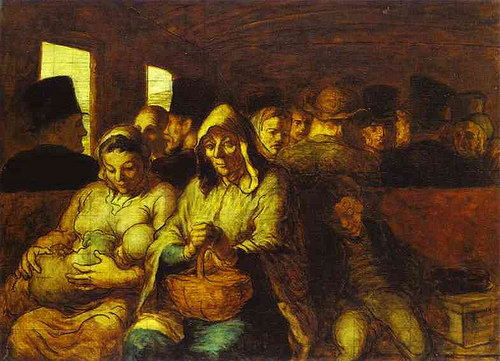
The carriage is now a public space, focussing down a tubular formthat enforces the single viewpoint perspective aspect, reinforces the notion that we meaningfully speed towards our destination. Unlike the steam era images that often stress the privacy of the first class carriage. Compare this with, for example, Daumier’s Third Class carriage, a density of rumpled lines and close tones, raw humanity.

Honore Daumier: 'The Third Class Carriage', 1863-65. Oil On canvas. Metropolitan, New York


Train Landscape is a third class carriage, you can tell this by the letter three on the door. But the number seems very big, it stands out. Earlier Cubists had used text to stress modernity, although this doesn’t look quite like that.