Archive

Tag Archives: Rubens

Het Steen, National Gallery, London, Friday Afternoon

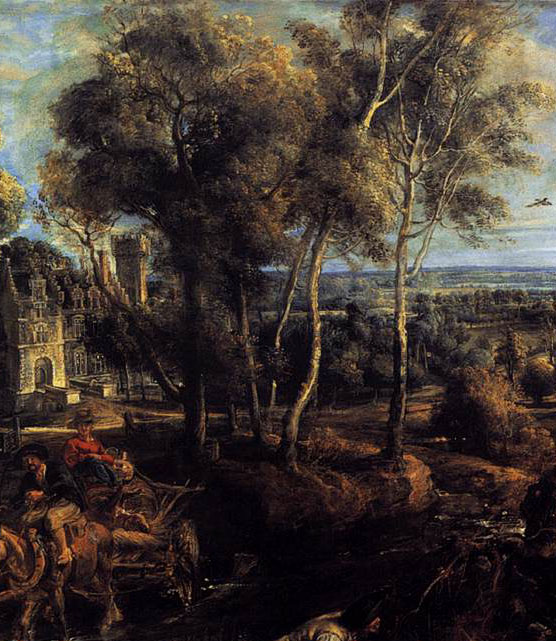
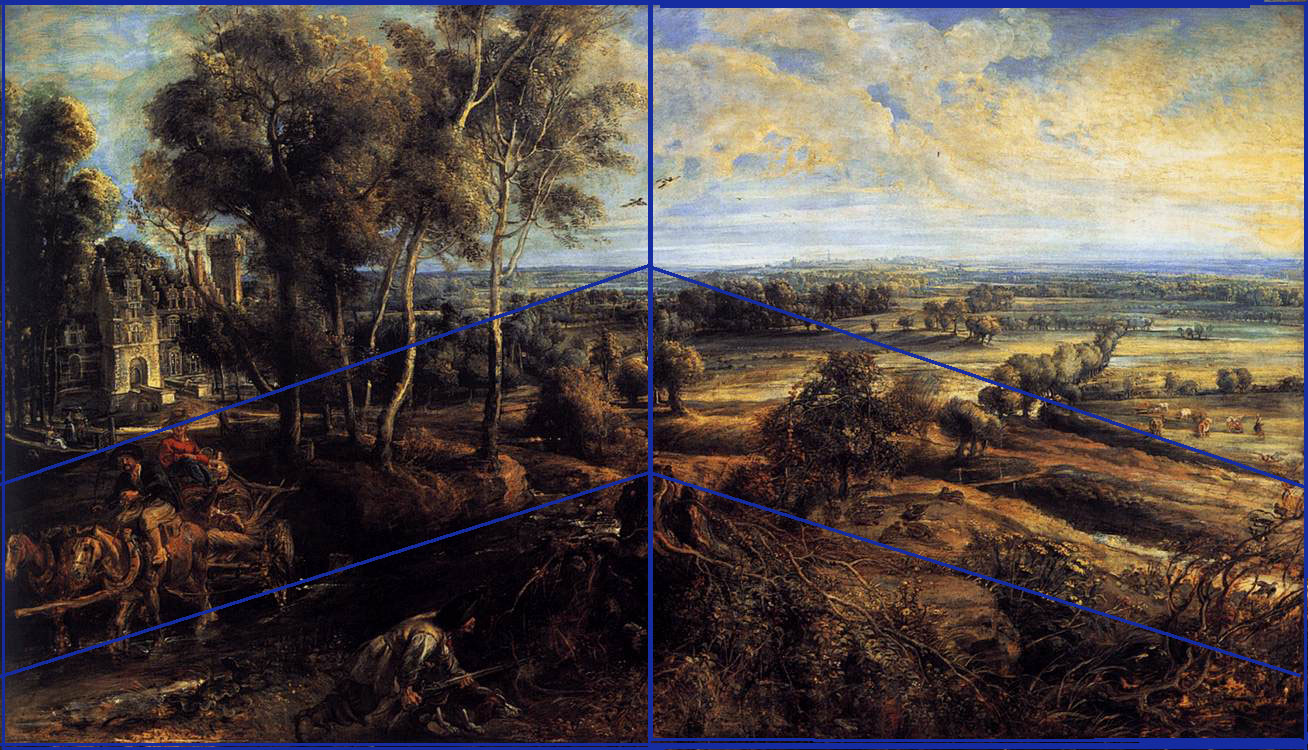
Peter Paul Rubens: 'A View of Het Steen in the Early Morning', 1636. Oil on Oak. 131 x 229.cm. National Gallery, London

The young woman in front of the later ‘Judgement of Paris’ is haranguing a large group of fellow Chinese. She has talked for 10 – 15 minutes without drawing breath, a small boy has his hand up; he is ignored. She is wearing cream trousers and a cream jacket zipped right up the neck, she does not look relaxed.

A complete contrast to a colleague I saw this morning, taking a large group of Year Eight students through a range of paintings about rooms and interiors: Dutch and Swedish ending with Rachel Whiteread. It was all about interaction, questioning, and the students lively responses.

How Do We See Art?

Returning to the central theme of all these posts: how do we see art, what do we get from looking at it? The students in front of the slide show had been led by careful pointed questions, what can we see? What might be the relevance of? What does that make you think about? The importance of composition/ light/ context/ new ideas about interiors. But I wondered, were they just showing their skills at a particular game: answering questions (very high) or were they actually engaging with images. Was this the equivalent of twenty questions,  just running around a museum pressing buttons. Their teacher by the way was wearing dressed down art teacher clothing; checked shirt and jeans.

Pictorial Space

I think these posts have established by now, that composition of pictorial space has a great deal to do with how a painting is approached; physically and mentally. But, schooled in iconographic analysis or not, you also bring assumptions about behaviour and meaning on the far side of the picture plane. For example, I remember a small boy’s response to Picasso’s ‘Woman Weeping’

Picasso: 'Woman Weeping', 1937, 60 x 49 cm, oil on canvas. Tate Gallery

‘I know she’s really upset’

‘Why do you know that Darren, is it to do with the shapes clashing together in the painting?’

‘No, it’s because she’s eating pizza, my mum always gives me pizza when I’m upset’

So, what do we bring to Het Steen? A general assumption about the reassuring properties of paintings about nature? A deep calm, from the gently lifting ground plane, the soft, close tonal range, the warmth of colours in the foreground, the bucolic carter and companion, the wealthy but not obtrusive house? Soft shapes rising sun: optimistic; reassuring; comforting. These are the sorts of terms that come to mind. It might be autumn, i.e. towards the end of a cycle, but time moves very slowly here.
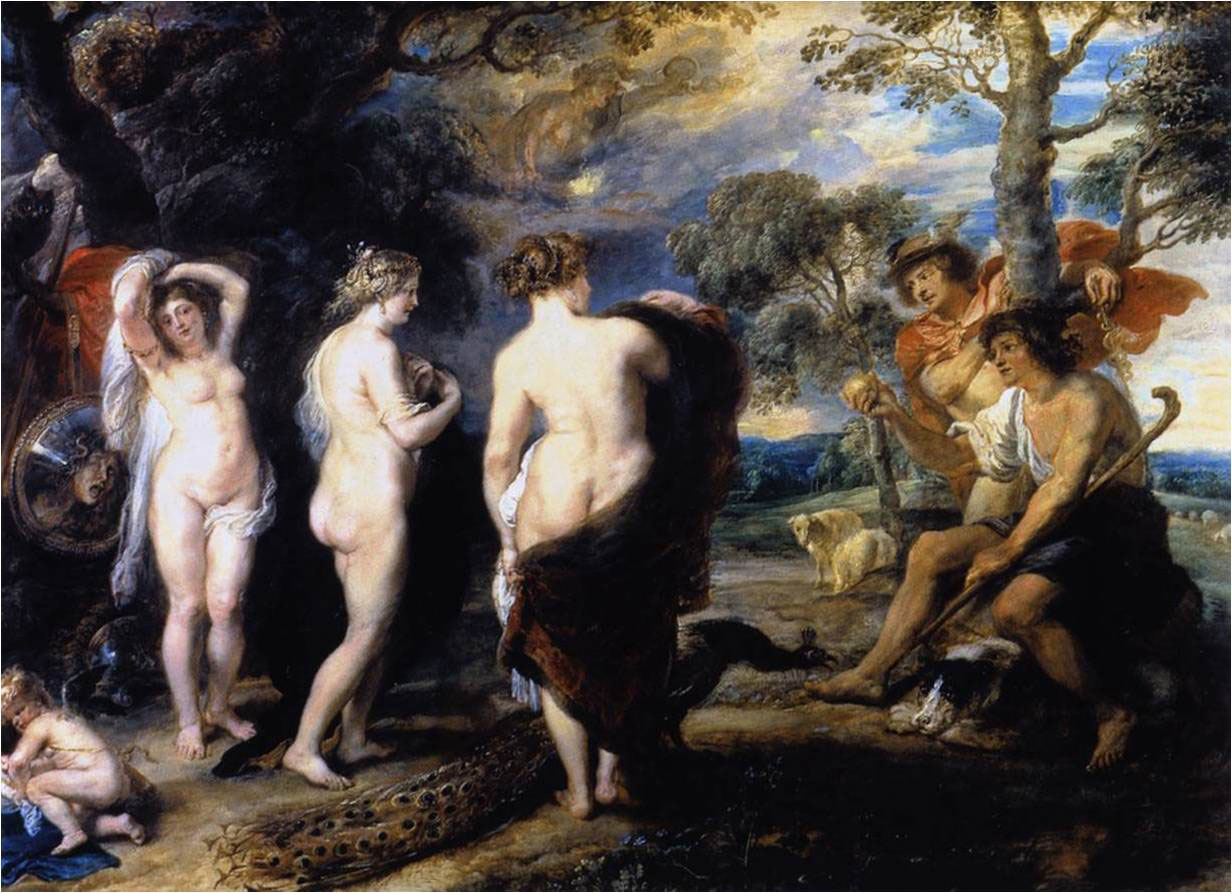
Rubens: 'The Judgement of Paris', 1632; Oil on canvas, 139 x 174 cm; National Gallery, London

Large numbers of Spaniards, smelling rather strongly of soap, not unpleasant but certainly insistent, are collapsed around the bench. It is a comfortable place to rest, they are exhausted, time this side of the picture plane is catching up with them. At the other end of the bench, a man is slowly making an extremely painstaking tonal drawing of the later Judgement; hours of evident labour. He is drawing from left to right and the proportions are gently getting away from him; the figures are beginning to elongate and lose their Rubensian plumpness as the drawing becomes widescreen.

The Spanish, distressed brown leather, sports gear and strange white tubular headgear rather like socks, do not look at the paintings. Later a middle aged English couple, beige trousers, grey anoraks, argue in a low monotone, carefully looking at an image, true; but it is a tube map. Most of the visitors, few are actually viewers, seem to regard being here as a form of labour, measured in miles walked, the occasional interesting painting is a bonus.

The ‘Art Study’ Problem

Perhaps this is behaviour learnt early. By and large students coming into an art room see making art as a subdivision of leisure activities; ‘Art’ is not real work etc. Whereas looking at art made by others is always more of a chore, any art teacher who has tackled the ‘art study’ will confirm this. I have written many books for teachers trying to overcome this reluctance, but never quite worked out why it is there; surely pictorial space is fascinating, isn’t it?

But What Shall I Wear?

Maybe it is to do with clothing, to make art in an art room you put on an overall, a paint spattered ‘cloak of creativity’ as it were. To study the art work made by others you are still in the clothes you wear for other activities, learning Maths for schoolchildren, travelling seems to be the main theme here in the National Gallery. I don’t mean that you should stand in front of Het Steen wearing seventeenth century muddy peasant linen bowing to the Lord of the Manor, but the awkward mismatch between formality and casual tourism is noticeable. At the Damien Hirst exhibition at Tate Modern, that I saw earlier (highly recommended by the way, very well put together indeed) there was none of that awkwardness; art and viewers seemed to be well matched. So perhaps it does help to dress accordingly, I’m off to order my rough smock now.

Morning Train

As we pull into a station two large herring gulls are slowly tearing apart a McDonalds bag, the train leaves and the birds walk with a proprietorial air down the platform.

In the seat across the aisle a youngish woman makes noises, reminiscent of a dog about to be sick. She (the youngish woman) has a transparent plastic cup and a can of Red Bull in front of her. From a carrier bag she opens a rectangular golden cardboard box and takes out a bottle of brandy. She tops up the cup and places a ham roll beside it. Her hair is red, as is her phone and all of her accessories – earrings, bracelets, flashes on trainers etc. It is 7.30 on a Saturday morning. As the train pulls away from the station she rushes towards the toilets.

“Of course, I won’t buy a new one, a perfectly ordinary biro, Why should I?”

“In the old days…”

“Of course, In the old days you could repair things, but now, I don’t see that I should.”

“In the old days…”

“Of course, in the old days, you would have signed it out wouldn’t you?”

“It would have lasted you for ever”

“Of course, you’d have looked after a thing like that, wouldn’t you?”

Both together: “in the old days…”

At the coffee shop

A well-dressed couple order extra-large and complex arrangements of what is really, sweetened milk with added cream, caramel, chocolate and finally coffee flavourings. They add a thick pink creamy looking drink each, and a couple of pain au raisins to their order. It takes them a while to organise carrying out this feast as they are both carrying large sporting bags.

“Ignorant of misfortune/ Living without worry”

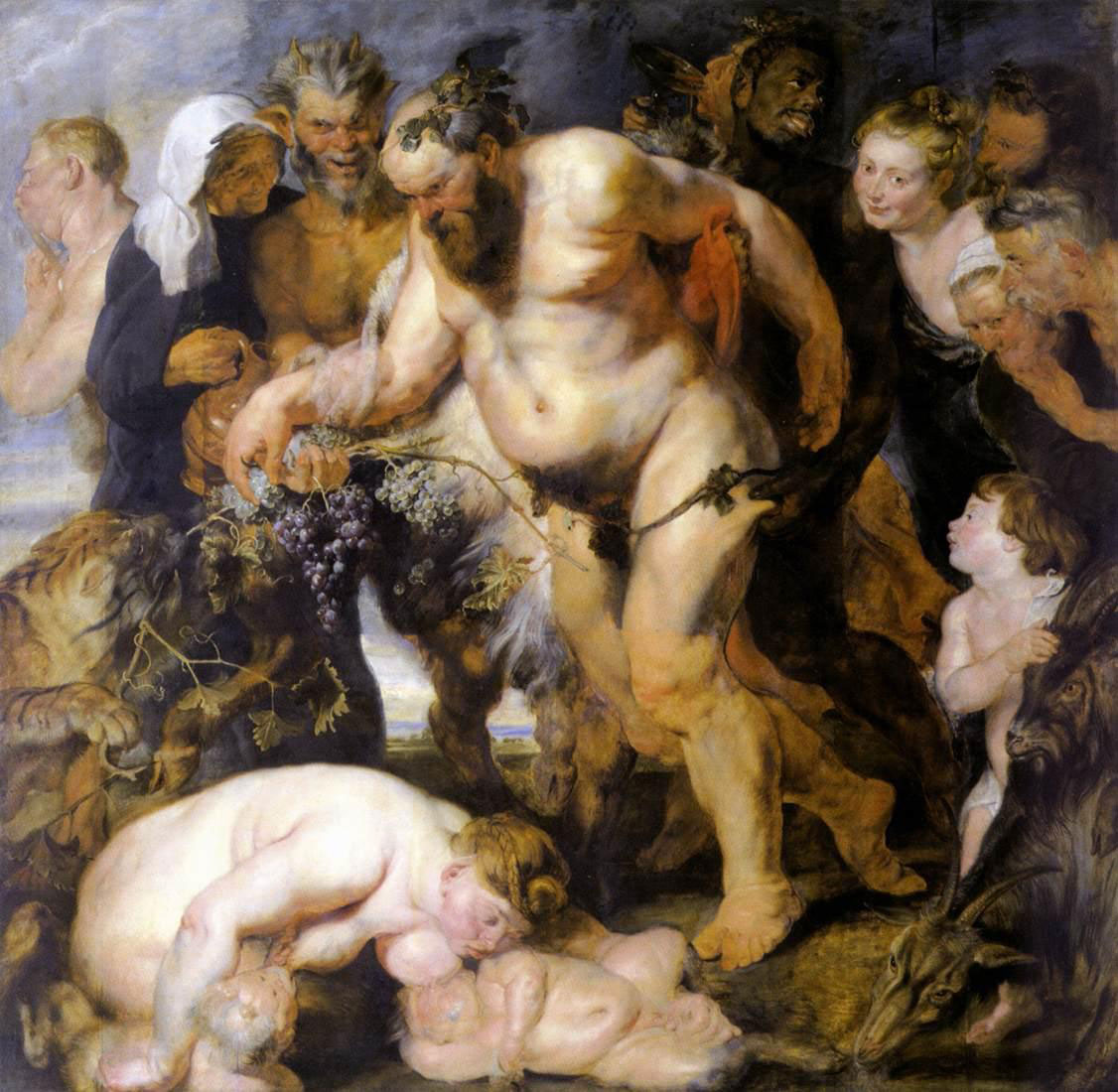
Witnessing these searches for gratification makes me think of paintings of Silenus. There are different approaches to this god, Titian’s ‘Bacchus and Ariadne’,

Titian: 'Bacchus and Ariadne', 1520-3, oil on canvas, 177 x 191 cm. National Gallery, London

and Van Dyck/ Rubens’ Studio’s ‘Drunken Silenus Supported by Satyrs’,

Attributed to Anthony van Dyck/ Studio of Rubens: 'Drunken Silenus supported by Satyrs'. 1620. Oil on canvas. 134 x 197 cm. National Gallery, London.

(both in the National Gallery, London) show the usual iconography: the hugely fat figure; the surrounding Bachante; riding on a donkey in the Titian. This is the Falstaffian Lord of the Revels, clearly, but happily showing the effects of that indulgence. The teacher and companion of Bacchus/ Dionysius, the god of wine and good times; someone I’ve always felt close to. The Van Dyck figure, in particular, seems a joyful image, the brushstrokes, the palette, the smiling red face, the white hair, everybody’s favourite uncle, even if he is blind drunk and cannot walk.

Whereas the darker delineation around the stumbling Silenus in Rubens painting,

Peter Paul Rubens: 'The Drunken Silenus'. 1618. oil on canvas, 212 x 213 cm. Alte Pinakothek, Munich, Germany.

although delicately held up by the pair on the left, is an altogether different and lonely character. To add to this theme, the woman (the face anyway) on the lower left looks surprisingly like the young person on the train. Rubens’ driven, but falling demi god, is closer to the Greek mythology later revisited by Nietzsche (The Birth of Tragedy). The melancholic, pessimistic and wise Silenus pursued by King Midas. For example when the golden king asked what is best thing for man, Silenus replies:

‘you, seed of an evil genius and precarious offspring of hard fortune, whose life is but for a day, why do you compel me to tell you those things of which it is better you should remain ignorant? For he lives with the least worry who knows not his misfortune; but for humans, the best for them is not to be born at all, not to partake of nature’s excellence; not to be is best, for both sexes. This should our choice, if choice we have; and the next to this is, when we are born, to die as soon as we can.’

( from Aristotle: ‘Eudemus’)

 Afternoon Train.

 Man to my right eating Salt and Vinegar Monster Munch, drinking Carling Black Label, bellowing into his mobile about borrowing requirements and bank lending rates. Behind, a baby screams. In front a woman eats a very ripe banana from a yellow storage box, it is shaped like an ideal banana. Two seats down, earnest young Asian men are talking about mathematical formulae and what happens when you substitute P for X – I think. Schoolchildren are everywhere, talking about ‘Games’ and teachers and work not done, and ‘then my dad did this’ and ‘my mum did that’. And ‘she said’ and ‘I was like’ and ‘I texted her’ and on and on in a continuous stream of high-pitched jollity.

It is a relatively new train, the announcements are up as loud as they will go, the sibilance could take off the top of your head and fill it full of strong smelling, potato based, snack opportunities.

“Look, look, look what I’ve bought”

“What?”

“I got ten sets of eyelashes, all sorts”

“Like, wow”

We all partake of nature’s excellence, each of us be-ing in our own particular way.

On the Platform

Waiting at the station, I talked to a man about cataract operations for Labradors, £3000 per eye apparently. It would be cheaper to send the dog to India he thought, but wasn’t sure about quarantine.

The bus to the station had to drive through thick fog, bright but visually impenetrable. Trees are just changes of tone in a wall of grey/ white, like the steam on glasses in a hot bathroom as you clean your teeth before departure.

Art about not seeing

It is rare to find art work that presents a restricted vision. Or, restricted vision as a deliberate theme. You could say that the late work of Monet and Degas, as they struggled with eyesight problems, are the results of restricted vision itself, but I’m not sure Claude or Edgar would thank you for it; not really what they were intending to do. Duchamp’s last work (Étants Donnés) perhaps, where we can only see through the holes in an old door. In most art your eye is directed around pictorial space, yet you are simultaneously aware of the whole work. Think of artist play with mirrors:

Velasquez: 'The Rokeby Venus',1647, oil on canvas, 122 x 177 cm. National Gallery, London

Velasquez’ ‘Rokeby Venus’, what we see in the mirror, (her face), is not what we (the male viewer) want to see, her naked front, although we know that the mirror is in fact pointed at that very form.

“Charlie ruined his IPad yesterday, he rebooted from a PC and it like, wiped all the applications, there is nothing to see, just the empty screen.”

“Why’d he do that then?”

“Don’t know, because he’s a boy? It was great”

What about ‘The Day of the Triffids’, those unable to see on the night of a meteor shower are saved from blindness. They survive deadly killer plants, ending up in the Isle of Wight of all places; is this a metaphor for enhanced perception? Perhaps not. Or the standard ‘blind so that he might really see’ trope (Homer, Gloucester in Lear, Milton etc.) I suppose it’s not surprising that an art work, an object to be seen, is made with visual clarity, and doesn’t concern itself with not being able to see. But art about how we perceive the world and how we see ourselves, there’s lots of that.

“Look, he sent me a text, says he wants a picture of me, not a dirty picture or nothing, just a nice one he can put it in bed at night and see me when he gets up in the morning”

“Nice”

“Yeah, right”

The schoolchildren are opposite, two women in front are discussing their day, they have documents on the table, ‘Rebranding  HLC/ALCs: a New Look’, quiet speech in determined tones, lots more jargon.

Peter Paul Rubens: 'A View of Het Steen in the Early Morning', 1636. Oil on Oak. 131 x 229.cm. National Gallery, London

In front of Het Steen

Behind me a large French youth is lying full length on the bench, earphones on and singing. Next to him, two equally disengaged young men, equally French; all are wearing sportsgear for the non sportif. They comment loudly on the girls that pass. They have yet to turn round and see the Judgements of Paris. I suspect their reaction would be similar to the primary school boys who have just passed, their hands over their mouths, pointing and giggling.

Peter Paul Rubens: 'A View of Het Steen in the Early Morning', 1636. Oil on Oak. 131 x 229.cm. National Gallery, London. Detail The Trees

The Trees

The small group of six trees in the foreground island, are reminiscent of a group of people, standing tall. The oak on the left proud and straight, the birches in the centre: lounging, and the birch on the right swaying gently.

I am surrounded by people standing – to look at the art – apart from the lolling French behind. Many viewers take the attitudes of the outer left and right trees. It is only the young in groups who lounge and lean. Do we take the attitude of that we look at? More noticeable when looking at standing figures perhaps, adopting the pose of the Arnolfinis; that sort of thing.

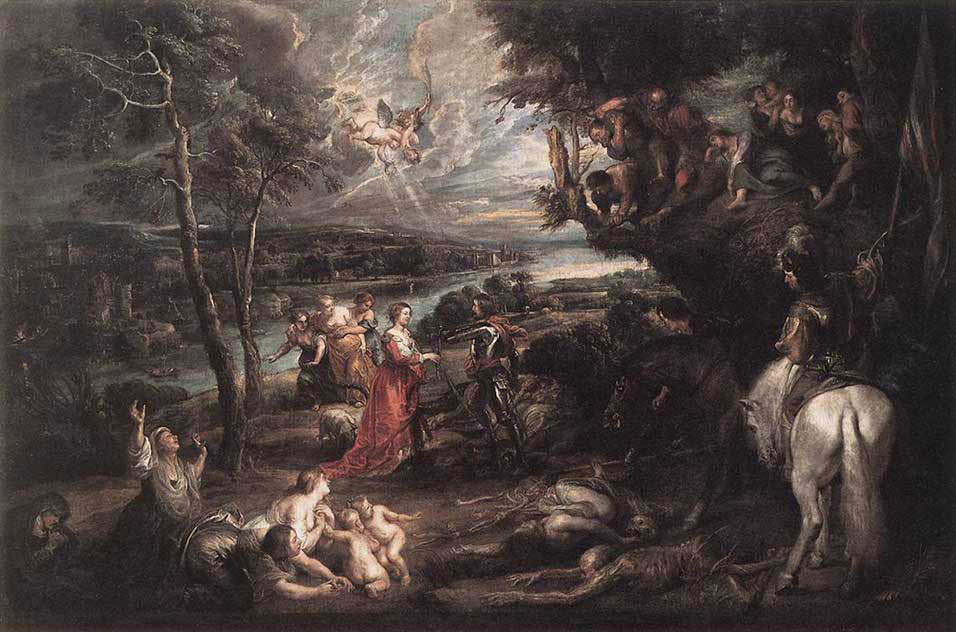
Peter Paul Rubens: 'Landscape with St George and the Dragon', 1630, oil on canvas. The Royal Collection

Pathetic Fallacy

The blasted tree in the ‘Landscape with St George’ now in Tate Britain reflects this sort of ‘pathetic fallacy’ approach, as incidentally do the trees in the later ‘Judgement of Paris’.

Rubens: 'The Judgement of Paris', 1632; Oil on canvas, 139 x 174 cm; National Gallery, London

Those to the left, with the clouds generated by the Goddess of Discord are dark and distorted and forked, echoing the shapes of the Goddess. The tree around which Hermes and Paris and their bovine dog are wrapped, is clean limbed and brightly lit.

Peter Paul Rubens: 'A View of Het Steen in the Early Morning', 1636. Oil on Oak. 131 x 229.cm. National Gallery, London

The scale of the trees in Het Steen really does not fit the figures. Judging from their foliage and form these are mature trees. Yet, stood beside them, the carter or his passenger would reach about half way up the trunk; implausible.

The Tree Question

Is it possible to be a self-conscious painted tree, a form that draws attention to itself?  A question that is not quite as footling as it sounds. Such a question assumes that painted forms in their painted world have mass and agency within that illusory space. A world in which the usual laws of physics, those from our side of the picture plane, still operate.

Perhaps other human traits also apply, the jeunesse dorée behind me clearly believe they are objects of interest. They have positioned themselves and behave to draw attention; admiring attention they assume. I do not share their opinion, but I am in the minority. Their belief, to watch the huge numbers of European and British young moving through the gallery, is shared.

 I wonder if the similarity I see between the composition of the trees and their anthropomorphic nature, comes from proximity. Apart from upright humans standing in front of them, they are flanked by triads of painted standing, naked women. Three goddesses confident in their nudity, conscious of being seen by Paris and Hermes, but not perhaps by us the viewers, or by aggressive young Frenchmen or giggling London primary schoolchildren. Is it possible to ask the question: are the trees in Het Steen aware that they are being watched, without putting my hand over my mouth and giggling?

The Tree Question: Context

The tree question presumes that we read a single standing form as part of a history of single standing forms. Rubens was a classicist, he would have known both something about Greek and Roman statuary and Vitruvius’ descriptions of the classical column as different forms of human figure.

The Classical Orders: Greek and Roman

Here, in these trees we have everything from Doric (the sturdy ‘male’ Oak) through Ionic (the curving birch as a young slender and female) through to Corinthian (The swaying birch on the right as the fuller female figure). John Summerson’s ‘The Classical Language of Architecture’, (Thames and Hudson) is very useful on all this by the way. Rubens would also have been aware of the general belief that Classical stone architecture was derived from wooden building techniques; we are looking at the painting of a building after all.

The Tree Question: Nonsense

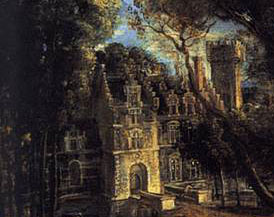
But, of course this is all fanciful. The building is Flemish vernacular, look at the stepped gables,

Peter Paul Rubens: 'A View of Het Steen in the Early Morning', 1636. Oil on Oak. 131 x 229.cm. National Gallery, London. Detail Het Steen itself

the only classical references are textual; to Virgil and Horace. The trees are, as I have established earlier, just stock trees from the painters studio repertoire, no reference to anthropomorphism here at all.

More French youth have appeared, an army of them, enough to stock a re-enactment of Delacroix’s ‘Liberty Storming the Barricades’ though without the bare breasted Liberty, much to the disappointment of those on the bench behind. Like Delacroix’s painting the young folk around me are also stock characters, gum chewing, unshaven, louche and aggressive, time to go.

Peter Paul Rubens: 'A View of Het Steen in the Early Morning', 1636. Oil on Oak.131 x 229.cm. National Gallery, London

Late night Friday opening at the National Gallery, on the bench in front of Het Steen.

The way pictorial space is organised, the route through the painting that the viewer walks, conceptually as it were, creates our reaction as much as the iconography and the figures. The rectangular surface of this painting appears (almost) to divide into two equal squares.

 The dimensions are 131.2 x 229.2 cm, so in fact each ‘square’ is 131.2 x 114.6. Nonetheless, there is a possible vertical axis, at the central join of the two squares. It goes up between the lines of the silver birch trunks and bisects the two birds, just touches the right hand branches of the of the silver birch on the raised circular area. Each ‘square could be a complete painting in itself, one contains pure landscape, the other contains the house etc.

It seems to be Spanish visitor night in the Gallery, lots of leather handbags and jackets, large family groups with large shopping bags labeled with large names of west ends shops. The Spanish woman behind me has, at last, finished her phone call. Mostly it consisted of ‘Si, Si, Si’ in a manner reminiscent of Sybil Falwty’s ‘Oh I know, I know, I know’

Peter Paul Rubens: 'A View of Het Steen in the Early Morning', 1636. Oil on Oak.131 x 229.cm. National Gallery, London. Detail Horizontal Axis

A horizontal line of light and shade runs across the painting, approximately half way up; although none of these putative lines are exact. This doesn’t just apply to the surface, but divides the structure of the space into quarters

Peter Paul Rubens: 'A View of Het Steen in the Early Morning', 1636. Oil on Oak.131 x 229.cm. National Gallery, London. Detail Numbered Quarters

A contains all the figures

B contains the house

C contains the sky and mid and background

D contains foreground  and the milkmaid with cows and the oversized ducks.

Not much else is organised around these axes. You might for example expect the tower on the horizon, (the Cathedral of St Rombout in Malines) to mark the point where the vertical axis touches the horizon.

Peter Paul Rubens: 'A View of Het Steen in the Early Morning', 1636. Oil on Oak.131 x 229.cm. National Gallery, London. Horizon Detail

Or that the tower would be balanced by something on the left, equidistant to the vertical axis; but it isn’t. You could say that the vague branch of the of the silver birch dropping down at about 45 degrees, just touching the horizon, is that balance but I don’t think so, do you? You could say that the orthogonal made by the right hand ditch, just below the milkmaid and cows, will join the horizon where it is bisected by the possible vertical axis.

 As, by the way, does the almost exactly symmetrical orthogonal line made by the front of the house. This again starts from the upright side of the canvas at the same point as it’s symmetrical twin. It cuts the horizon at the same point, where the vertical axis and the orthogonals meet; just about.

A young Spanish couple next to me on the bench are trying to organise English terms,

‘With you…With me…You say I go with you…You come with me…We go on this tour”.

There is much hesitant repetition. Each time they get a phrase right, they kiss. An improvement on my own French language education with Monsieur Hervé. If we declined wrongly he would hit us, rhythmically in time with the right stresses as he repeated the correct form. I can still spell ‘old’ in French as a result, and it still hurts.

In ‘The Science of Art’, Martin Kemp points out that Rubens knew his perspective systems well, although he didn’t use them in an obvious manner. With a bit of effort you could say that underneath this bucolic autumnal dishevelment are some careful pictorial structures.

Peter Paul Rubens: 'A View of Het Steen in the Early Morning', 1636. Oil on Oak.131 x 229.cm. National Gallery, London. Detail Orthogonals 2

Even more debatable, look at the equilateral triangle made by the fallen trunk, you could say that the dominant lines are parallel with the orthogonals of the ditch and house. Above, as you travel up the vertical axis, is another meeting of orthogonals made from the lower of the ditches and a line formed by the angles of the horses hooves and cart wheels. I.e. a herringbone pictorial construction, that system of depth projection that preceded linear perspective. But in this case, unlike for example the Veronese I was looking at in an earlier post, I think this interpretation would be over-reading the visual evidence.

We can say is that the underlying structure creates a calmness and a logic to the pictorial space, which could otherwise be over-ridden by the figures in the bottom left quarter.

At this point a Spanish couple stand in front of the painting, one behind the other and both exactly on the vertical axis. He is very tall, his face very close to the picture surface. The top of his bright, bald spot, haloed by dark hair just touches the horizon. She is much shorter, her head directly below his, so that where his thinning hair stops hers starts. She is wearing a large brown leather coat that obscures their bodies and she is perfectly positioned so that his legs are obscured also. All I can see is the back of two heads in exact vertical alignment. His head is shining like an extra sun, placed where a less successful painter than Rubens might have positioned a painted version, centre stage.

By now all the other Spaniards seem to have gone, to shops and bars and restaurants. Behind me, a couple have been having a quiet and intense discussion for some time. Something about it is increasingly unnerving, and I can’t work out why. Then I recognise the language, they are speaking in Danish. After two series of  The Killing, I associate that sound, those characteristic stresses and language forms with fear, anxiety and rain. All the suns in the painted world in front of me cannot dissolve that association; time to go.

Peter Paul Rubens: 'Landscape with St George and the Dragon', 1630, oil on canvas. The Royal Collection

On first sight, I thought that the two blasted oaks in the newly exhibited Rubens: ‘Landscape with St George’ at Tate Britain were closely related to the foreground clump in Het Steen. On sitting in front of the latter, I think probably not.

Peter Paul Rubens: 'A View of Het Steen in the Early Morning', 1636. Oil on Oak. Oil on oak.131 x 229.cm. National Gallery, London

From a generic stock of trees perhaps, but not the same. In Het Steen the trees are sturdy/ healthy, whereas, deliberately/ iconographically in the St George they are all peeling bark and thinness. That Flemish bent silver birch – with a bend to the right – seems surprisingly unconvincing today, particularly when compared to the carefully painted fruiting tree with the weeping tendency in the centre.

Stock Figures

Unlike St George and the Princess, these stock figures (the carter and passenger and the hunter) look suitably lumpen and graceless. Even more so in comparison to the apotheosis of St James 1st, in Rubens’ Banqueting House ceiling in Whitehall. Gestures and poses derived from Michelangelo and others would clearly have no place in such a personal landscape.

Peter Paul Rubens: 'The Apotheosis of James 1st'. The Banqueting Hall, Whitehall

Thinking further about stock figures: in Trafalgar Square in a parallel line to the front of the National Gallery, as I came in there was, counting from the left:

An amplified violinist playing either ‘If You Were the Only Girl in the World’ or possibly ‘Don’t Fence Me in’, not easy to tell

An entirely silver man

A Charlie Chaplin

A man dressed in Union Jacks held on by rubber bands and sellotape, his thematic purpose was unclear

An entirely gold man

A Shrek, or rather a fat man in ordinary clothes with a beer can in one hand wearing a green rubber Shrek mask

Two young men playing noodling jazz on a double bass and a saxophone, no tune was obvious here.

All the dressed figures stood on wheeled tool boxes. These metallic men seem to have their iconography relatively fixed: the all over spray; a non-descript hat; the plain slightly industrial clothing; often with mock rubber bare feet; always a very large nose. They seem to have no relation to, for example, the Tin Man from the Wizard of Oz, what is their ultimate derivation I wonder? When I first saw them, many years ago in front of the Pompidou centre, these figures where completely static, living statues. Now, they make sweeping arms movements to beckon in children to stand next to them and be photographed. They have moved, as it were, from skills based activity to a form of celebrity; proximity rather than admiration is the current role of the viewer, although no one wants to stand next to the increasingly belligerent Shrek.

Het Steen

In front of the painting I keep coming back to a different version of that question: there must be more to our interest/ enjoyment in the painted representation of depth than admiration of skill, of a magic trick. It is always enjoyable to find a specific skill, but once you have seen it a few times the trick becomes less entrancing; not so here, painted depth always seems to excite. It must be more than just the daydreaming of an internal spectator, walking the illusory fields that holds the eye? More than the urban enjoyment of a lost rural scene? More than the joy of looking at something celebrated by others?

An animal or bird is always aware of what is above its horizon, that’s why dogs can react so strongly to hot air balloons, and a few dirigibles floating in this Flemish dawn would not look out of place. Something floating just on your skyline is threatening, think of small birds looking out for birds of prey. Do we delight in representations of a clear horizon because of some sort of atavistic pleasure: our way is clear, we dominate the land in the same way that we dominate the pictorial space?

“Daddy, can I do some drawing and draw the Mona Lisa?

When you get home you can

I don’t want to go home”

Or am I just overcomplicating something very simple? The reactions of my fellow viewers seem straightforward: the colours harmonise in a pleasant manner, the view looks nice and we like a view for the same reason we like the painting of a view: ‘it takes us out of ourselves’.

Two very young Spanish boys are running around the bench and choosing which section to jump on, chasing each other round a safe landscape I suppose; time to go.

Leonardo da Vinci: ‘Mona Lisa’, 1503 -19

I once heard Martin Kemp, the great Leonardo specialist, talk about the geology in background of the Mona Lisa. Apart from surprise at the blackness of the distinguished professors hair, I remember him saying that the artist had been hired to survey the land between Florence and Pisa, to give Florentines a navigable waterway to the sea bypassing their rivals. That survey work, and Leonardo’s analysis of the role of water in changing topography, allowed him to think of time in different ways, to move away from the prescriptive Christian chronology; geological time for example. His proposed route was to go through Prato and Pistoia, although the land behind Leonardo’s portrait of Lisa Gherardini is not an exact portrait of the lakes above the great valley of the Arno, it bears similarities. It allows Leonardo to use the landscape to meditate on the role of time, as well as present the site for a pre combustion engine form of transport, that is now incidentally the route for the A11 from Florence to Pisa.

What transport routes are we looking at in Het Steen?

Peter Paul Rubens: 'A View of Het Steen in the Early Morning', 1636. Oil on Oak. Oil on oak.131 x 229.cm. National Gallery, London

What geology? What time span? Apart from the obvious track leading the horses and cart out to our left, what other forms are here and what do they tell us about Rubens’ thinking? There are tracks in the centre midground, serpentine, leading toward the horizon, lighter in colour than the green and possibly slightly frosted grass that surrounds them. Several tracks seem to come together here, to lead in to the space towards Malines (the town on the horizon). They are not large roads, nor direct.

This is presumably an alluvial plain, laid down over millennia by slow moving rivers, they are not the fast moving lakes of built up water, about to burst their banks and cause tumultuous change as represented by Leonardo. Het Steen is placed in a land where not much changes, not of course true, this was a sector of Europe that had been constantly fought over, the Northern Netherlands were at war with Spain right up until 1648, and we are in the middle of the Thirty Years War. Land reclamation to the north and west was at its peak, new canals being dug constantly, agricultural practices were changing fast to keep pace with growing urbanisation.

Viewing it now, this great flat plain stretching to a low horizon, looks just made for a 21st century motorway system: 6 lanes; gantries; illuminated signs throughout the night; those huge, double European lorries. In fact it has the A1/E19 running from Brussels to Antwerp, which apparently has one of the widest central reservations in Europe (40 metres wide over 31 km since you ask)

The hunter in the foreground, the stock figure, he is trying to move to his right, to go around the tree trunk, through the thickest part of the brambles to shoot the oversized ducks behind. Surely, his quickest path would be to his left? Or so our elevated viewpoint would seem to indicate. It would be easier to shoot the ducks from the left hand side of the trunk, he could just hit them with his great long barrel in fact.

“It must be fairly late”

“In the day?”

“No, in the History of Art, you look at that Renaissance painting over there and the trees aren’t half as green”

“True”

“What’s the best way to get to our hotel anyway?”

The brown foreground of the painting ends at a very strong horizontal line, tilted down slightly to the left. One’s eye first notices it at the right where it is marked by a drainage ditch, the field boundary for the cow field with the milkmaid, although there are more cows in the field beyond as well. The pure sunshine continues across the midground, a line of sunlight ends just in front of the house. This lets Rubens spotlight the house, placing it on a boundary edge, the left corner of sunlight exactly touches the left hand end of the mansion.

The later Judgement of Paris to my right is a constant draw for Chinese visitors, in huge numbers. They stand today in Burberry scarves, usually their leader has one of those microphone affairs, they never stay long, they have an itinerary to follow.

I’m intrigued to know where the rustic wooden bridge would lead anyone to. If it is for the milkmaid approaching the cows in the next field but one, then two questions occur:

  1. Would the bridge bear her weight and that of the milk she will carry? Presumably in another of the brass jugs like that on the cart, and the same balanced on the head of the girl in Landscape with a Rainbow, the companion piece to this (see previous post). If you look closely at the smudges of paint, the milmaid would appear to have something on her back with a highlight, a jug strapped there? The bridge is flimsy with only one handrail, in a list of ‘Bridges in Art’ (Hiroshige, copied by van Gogh; Monet; Sisley; Constable; Turner; Stella; there is of course a bridge in Mona Lisa, on the right, just where her clothing swirls across her bare shoulder; that poem by McGonagall, the Tay Bridge Disaster etc. Any more? I refuse to sing Bridge over Troubled Water in the National Gallery) in that list, this little wooden span is not the most convincing.
  2. The milkmaid would have to cross another bridgeless ditch to get from her cows to this one, is that right? Then she would have a long walk round the wrong way to the house. That route would take her to the front and the drawbridge as well. Would servants go in that way? Was the drawbridge the only way over the moat around Het Steen? Perhaps there was a loading place for milk and the cart, by the tall foreground trees? Evidence of growing rural industry?

The last time I was here, someone was drawing the earlier Judgement of Paris in pencil. Today, an elderly man, quite scruffy in a grubby brown jacket, trainers, battered grey rucksack old jeans is drawing Minerva from the same painting. She is the figure with her back to us, with armour at her feet. It is a copy with a high degree of accuracy, and he is making it on an Ipad. Minerva, in the digital drawing, is completely isolated on a pale blue grey background. The digital drawing has a definite sense of texture from the ‘tooth’ of a virtual surface, Ingres paper is the name of the physical paper with equivalent qualities.

I see all this as I leave, finding my own path past the Turners and Constables, all that power and paint as thick as the painted skeins of cloth on Lisa Gheradini; seized moments of meteorological time.


Peter Paul Rubens: 'A View of Het Steen in the Early Morning', 1636. Oil on Oak. Oil on oak.131 x 229.cm. National Gallery, London

Perhaps, because autumn is really starting to get going outside, the autumnal colours of the foreground seem particularly strong. The browns, in fact a translucent wash (looking a bit like a Sienna, though probably an umber with a touch of yellow) over thicker white underpaint with sludgier greens and umbers mixed on to the underpainting. This site, along with the National Gallery site itself, is helpful

Painting materials of Peter Paul Rubens: http://www.lalaragimov.com/research

Norman Bryson in ‘Vision and Painting’ (Macmillan, London 1983) talks at some length about the triangulation between the artist’s viewpoint, the viewers’ and the vanishing point. Stressing the importance of what happens, or is presumed to happen, this side of the picture plane. It is difficult to be both the artist and the artist as viewer but, we know that this painting was made for his own pleasure, possibly to display his own success to the powerful, but for Rubens’ pleasure nonetheless. I.e. an autumn scene for a man in his own September days, fact closer to November as he died four years later. Is it therefore too fanciful to make associations between the rumpled, creased, worn ground plane as it moves from the cart at bottom left to the rising sun top right and skin. Steen is after all, flanked in the National Gallery by two versions of the Judgement of Paris, young female skin by the yard.

Next to me on the bench in front of these three paintings a youngish art student in a flowery red summer dress is making a tonal study of the earlier Judgement (on the left from 1597-9)

Peter Paul Rubens: 'The Judgement of Paris', 1597-9. Oil on Panel. The National Gallery, London

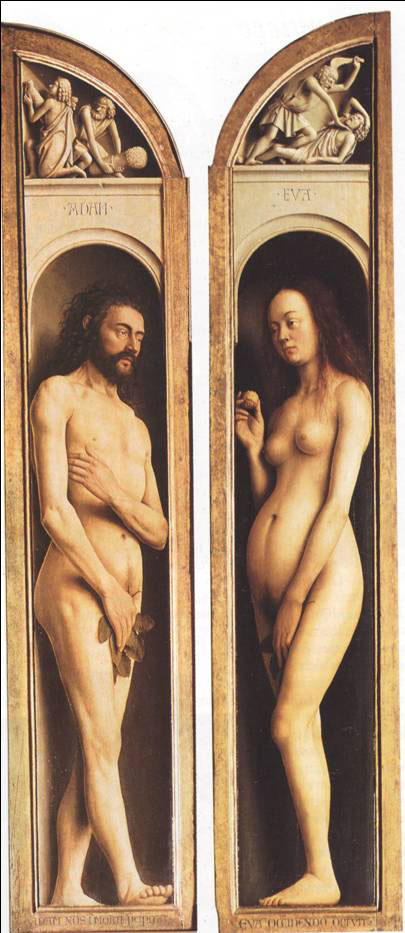
The central nude (Athena) appears in the drawn copy to have clear bikini marks, whereas Rubens’ goddesses of course are immortal and have no marks of the sun at all. While for example, the clearly human Adam in the van Eyck brothers Ghent altarpiece has worked in the fields and his burnt head and arms are testament to his lowliness.

The van Eycks: 'The Ghent Altarpiece, detail'. 1432 tempera and oil on panel

Sun tan as a desirable attribute doesn’t start till the early Twentieth Century.

So, skin, the action on Steen takes place on a surface light by raking light, the more one looks at it, again perhaps the triangulation of viewer’s viewpoint, the more this looks the skin of an old man, no longer taut, odd risings of hair in the folds.

That grouping of oak and silver birch in the foreground, they really do look like the subsequent tree paintings of artists like Ruisdael, Hobbema and Constable, a line you can trace back to Pieter Bruegel the Elder and back further to woodcuts from Titian. The tops of the trees, billowing forms are tinged with pink as are the grey clouds in the top left and fronted with thick creamy white. A similar palette to that around Discord in the storm clouds in the other Judgement of Paris to our right, the later one: 1632-5.

Peter Paul Rubens: 'The Judgement of Paris', 1632-5. Oil on Panel. National Gallery, London

Huge billowing shapes, dramatic lighting, powerful form, this upper right section of Steen is slightly different to the climactic conditions and tree-scape across the autumnal, linear composition below. Rubens is gussying up the scene a bit, he can’t help it, all those years of grand istorias for the powerful; it has become a habit. The isolated intense focus on others areas, the abrupt changes in scale, show an artist working on bits that interest him, no need to harmonise the composition.

Today seems to be young and old day in the National Gallery, huge fleets of little children, all pigtails and holding hands are ushered through with much shushing and repeated directions. Amongst the excited little beings are the old, with sticks and grey jackets and  audio guides and armfuls of gallery pamphlets; fretful that they are in front of the wrong painting as they press buttons 9, 4 and 3. I am suddenly surrounded by an unnumbered horde of small, very small children all with their ‘Kerbcraft Walking Bus’ fluorescent tabards, their joy is overwhelming, their need to sit on the bench equally so; time to go. 

Peter Paul Rubens: 'A View of Het Steen in the Early Morning', 1636. Oil on Oak. Oil on oak.131 x 229.cm. National Gallery, London

Thinking further about those clouds and the trees in the foreground, their derivation and their future effect (although this was less in the Netherlands, the major influence would be on artists like Constable,Het Steen was owned by Sir George Beaumont, Constable’s patron). I have been reading the catalogue for a National Gallery Exhibition on ‘Dutch Landscape, the Early Years, Haarlem and Amsterdam 1590-1650’ published in 1986, National Gallery Publications, London. A show which centred on the development of work directly from nature; a process that characterises Dutch landscape drawings, prints and paintings in the seventeenth century.

Rubens was though, a Flemish artist, Italianate, learned, and devoted to istoria. The growing 16th century Dutch landscape tradition, developing around Haarlem, based itself on nature/ observation, the ‘extensive landscape’ a correlation between marine and landscape painting particular to the newly reclaimed Dutch landscape. These artists, inspired by the marine painters like the splendidly named Vroom, closely observed wind, cloud types and the effects of light. Unlike the Flemish:

“These [Rubens’] clouds are an arbitrary backdrop and are scarcely recognisable in meteorological terms” J E Thomas, Geographical Magazine 51.7 April 1979, quoted in ‘Dutch Landscape’ page 79.

“the marine painters observations of the sky ensured that in Dutch Landscapes and marine paintings sunlight always falls from the same direction [as the wind], Rubens’ ‘artistic licence’ in showing shadows falling from opposite directions in the same landscape would have been unthinkable for a contemporary Dutch artist’

In fact the light and shadows fall in Steen is reasonably consistent from top right to bottom left. There is no strong wind but a gentle East to West breeze, following the line of the clouds would seem believable. The painting that Russell is referring to in this second reference is the ‘Return from the Harvest’ in the Galleria Pitti, in which the shadows cast the peasants in the foreground run at right angles to the source of light.

By the way, can I recommend the Hay in Art Website www.hayinart.com which does exactly what it says, in great detail; indispensable.

This double light is not down to incompetence, or lack of knowledge, it is the traditional role of the artist to transcend the natural.

“It is by this that Rubens proves himself great and shows to the world that he, with a free spirit stands above Nature and treats her to his higher purposes” Goethe, conversation with Eckermann, in discussion over Return from the Harvest where Goethe uses the double light as an illustration of Rubens’ greatness, rather than Russell’s approach which tries to indicate Rubens’ indifference at best.

To point out where Rubens/ Flemish landscape and the emerging Dutch tradition meet, it would be worth mentioning Carel van Mander. van Mander’s treatise on painting, (Het Schilderboeck) published in the Netherlands in 1606, and went into great detail about art, artists and translated Ovid’s Metamorphoses. Chapter 8 was exclusively on landscape, parts of it seem relevant to Het Steen, for example:

“4: note, first of all, how over there the bride of old Tithonus rises from her saffron bed to announce the approach of the torch of day, and see how the four piebald horses soaked with water, rise panting from the shallows of the Ocean. See how the little purple clouds become tinged with pinkish red and how beautifully Eurus’ bright home is adorned ready receive Phoebus…see there in front of us, hunters are walking with their dogs through the green dewy fields: see how that trodden dew turns a lighter tone of green, showing their footprints, and so giving their route home. (Let the landscape recede smoothly into the distance, or let it gradually merge into the sky)”

From ‘Dutch Landscape, the Early Years, Haarlem and Amsterdam 1590-1650’ published in 1986, National Gallery Publications, London page 36.

There is a distinct similarity between these stock figures from classical myth and the role of the genre figures that people Steen’s foreground, certainly the horse/ cart drawing of the sun across the sky motif. A coincidence? A wry reworking of classical themes? Probably, these references were, after all, part of the trade of any literate 17th century artist across Europe. Had Rubens read van Mander? What is more relevant perhaps, is that these references had nothing to do with the new Dutch landscape style that was appearing, on his doorstep as it where, some 100 miles away from Het Steen.

It would be tempting to say that old man was learning new radicalism, by working directly from nature for example. Certainly this is a recognisable landscape, but, all the marks of composition, of his higher purpose, of studio bound painting, are here. Het Steen is framed, by the group of trees that also frame the house. The hunter, fallen tree arrangement makes the traditional the diagonal, foreground repoussoir element, characteristic of Flemish landscape painting.

“First of all it is important to show clear contrast in the foreground, as it pushes the other planes into the background. Ensure something large is painted in the foreground as was done by Bruegel and other great artists who are acclaimed for their contribution to landscape painting. Since they often place enormous tree-trunks in the foreground let us enthusiastically strive to follow their example.”

van Mander quoted in From ‘Dutch Landscape, the Early Years, Haarlem and Amsterdam 1590-1650’ published in 1986, National Gallery Publications, London page 38.

The Steen pictorial space is divided up into the traditional brown foreground, green mid and blue background. Yes, there is evidence of farming, of quotidian purpose that you can see in drawings especially by artists like Coninxloo. Rubens’ painting contains the field boundaries, the milkmaid etc. But, the centrality of the hunter makes it clear; this is a landscape for recreation. And, lastly there is the high view, the recognizable method for constructing the Antwerp landscape style that you can trace back to Patinir and the early sixteenth century.

So, back to the trees.

Van Mander wrote that the changes in the representation of trees in art in the Netherlands, was down to Coninxloo, because of him Netherlandish trees in art became leafier. Coninxloo  was an artist who specialised in dense forest landscapes, a subject and style that according to Christopher Brown in the Dutch Landscape Introduction, (‘Dutch Landscape, the Early Years, Haarlem and Amsterdam 1590-1650’ published in 1986, National Gallery Publications, London page 17) you can trace back to Pieter Bruegel the elder, and his son Jan Brueghel the Elder. Pieter had in his turn taken his inspiration from woodcuts after Titian, Campagnola and Muziano, i.e. from art, from higher purpose, not from life. 

Rubens’ little group of tall foreground trees, growing at angles, overlapping one another, with recognisably different foliage, and the foreground tree stump; this compositional form is pure Flemish landscape tradition. A tradition that Rubens had already conquered on his return to Antwerp from Italy, in his groups of landscape painted 1614-25. Paintings that seem to celebrate lushness, fertility and his identification with his native country. A return to prosperity after war. In the horribly complex history of the Netherlands, this was a period of powerful Counter Reformation, lots of work for a Catholic history painter newly returned from Italy, e.g. the Raising of the Cross for Antwerp Cathedral, 1610-11.

The landscape painting that makes all this clear is ‘Milkmaids with Cattle in a Landscape: ‘The Farm at Lacken’, 1618, oil on Panel, The Royal Collection.

Rubens: 'Milkmaids with Cattle in a Landscape: 'The Farm at Laeken', 1618. Oil on Panel, The Royal Collection, London

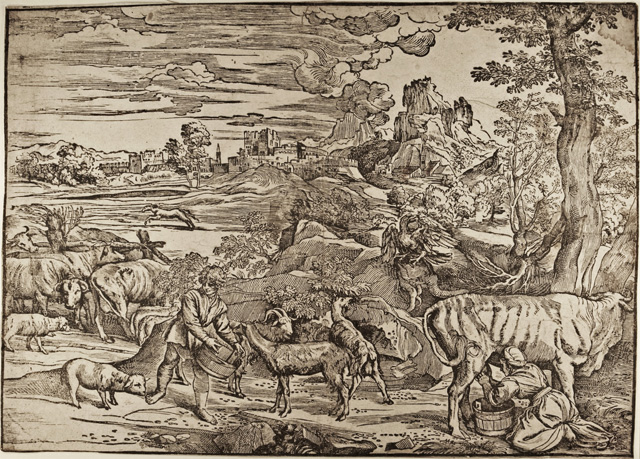
 Notice that there is some formal similarity between the arrangement of the right hand branches on the birch in the clump above the figure with the cornucopia of fruit and veg on her head and the right hand birch in the Steen foreground. To further emphasise our theme about the derivation of, and intentions behind these compositions, Christopher Brown in ‘Making and Meaning: Rubens Landscapes’, points out that this composition loosely owes something to a Titian woodcut (Landscape with a Milkmaid 1525).

Boldrini (after Titian) Landscape with a Milkmaid 1525. woodcut, British Museum

And, he goes deeper to show that the church, just visible top right, was a key centre of Marian worship and nationalist associations. In other words there are strong connections between this painting of prosperity and peace, the power of the Catholic Church and the Archdukes Albert and Isabella, Rubens was their court artist. Do we find our trees in Het Steen pointing us in any of these directions? No, the context is different. There is of course the same brass jug, here for containing milk, in ‘the Watering Place’ of 1620 for, presumably, water and in ‘Landscape with a Rainbow’ (generally assumed to be the companion piece to Het Steen) where it is also on a head, either water or milk. A Rubensian shape for indicating plenty/ fecundity/ prosperity, i.e. peace?


Peter Paul Rubens: 'A View of Het Steen in the Early Morning', 1636. Oil on Oak. Oil on oak.131 x 229.cm. National Gallery, London

http://www.nationalgallery.org.uk/paintings/peter-paul-rubens-a-view-of-het-steen-in-the-early-morning
24th August, m
orning, not long after opening, summer holidays, no schoolchildren.

The proportions of Het Steen are interesting, much wider than tall, (131.2 x 229.2 cm, ie 1:1.75)  a proportion that developed, from the initial central three panels through to the seventeen that he finished with. It is noticeably wider than, for instance the smaller landscape works on the wall behind. A proportion that reinforces the notion that we are not looking through a window, it does not correspond to the windows shown in Het Steen. The painting is not quite two equal squares, they would have to overlap slightly. Certainly the proportions summons up the notion of stereoscopic vision, two eyes not quite combining and the mid point marked at the bottom of the picture plane by the upturned tree.

For someone who made such spectacular paintings of grand horses fighting, the two cart horses really are splendidly rural.

Are there two figures on the tower? Or is just the castellation? The blobs are in roughly the right place for architectural features, but then again they are slightly different colours. The left is bluish, the right is yellow; the blue figure could have an outstretched hand: “This is all mine”. Reading too much into vague sploshes of bravura paint?

If these are figures, than that could place Rubens, the narrator, within the pictorial space at a series of viewpoints. He is on the tower; by the gate; on the cart; as the hunter; as the artist/ creator and of course as the artist/ owner of the estate showing it off to the privileged viewer. And, each time I see this painting I am convinced that this is a view made to be shown rather than an artists’ ‘personal response’ in the late 19th Century manner. The way that our perceptual perambulation is arranged makes that very clear.

Clark talks about Poussin’s tiny figures in ‘The Sight of Death’,

“What are these miniature figures in Poussin about? Why do they come and go in perceptions? Why, once see, do they matter so much?….I think they are best understood as different proposals about recognition and interpretation, about “picking out” what is human in a human and non-human world, about the way humans belong to their surroundings…Let’s talk about stories. They are analogous to the small figures in Poussin: that is, there often turns out to be more and more of them, implied, embedded, the longer one looks.”

(T J Clark: The Sight of Death: An Experiment in Art Writing. Yale University Press, 2006. ISBN 0300137583. Pages 45-50)

The figures then, give the painting agency, do they work the same way in Het Steen?

 A young Eastern European (Russian perhaps?) points out the two flying ducks to his girlfriend, then the hunter, then he makes the appropriate internationally recognised gestures for shooting something. She laughs appropriately, but looks slightly embarrassed.

I go to look carefully at the tower, I think that (probably) these are merely battlements/ castellation. Presumably such architectural features were for show. But, whether or not these figures are ‘real’, the point about their role remains.  The fisherman on the bridge, or the hint of figures to the left. I return to the bench to find a Japanese woman sitting on my notebook, she is not apologetic.

Thinking about Clark, I go to see Poussin’s ‘Landscape with a Man Killed by a Snake’

Poussin: 'Landscape with a Man Killed by a Snake', oil on canvas, 1648


http://www.nationalgallery.org.uk/paintings/nicolas-poussin-landscape-with-a-man-killed-by-a-snake

It has been in Room 19 for a while now, but the lighting is bland and dull. Gradually lamps turn on, the room gets brighter and slowly the painting comes to life. It clearly needs strong light, whereas the same lighting scheme kills the Rubens; Het Steen was made for dim candle light: the North. ‘Landscape with a Man Killed by a Snake’ for the bright clear South. Returning to the original position a painting was designed for, can affect how we understand it. Such a search can become an ‘early music’ style fetish, nonetheless it is extraordinary how different art, for example the Poussin here, can look under sympathetic lighting. The lighting clicks off and Landscape’ returns to a dull, dark gloom.

A fully immersive art experience in every sense. It starts with online booking, then a woman in wellies and clipboard ticking off names, in front of a large rusted metal door in a carpark at the back of a warehouses just of Kingsland High Road, East London. You have to walk past a McDonalds and all the excitement of Hackney street life to get there. ‘There’ is Edgelands, the car park is one of several hemmed in blank urban spaces, derelict and graffitied (including oddly a memorial to a Chechen freedom fighter). In the distance the sound of Ridley Road market (“come on love don’t be shy, everything for a paand”) around the wastes are stacks of cardboard for rough sleepers. But we must go; our group of slightly baffled art enthusiasts are being hurried through the door by a tall figure in black with a strange voice.
Down steep stairs into darkness, dampness and oddness. We are recruits for a job with Bunker PLC apparently. We fill out application forms in almost complete darkness, chivvied by strange figures with headtorches, who fit waterproof slippers over our shoes, later we will get into full waterproof ponchos. Scientific glass vessels full of beautiful, crystallised plant life provide light. We watch the company film, full of appropriate corporate cliché, in another room, hurried down many dark, wet mouldy corridors from low ceilinged space to space. We find out more about the company, set up after cataclysmic climatic events in 2012 (we are in the future now). Life evolves underground: human pollination; urban vertical farming; genetic modification by plunging the hands deep into bloody chest cavities; a hands on art work then.  The combination of film/ sci fi/ dystopia/ comic references echoes throughout the hour underground and in every one of the rooms; crystallised books by Ballard in one room, references to Tarkovsky on a white board in another. The conviction by the actor/ artists is total, as is the whole set up.
The usual fear of role play promotes the wish to see this art work on many levels. As a walk through film, a theatrical polemic about climate change, an artwork that derives from performance and installation traditions of the 1960’s. I suppose you could say that critique has been implicit within performance art since Oldenburg’s anti materialist Happenings and is certainly present here. You could also point out that a future in which nothing works is a common feature of much contemporary art work. Noticeably none of these futures involves digital technology, imagine Blade Runner without all the toys, or the replicants for that matter.
But you could also say that what links many of these works is a common understanding of the role of time within the artwork and in the way that the viewer encounters it. There is more to this than the simple process of setting the work in the future, as seen in both ‘Bunker PLC’ and ‘whiteonwhite’ (see previous post).  Could we say that, in using an overarching narrative: the role of this imaginary corporation in a future society that has undergone cataclysmic change; the search for meaning by a geophysicist in a post Soviet city, both works fluently create sequenced packages of time that are apparently linear, but are in fact circular? Time that appears ‘representational’, in that it is subject to the usual chronological rules that exist this side of the picture plane: diurnal (A diurnal cycle is any pattern that recurs every 24 hours as a result of one full rotation of the Earth).But time that is in fact subject to systems set up by the artist/s.
In the Bunker, although our narrative packages are physically divided by rooms in which the different activities occur, including the relaxation room/ bar at the end where loud music is played at us. Drinks, by the way, have been served throughout in different forms, there is a level of humour/ wit/ fun in this work that is admirable and adds to the sense of understanding this on many levels. Although the way we move through the scenarios appears linear, they could work in any direction. I did try to move away from one room, only to be approached by a very fierce actor/ artist squeaking “Task? Task? Have you completed your Task?” at me; impressively staying in character throughout. In ‘Bunker PLC’, in common with ‘whiteonwhite’, we make the overarching narrative complete in our reaction to the sequences of activity we participate in, and the connections we make between them and what we know of the outside world.
How does that fit into what I have been struggling with in my encounters with an earlier art work (Het Steen, see earlier posts)? We left the notion that art needs to be a physical object behind in the 1970’s. Nonetheless, the way we encounter, for example the glued together boards covered with green and brown paint that is called ‘A View of Het Steen in the Early Morning’, bears more similarities with these two recent works than you might think. Granted they are not art objects, In an art object, traditionally a flat piece of static painting, time can be encapsulated in the ways in which the artist has laid material on the surface: slowly drawn line; thick violent gestural paint; visibly layered surfaces etc. Time can also be manipulated conceptually ‘through the picture plane’ as it were, on the other side of the Albertian window. So, for example in Het Steen we see the horse pulling the cart with its two occupants to our left, the sun will rise, the hunter will shoot the ducks on the far side of the fallen tree. In other words the representations are presented for us to read as mental images that we can happily accept as a narrative sequence subject to the usual rules of diurnal time.
As I think I have established in earlier post, it is how you traverse the mental image of the landscape that tells the viewer about the qualities of that landscape. ‘Bunker Plc’ the artwork is both a physical landscape – a Second World War bunker- and a conceptual landscape- ‘Bunker Plc’. We traverse the conceptual landscape according to the rules we are given by the imagined protagonists. So what have we established? That these works (‘Bunker PLC’, ‘whiteonwhite’) are also ‘landscape’ in that they involve traversing a landscape (physically and conceptually). They involve presenting time, on the far side of the ‘picture plane’, as a diurnal chronological process sequenced through traditional narrative structures. But, beneath the immediately visible layers of pictorial space, in the formal features of the composition so to speak, are far more complex, contemporary, non linear time based processes. Playing with stories is as old as humankind, it’s fascinating to see how artists are now working with them in such a multilayered referential and, crucially, easily accessible manner.
It occurs to me as a postscript that: Het Steen, like most painting is the work of a single ego, and as many post Pollock (Griselda not Jackson) will point out, white and inevitably male. Whereas both Bunker Plc and whiteonwhite are collaborative works, film is inevitably so and such a substantial installation must have demanded continuous negotiation. Both contemporary works seem to be largely put together by women, Eve Sussman as well as the rufus corporation for ‘whiteonwhite’ and Jo Shaw & Olivia Bellas, as well as the other women artists and actors involved in Bunker Plc.