Archive

National Gallery

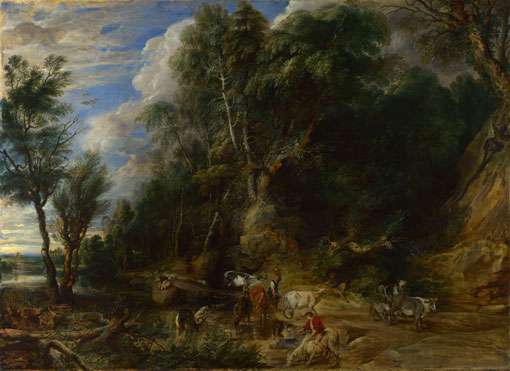
Peter Paul Rubens: 'A View of Het Steen in the Early Morning', 1636. Oil on Oak. Oil on oak.131 x 229.cm. National Gallery, London

Alberti defined seeing a painting as looking through a window but, you can look out of or into a window. Looking at pictorial space is a reciprocal process. Norman Bryson (‘Vision and Painting’, page 96) points out that the viewer’s space, on this side of the picture plane, has differed over time. The dramatic liturgical theatre of Byzantine Christendom; you approached the image in a full architectural setting with aural context. You moved from devotional icon to icon in a set pattern, at a particular time of the year, according to prescribed physical ritual accompanied by prescribed sounds and of course smells, incense etc. The contested piazza of the Renaissance self; always measuring, always calculating proportion, always negotiating a better deal with God. The pure white cube of the fiercely convinced, Protestant communicant. The contingent world of the modern being, a fluid range of virtual selves, constantly subject to a vast choice of undifferentiated stimuli.

Perhaps I was aware of this as I took my usual place in the National Gallery, on the bench before Het Steen on a Friday evening. Perhaps it was because, on leaving the Leonardo exhibition, I had seen Professor Martin Kemp (the international authority on da Vinci) in the Gents, prepping himself for his evening talk. He was dressed in a blinding white, collarless linen frock coat, buttoned to the neck. The neckline was giving him problems and took time to adjust – much fiddling and staring into the mirror. I last saw him, in the flesh, at a talk some 8-10 years ago. He seems curiously ageless, although his hair, then a dazzling black, now has shades of deeper red; we know he’s worth it. Outside, he is greeted by attendant young women in flowing dark tailoring, they whisk him away to bathe his brow in perfumed oils; aah the life of the eminent art historian.

Perhaps it was because the Leonardo show was so crowded (only a three hour queue to buy a day ticket, time quickly lost in explaining the processes of Christianity to a puzzled Malaysian Economics student struggling with terminology in the exhibition hand-out). An exhibition crowded with a certain class of person, fragrant is the term I think, modulated voices and modulated décolletage on show as well; parties to go to I suppose.

Perhaps this was why I was more than usually aware of others as I sat in front of Rubens’ joyful autumn.

A Study of Hand Gestures in Front Of Het Steen

Older hands are often clasped behind the back, male tending to one hand holding the clenched other. Female hands seem to be relatively open. Younger hands tend to hold digital devices in front or to the side, or carry bags, handbags or labelled shopping bags.

A couple walk past, constantly changing their hand grasp with each other, sometimes fully entwined fingers, sometimes laid palm in palm, sometimes holding little fingers as though they are about to pull a wishbone. They read the label, ignore the painting.


“It’s very nice, this landscape, quite a size, but just a bit big for our lounge”

Two women, middle aged, one in a pale pink cardigan, the other all in black. They are clearly absorbed by the painting and keep making paired movements, each pushes her hands together from a height about nose level and moves them down to about the waist, mostly whilst pointing to the carter and the house.

Three very small Japanese women/ girls (difficult to tell) make small dabbing movements as they point upwards to the painted sky; dab, then circular movement, dab, then circular movement. They stop, hold up their phones, standing like the three graces (two facing the work, one away from it) they each consult their mobiles, this uplights their faces with a delicate blue glow. Whatever they find, it returns them to the painted sky, more very careful anti clockwise gestures, this time with thumb and forefinger; precise and in a single plane.

The digital light from the three graces glowed briefly across the silver birches in the paintings foreground. The painted highlight on those top branches is frontally lit, as though a film crew had rigged up towers and put full spots –no coloured gels – onto the upper parts, prior to some swooping camera shots across the plain. But the sun, pale straw yellow, but yellow nonetheless, comes from the right hand horizon behind the trees. That the sun is low is clear from the sight and intensity of the shadows cast by trees in the midground; surely the trees should be in silhouette and dark at the top?

Young couple in matching anoraks stand with an arm around each other’s back. With her other hand, she takes out her chewing gum, examines it, rolls it between her fingers and pops it back in her mouth.

White haired, large middle aged man to equivalent companion, pointing with fleece clad arm whilst sat on the bench.

“Frank, what’s that building”

Frank gets up, looks at the label, waves his arm slowly in front of the painting in a horizontal manner

“It’s Birmingham”

A very large class of students appears, to draw the right hand Judgement of Paris, all hats and boots and tights. They carry A3 black sketchbooks, Seawhite’s finest held in front of them like protective shields, or perhaps devices to declare their allegiance. Time to go.
Peter Paul Rubens: 'A View of Het Steen in the Early Morning', 1636. Oil on Oak. Oil on oak.131 x 229.cm. National Gallery, London

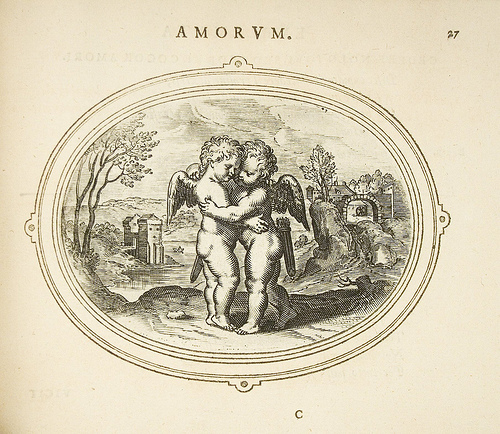
Is this a moral landscape? I have been reading ‘Gainsborough’s Vision’ by Amal Asfour and Paul Williamson (Liverpool University Press, 1999) in which the authors describe the role of the emblem in Gainsborough’s landscapes. Emblems were moral tales told through images, always accompanied by a descriptive text. An important Dutch form, travelling to Gainsborough through the Calvinist/ nonconformist tradition. A key early source was Otto van Veen: ‘Amorum Emblemata’ (1608) and the ‘Amoris Divini Emblemata’ (1615)

Otto van Veen: 'Amoris Finis Est' Amorum Emblemata 1608

“Van Veen is faithful to what can be termed a northern style of imagery – a detailed and naturalistic rendition of landscape settings. He presents a moral dilemma in a more or less realistic, rather than as an idealistic, single quality”  

(Gainsborough’s Vision page 82)

Rubens was apprenticed to Van Veen, and would have absorbed the tradition. Despite the different scale, materials and function, in Het Steen we have some of the possible elements of an emblem: the cart; the hunter; the house and the elegant bystanders. But:

1/ we don’t have any improving text

2/ Calvinist/ Christian images of agriculture tend to refer to husbanding the land as post Fall/ post Edenic toil:

‘In the sweat of thy face shalt thou eat bread, till thou return unto the ground; for out of it wast thou taken: for dust thou art, and unto dust shalt thou return.”

Often shown through the image of a thistle:

‘Cursed is the ground for thy sake; in sorrow shalt thou eat of it all the days of thy life. Thorns also and thistles shall it bring forth to thee; and thou shalt eat the herb of the field’

There are no thistles, some brambles of a fairly beneficent kind, they act as a cover to the hunter, but no obvious thistles. More importantly there is no ploughing, no evidence of turning the cursed ground, not a ploughed field in sight; it is pasture as far as the eye can see. The only work seems to be the bucolic acts of milking/ hunting and riding a cart. There are no crops, apart from milk and the wild fruit on the tree.

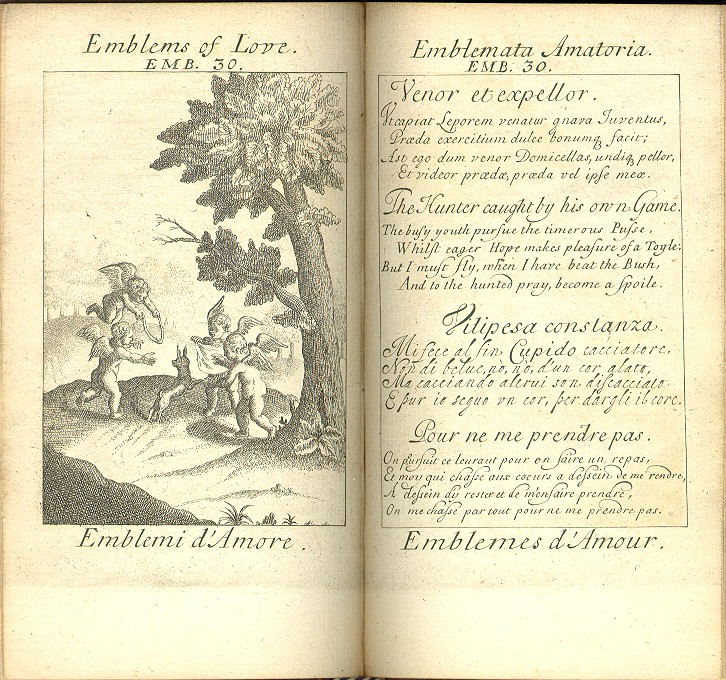
The hunter: in 17th century emblems, the hunter tends to be a reference to Cupid, eg Philip Ayres: Emblemata Amatoria, and ‘The Hunter Caught by his Own Game’, Actaeon changed into a Stag, that sort of thing.

Philip Ayres: 'The Hunter Caught by his own Game', Emblemata Amatoria, 1683

Frankly, most of the emblems tend to refer to getting love/ sex wrong, the same use that Gainsborough makes of them as well. Nor is Rubens’ man a metaphorical hunter searching for some other form of meaning. The deer on the cart would lead us to think about stag hunting, the pursuit of the aristocracy. Apparently Rubens did not hunt himself, and problems with arthritis and gout during the five or so years that lived at Het Steen would have limited his mobility.

Can we construct a moral tale out of these elements? Not, I would suggest without some heavy guidance from the composition and the authorial voice, Rubens was after all on the wrong side of the Catholic/ Calvinist divide. Despite early work with van Veen, the Counter Reformation/ Classical tradition is likely to be his source; Virgil’s Georgics, not Genesis. You can, as Asfour and Williamson do, plausibly connect Gainsborough landscapes to morally improving tales, can’t quite make that connection here.

Thomas Gainsborough: 'Landscape with a Woodcutter Courting a Milkmaid', 1755 (Tavistock Estates)

Next to me on the bench, a father and his daughter, she is 6 or 7 maybe, are going through a worksheet on the painting. They carefully read the question together, she skips to the image and points out the number of birds, people, where the sun rises or whatever. She is entirely dressed in shades of pink, with a diamante necklace and those trainers that light up when you walk. They stay looking at the painting, counting off the questions for a very long time, completely absorbed. Longer even than the Chinese tour groups in front of the right hand ‘Judgement of Paris’; today they are mostly dressed in lightweight tweed.

We could advance the theory that, at the end of his life, Rubens is celebrating God’s creativity with his own. But there is no obvious evidence of Christian agency here, no attributes or idealism of the humanist inspired Roman Catholic for example. No old bearded man in a bed sheet appears to bless us all, no youthful Apollonian sun-god races across the sky either. This, then, is all materialism: I own; I observe; I deserve, because I am worth it (which of course Rubens was).

A kinesthetic learner, the term we have been taught to use, is being urged by his mother to complete the Het Steen worksheet. The small boy, Dutch at a guess, is whirling his arms around his head, sucking the toggles of his fleece, jumping from foot to foot, trying to pull his mother’s pony tail, pointing at the ducks in the sky and shouting; all at once. To my right, the whining conversation between the two guards has become much louder. The man on the bench behind me is starting to snore and another, very large Chinese tour group is bearing down on the naked threesome to judge them for themselves; time to go.

Leonardo da Vinci: ‘Mona Lisa’, 1503 -19

I once heard Martin Kemp, the great Leonardo specialist, talk about the geology in background of the Mona Lisa. Apart from surprise at the blackness of the distinguished professors hair, I remember him saying that the artist had been hired to survey the land between Florence and Pisa, to give Florentines a navigable waterway to the sea bypassing their rivals. That survey work, and Leonardo’s analysis of the role of water in changing topography, allowed him to think of time in different ways, to move away from the prescriptive Christian chronology; geological time for example. His proposed route was to go through Prato and Pistoia, although the land behind Leonardo’s portrait of Lisa Gherardini is not an exact portrait of the lakes above the great valley of the Arno, it bears similarities. It allows Leonardo to use the landscape to meditate on the role of time, as well as present the site for a pre combustion engine form of transport, that is now incidentally the route for the A11 from Florence to Pisa.

What transport routes are we looking at in Het Steen?

Peter Paul Rubens: 'A View of Het Steen in the Early Morning', 1636. Oil on Oak. Oil on oak.131 x 229.cm. National Gallery, London

What geology? What time span? Apart from the obvious track leading the horses and cart out to our left, what other forms are here and what do they tell us about Rubens’ thinking? There are tracks in the centre midground, serpentine, leading toward the horizon, lighter in colour than the green and possibly slightly frosted grass that surrounds them. Several tracks seem to come together here, to lead in to the space towards Malines (the town on the horizon). They are not large roads, nor direct.

This is presumably an alluvial plain, laid down over millennia by slow moving rivers, they are not the fast moving lakes of built up water, about to burst their banks and cause tumultuous change as represented by Leonardo. Het Steen is placed in a land where not much changes, not of course true, this was a sector of Europe that had been constantly fought over, the Northern Netherlands were at war with Spain right up until 1648, and we are in the middle of the Thirty Years War. Land reclamation to the north and west was at its peak, new canals being dug constantly, agricultural practices were changing fast to keep pace with growing urbanisation.

Viewing it now, this great flat plain stretching to a low horizon, looks just made for a 21st century motorway system: 6 lanes; gantries; illuminated signs throughout the night; those huge, double European lorries. In fact it has the A1/E19 running from Brussels to Antwerp, which apparently has one of the widest central reservations in Europe (40 metres wide over 31 km since you ask)

The hunter in the foreground, the stock figure, he is trying to move to his right, to go around the tree trunk, through the thickest part of the brambles to shoot the oversized ducks behind. Surely, his quickest path would be to his left? Or so our elevated viewpoint would seem to indicate. It would be easier to shoot the ducks from the left hand side of the trunk, he could just hit them with his great long barrel in fact.

“It must be fairly late”

“In the day?”

“No, in the History of Art, you look at that Renaissance painting over there and the trees aren’t half as green”

“True”

“What’s the best way to get to our hotel anyway?”

The brown foreground of the painting ends at a very strong horizontal line, tilted down slightly to the left. One’s eye first notices it at the right where it is marked by a drainage ditch, the field boundary for the cow field with the milkmaid, although there are more cows in the field beyond as well. The pure sunshine continues across the midground, a line of sunlight ends just in front of the house. This lets Rubens spotlight the house, placing it on a boundary edge, the left corner of sunlight exactly touches the left hand end of the mansion.

The later Judgement of Paris to my right is a constant draw for Chinese visitors, in huge numbers. They stand today in Burberry scarves, usually their leader has one of those microphone affairs, they never stay long, they have an itinerary to follow.

I’m intrigued to know where the rustic wooden bridge would lead anyone to. If it is for the milkmaid approaching the cows in the next field but one, then two questions occur:

  1. Would the bridge bear her weight and that of the milk she will carry? Presumably in another of the brass jugs like that on the cart, and the same balanced on the head of the girl in Landscape with a Rainbow, the companion piece to this (see previous post). If you look closely at the smudges of paint, the milmaid would appear to have something on her back with a highlight, a jug strapped there? The bridge is flimsy with only one handrail, in a list of ‘Bridges in Art’ (Hiroshige, copied by van Gogh; Monet; Sisley; Constable; Turner; Stella; there is of course a bridge in Mona Lisa, on the right, just where her clothing swirls across her bare shoulder; that poem by McGonagall, the Tay Bridge Disaster etc. Any more? I refuse to sing Bridge over Troubled Water in the National Gallery) in that list, this little wooden span is not the most convincing.
  2. The milkmaid would have to cross another bridgeless ditch to get from her cows to this one, is that right? Then she would have a long walk round the wrong way to the house. That route would take her to the front and the drawbridge as well. Would servants go in that way? Was the drawbridge the only way over the moat around Het Steen? Perhaps there was a loading place for milk and the cart, by the tall foreground trees? Evidence of growing rural industry?

The last time I was here, someone was drawing the earlier Judgement of Paris in pencil. Today, an elderly man, quite scruffy in a grubby brown jacket, trainers, battered grey rucksack old jeans is drawing Minerva from the same painting. She is the figure with her back to us, with armour at her feet. It is a copy with a high degree of accuracy, and he is making it on an Ipad. Minerva, in the digital drawing, is completely isolated on a pale blue grey background. The digital drawing has a definite sense of texture from the ‘tooth’ of a virtual surface, Ingres paper is the name of the physical paper with equivalent qualities.

I see all this as I leave, finding my own path past the Turners and Constables, all that power and paint as thick as the painted skeins of cloth on Lisa Gheradini; seized moments of meteorological time.


To the Wallace Collection to see Rubens’ Landscape with a Rainbow’ , 1636.

Peter Paul Rubens: 'Landscape with a Rainbow', 1636. Oil on Panel. The Wallace Collection, London

the companion to Het Steen. It is much less finished, look at the way the yellow blocking between the legs of the cart horses on the left has entirely covered the second horse, it has not been corrected; Rubens never got round to it. Underpainting and drawing clearly showing through.

Strong diagonal from middle right across the ground plane towards the centre. A surprisingly incoherent composition, not quite clear where the central pond begins or ends. It is in the centre of the painting, but is just a vague hole.

Very little accuracy in the trees, oak like, but without the precision of the birches and the oak in the Steen foreground. In the left mid-ground of Rainbow there is a vaguely birch like copse, some clarity in the background recession.

Carefully painted cattle and ducks, brown foreground, green mid, blue background seen from a slightly elevated viewpoint but not as high as Steen. Without the house we have less of the arrogance,, or showing off, that characterises Steen. Rainbow is far more of a genre painting about countryside activities i.e. Haymaking, bringing in the cattle, no doubt killing the ducks; activities in the Brabant. The ground plane rises relatively steeply from below our feet to a midpoint at the grown out hedgerow.

Is the rainbow a sign of the covenant, God will not break his promise? A sign of peace (relevant of course to Rubens own position), look at the way our eye is drawn from the dark right towards the brighter left. Is the rainbow a symbolic form in common with the genre figures?

In the National Gallery in front of Het Steen

Peter Paul Rubens: 'A View of Het Steen in the Early Morning', 1636. Oil on Oak. Oil on oak.131 x 229.cm. National Gallery, London

There is perhaps a compositional similarity between Steen and Rainbow, in that both have a dark diagonally composed foreground element in roughly the same place; a standard Flemish landscape component after all. The Rainbow haystack corresponds approximately with the position of the house, but only just; positions of plenty?

Looking again at the Steen foreground clump of trees, might that dominant tree on the left be a pine rather than an oak? Native pine has lower branches that come out at a 45 degree angle, in oaks they tend to be higher up and at 90 degrees to the trunk. But, it can’t be, the leaves are bulging groups of flora, not short dark needles at all.

The Rainbow figures owe more to The Watering Place, 1622

Peter Paul Rubens: 'The Watering Place', 1622. Oil on Panel, The National Gallery, London

than they do to Het Steen. The Watering Place is on the opposite wall to het Steen, it is a far more finished painting than either of the two later works. Specimen pollarded willows, edged with dark glazes and trembling waves of Italianate leaves on Northern European tree trunks. Bruegel like rocks and tree formations, elevated viewpoint and the usual colour division to the composition. Genre figures including peasant with brass pitcher on head and shepherd playing flute under the tree (lots of references to Virgil: Tityrus lying under a spreading beech wooing the muse on a slender reed etc) None of that obviousness in Steen, which is an ostensibly contemporary scene in which the season is established as much through light and colour as through content. Autumn, ie harvest time, is established by content and activity rather than through depiction and observation.

It is toward the end of the day in the National Gallery. Sino-Italian day by the look of it: elegant; elderly; attenuated Italian couples and younger, plumper Chinese family groups. The elderly Italian man next to me on the bench, in light brown wool jacket, grey trousers, slip on brown leather shoes, light smell of woody eau de toilette, has been asleep on the corner seat of the bench the whole time I have been here. The colour of his jacket almost exactly matches the bottom right glazing over the underpainting of Het Steen. A woman, in folds of fine grey wool, with tumbling hair full of gold highlights and gold necklaces, re-appears to wake him up; lots of whispered Italian. Is gold an autumnal colour?

Peter Paul Rubens: 'A View of Het Steen in the Early Morning', 1636. Oil on Oak. Oil on oak.131 x 229.cm. National Gallery, London

Perhaps, because autumn is really starting to get going outside, the autumnal colours of the foreground seem particularly strong. The browns, in fact a translucent wash (looking a bit like a Sienna, though probably an umber with a touch of yellow) over thicker white underpaint with sludgier greens and umbers mixed on to the underpainting. This site, along with the National Gallery site itself, is helpful

Painting materials of Peter Paul Rubens: http://www.lalaragimov.com/research

Norman Bryson in ‘Vision and Painting’ (Macmillan, London 1983) talks at some length about the triangulation between the artist’s viewpoint, the viewers’ and the vanishing point. Stressing the importance of what happens, or is presumed to happen, this side of the picture plane. It is difficult to be both the artist and the artist as viewer but, we know that this painting was made for his own pleasure, possibly to display his own success to the powerful, but for Rubens’ pleasure nonetheless. I.e. an autumn scene for a man in his own September days, fact closer to November as he died four years later. Is it therefore too fanciful to make associations between the rumpled, creased, worn ground plane as it moves from the cart at bottom left to the rising sun top right and skin. Steen is after all, flanked in the National Gallery by two versions of the Judgement of Paris, young female skin by the yard.

Next to me on the bench in front of these three paintings a youngish art student in a flowery red summer dress is making a tonal study of the earlier Judgement (on the left from 1597-9)

Peter Paul Rubens: 'The Judgement of Paris', 1597-9. Oil on Panel. The National Gallery, London

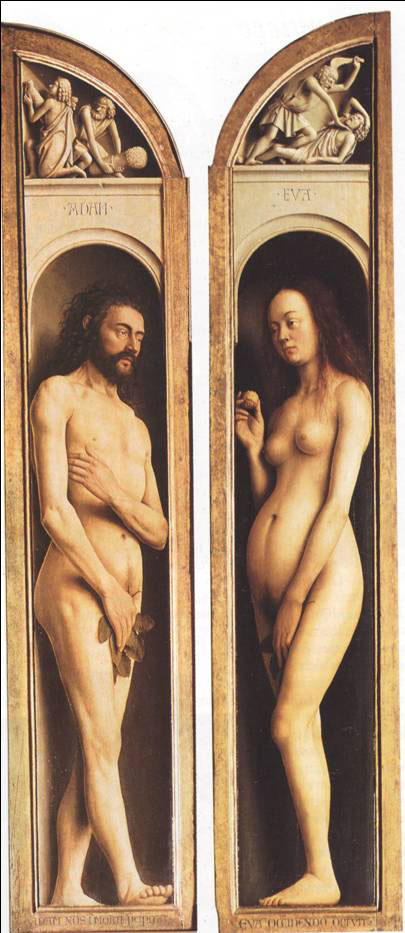
The central nude (Athena) appears in the drawn copy to have clear bikini marks, whereas Rubens’ goddesses of course are immortal and have no marks of the sun at all. While for example, the clearly human Adam in the van Eyck brothers Ghent altarpiece has worked in the fields and his burnt head and arms are testament to his lowliness.

The van Eycks: 'The Ghent Altarpiece, detail'. 1432 tempera and oil on panel

Sun tan as a desirable attribute doesn’t start till the early Twentieth Century.

So, skin, the action on Steen takes place on a surface light by raking light, the more one looks at it, again perhaps the triangulation of viewer’s viewpoint, the more this looks the skin of an old man, no longer taut, odd risings of hair in the folds.

That grouping of oak and silver birch in the foreground, they really do look like the subsequent tree paintings of artists like Ruisdael, Hobbema and Constable, a line you can trace back to Pieter Bruegel the Elder and back further to woodcuts from Titian. The tops of the trees, billowing forms are tinged with pink as are the grey clouds in the top left and fronted with thick creamy white. A similar palette to that around Discord in the storm clouds in the other Judgement of Paris to our right, the later one: 1632-5.

Peter Paul Rubens: 'The Judgement of Paris', 1632-5. Oil on Panel. National Gallery, London

Huge billowing shapes, dramatic lighting, powerful form, this upper right section of Steen is slightly different to the climactic conditions and tree-scape across the autumnal, linear composition below. Rubens is gussying up the scene a bit, he can’t help it, all those years of grand istorias for the powerful; it has become a habit. The isolated intense focus on others areas, the abrupt changes in scale, show an artist working on bits that interest him, no need to harmonise the composition.

Today seems to be young and old day in the National Gallery, huge fleets of little children, all pigtails and holding hands are ushered through with much shushing and repeated directions. Amongst the excited little beings are the old, with sticks and grey jackets and  audio guides and armfuls of gallery pamphlets; fretful that they are in front of the wrong painting as they press buttons 9, 4 and 3. I am suddenly surrounded by an unnumbered horde of small, very small children all with their ‘Kerbcraft Walking Bus’ fluorescent tabards, their joy is overwhelming, their need to sit on the bench equally so; time to go. 


Peter Paul Rubens: 'A View of Het Steen in the Early Morning', 1636. Oil on Oak. Oil on oak.131 x 229.cm. National Gallery, London

http://www.nationalgallery.org.uk/paintings/peter-paul-rubens-a-view-of-het-steen-in-the-early-morning
24th August, m
orning, not long after opening, summer holidays, no schoolchildren.

The proportions of Het Steen are interesting, much wider than tall, (131.2 x 229.2 cm, ie 1:1.75)  a proportion that developed, from the initial central three panels through to the seventeen that he finished with. It is noticeably wider than, for instance the smaller landscape works on the wall behind. A proportion that reinforces the notion that we are not looking through a window, it does not correspond to the windows shown in Het Steen. The painting is not quite two equal squares, they would have to overlap slightly. Certainly the proportions summons up the notion of stereoscopic vision, two eyes not quite combining and the mid point marked at the bottom of the picture plane by the upturned tree.

For someone who made such spectacular paintings of grand horses fighting, the two cart horses really are splendidly rural.

Are there two figures on the tower? Or is just the castellation? The blobs are in roughly the right place for architectural features, but then again they are slightly different colours. The left is bluish, the right is yellow; the blue figure could have an outstretched hand: “This is all mine”. Reading too much into vague sploshes of bravura paint?

If these are figures, than that could place Rubens, the narrator, within the pictorial space at a series of viewpoints. He is on the tower; by the gate; on the cart; as the hunter; as the artist/ creator and of course as the artist/ owner of the estate showing it off to the privileged viewer. And, each time I see this painting I am convinced that this is a view made to be shown rather than an artists’ ‘personal response’ in the late 19th Century manner. The way that our perceptual perambulation is arranged makes that very clear.

Clark talks about Poussin’s tiny figures in ‘The Sight of Death’,

“What are these miniature figures in Poussin about? Why do they come and go in perceptions? Why, once see, do they matter so much?….I think they are best understood as different proposals about recognition and interpretation, about “picking out” what is human in a human and non-human world, about the way humans belong to their surroundings…Let’s talk about stories. They are analogous to the small figures in Poussin: that is, there often turns out to be more and more of them, implied, embedded, the longer one looks.”

(T J Clark: The Sight of Death: An Experiment in Art Writing. Yale University Press, 2006. ISBN 0300137583. Pages 45-50)

The figures then, give the painting agency, do they work the same way in Het Steen?

 A young Eastern European (Russian perhaps?) points out the two flying ducks to his girlfriend, then the hunter, then he makes the appropriate internationally recognised gestures for shooting something. She laughs appropriately, but looks slightly embarrassed.

I go to look carefully at the tower, I think that (probably) these are merely battlements/ castellation. Presumably such architectural features were for show. But, whether or not these figures are ‘real’, the point about their role remains.  The fisherman on the bridge, or the hint of figures to the left. I return to the bench to find a Japanese woman sitting on my notebook, she is not apologetic.

Thinking about Clark, I go to see Poussin’s ‘Landscape with a Man Killed by a Snake’

Poussin: 'Landscape with a Man Killed by a Snake', oil on canvas, 1648


http://www.nationalgallery.org.uk/paintings/nicolas-poussin-landscape-with-a-man-killed-by-a-snake

It has been in Room 19 for a while now, but the lighting is bland and dull. Gradually lamps turn on, the room gets brighter and slowly the painting comes to life. It clearly needs strong light, whereas the same lighting scheme kills the Rubens; Het Steen was made for dim candle light: the North. ‘Landscape with a Man Killed by a Snake’ for the bright clear South. Returning to the original position a painting was designed for, can affect how we understand it. Such a search can become an ‘early music’ style fetish, nonetheless it is extraordinary how different art, for example the Poussin here, can look under sympathetic lighting. The lighting clicks off and Landscape’ returns to a dull, dark gloom.

Peter Paul Rubens: 'A View of Het Steen in the Early Morning', 1636. Oil on Oak. Oil on oak.131 x 229.cm. National Gallery, London

http://www.nationalgallery.org.uk/paintings/peter-paul-rubens-a-view-of-het-steen-in-the-early-morning
Het Steen

The behaviour of gallery goers is endlessly fascinating. Apart from the usual schoolchildren (poorly behaved and French today) others trudge through the galleries, is this a form of nomadism? A pilgrimage? Something dutiful, done with little interest, the journey is the penance, the reward comes at the end. Although some are clearly fascinated and will stand entranced. Is gallery going a useful space to think about life outside the gallery?
Woman on cart has red blouse/ shirt and blue dress; contrasting complementaries. Only just noticed that the man driving the cart is actually on top of his horse, not on the right of the woman as I had always assumed. He (looking vaguely like a younger Rubens, with the hat to hide his baldness) is sitting on some sort of saddle and the two horses have a heavy bridle between them to pull the two wheeled cart; a fairly agricultural affair. She sits on hay with the brass jug (by the way there is a very similar jug in an equivalent late landscape ‘Landscape with a Rainbow’ 1635,

Rubens: 'Landscape with a Rainbow', 1636. The Wallace Collection, London

a peasant balances it on her head). In front of her is the deer.

Paintings change according to the light that falls upon them, in some cases this is merely a matter of it becoming more or less visible. Het Steen perhaps because it is so obviously an internally lit landscape, changes tone completely. The National Gallery lighting system is unsubtle, to put it mildly, but there is diffuse neutral top light. This set up can move the landscape from warm to cold, from fertile and misty to grim and frosty within moments.
Which begs a question, well a series of questions, based around the autonomy of the text. We have a tendency to give agency to figures in art, the Pygmalion complex. If the tone of the view is changing, is that change:
1: Analogous with the state of mind of the viewer in a form of pathetic fallacy, Horses eating themselves. Foul and fair weather etc.
2. Is this scene and its changing weather, independent of human action? The clock maker winds up his clock and walks away, or more likely those mini landscapes within a huge glass bottle that I remember being fashionable in my youth, it was a sealed ecosystem, is this?
3. Solely a matter of subjective over interpretation, changing external light can have no bearing on our approach to the painting; it is fixed and immutable. All this composition of paint can do is decay from the moment that Rubens laid down his brush.
To continue from where I left off, searching for Rubens in this work. Who is the witness within? Do we see from the point of view of the hunter, new ways of spying the land? I have always assumed that we stood as Rubens himself stood, I am surveying all that I have made and it is good. But given the height of the viewpoint, some twenty foot off the ground and our previous identification with the hunter and our nose to the ground, is it too fanciful to assume:
A: that we are being shown this land by a proud owner
B: that the person to whom we are showing it is in some way elevated, notice the centrality of our viewpoint, and yes I know viewpoints are usually central, but they can be skewed, think of most Degas paintings, ‘The Ballet Rehearsal on Stage’ for example, when the stage veers away to our right as though we were sitting in a box watching the young girls rehearse, in a similar manner to the Jockey Club member actually on stage left. That elevated, central viewpoint, and back to the personal sun. In other words is Rubens showing off his estate to a king? To those his diplomatic skills have flattered and who have presumably, in effect, paid for all this land and the house.
If it is autumn, only the big trees in the foreground are starting to turn, especially the dead leaves from the fallen tree and from the lower branches of the –oak? – in the centre island and the other trees to the left of Het Steen itself. Notice by the way that the sapling, or the part of the tree that has fallen with it, echoes the shape of the ditch and one of the circular ditches radiating from the island. Apart from the hunting and fishing (man on the bridge) and maybe the fungi showing the bounty of autumn, where are the fruits?
Northern Damp
Looking at the Bacon-esque smears of white paint that run horizontally from under the horses hooves across to the fallen tree trunk, they have some of the qualities of water about them. What could be construed of the path/ track that runs around to our right of the tree island is a murky indistinct series of smudges in a grey brown. Taken in parallel with the white, can this also be read as water, is the cart coming through a stream/ ford. The mushroom/ fungi on the fallen wood certainly tell us how damp it is.
To the left of the drawbridge, into the front of Het Steen, further horizontal smudges that could be read as more people, at least three of the smudges go down to the ground; therefore skirts.
I am here after a GCSE inset course on the new specification, needing consolation after all those numbers and phrases and procedures. So, here I am putting in a bit of critical and contextual study of my own. Is the light of the sun, rising we think, the light of nature? Or given that we are considerably post Reformation, the Light of God? Or I suppose, given that this is painted by an artist in some sort of retirement, the light of art? A raking light from upper right to lower left, almost as if Het Steen has it’s own personal sun, painted by a man who had, in his relationship to the Stuarts and the Hapsburgs, been close to a Royal Sun/ Son.
If standing, the central tree would exactly bisect the image, it would become a diptych. Whilst there is little in the way of overt cultural symbolism here, an accumulation of narrative perhaps but few other attributes or linkages. Nonetheless the fallen tree, much drawn in Northern European art, must bring with it a series of meanings. Old age? The power of nature? Fittingly perhaps, a man with a briefcase has just sat down next to me go through a set of auction papers referring to a range of different lots. Property, past relevance to one person, sold on to the next. Time to go