Archive

Tag Archives: Rubens Het Steen National Gallery

To the Wallace Collection to see Rubens’ Landscape with a Rainbow’ , 1636.

Peter Paul Rubens: 'Landscape with a Rainbow', 1636. Oil on Panel. The Wallace Collection, London

the companion to Het Steen. It is much less finished, look at the way the yellow blocking between the legs of the cart horses on the left has entirely covered the second horse, it has not been corrected; Rubens never got round to it. Underpainting and drawing clearly showing through.

Strong diagonal from middle right across the ground plane towards the centre. A surprisingly incoherent composition, not quite clear where the central pond begins or ends. It is in the centre of the painting, but is just a vague hole.

Very little accuracy in the trees, oak like, but without the precision of the birches and the oak in the Steen foreground. In the left mid-ground of Rainbow there is a vaguely birch like copse, some clarity in the background recession.

Carefully painted cattle and ducks, brown foreground, green mid, blue background seen from a slightly elevated viewpoint but not as high as Steen. Without the house we have less of the arrogance,, or showing off, that characterises Steen. Rainbow is far more of a genre painting about countryside activities i.e. Haymaking, bringing in the cattle, no doubt killing the ducks; activities in the Brabant. The ground plane rises relatively steeply from below our feet to a midpoint at the grown out hedgerow.

Is the rainbow a sign of the covenant, God will not break his promise? A sign of peace (relevant of course to Rubens own position), look at the way our eye is drawn from the dark right towards the brighter left. Is the rainbow a symbolic form in common with the genre figures?

In the National Gallery in front of Het Steen

Peter Paul Rubens: 'A View of Het Steen in the Early Morning', 1636. Oil on Oak. Oil on oak.131 x 229.cm. National Gallery, London

There is perhaps a compositional similarity between Steen and Rainbow, in that both have a dark diagonally composed foreground element in roughly the same place; a standard Flemish landscape component after all. The Rainbow haystack corresponds approximately with the position of the house, but only just; positions of plenty?

Looking again at the Steen foreground clump of trees, might that dominant tree on the left be a pine rather than an oak? Native pine has lower branches that come out at a 45 degree angle, in oaks they tend to be higher up and at 90 degrees to the trunk. But, it can’t be, the leaves are bulging groups of flora, not short dark needles at all.

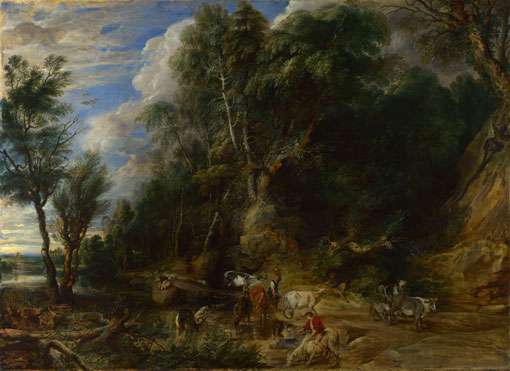
The Rainbow figures owe more to The Watering Place, 1622

Peter Paul Rubens: 'The Watering Place', 1622. Oil on Panel, The National Gallery, London

than they do to Het Steen. The Watering Place is on the opposite wall to het Steen, it is a far more finished painting than either of the two later works. Specimen pollarded willows, edged with dark glazes and trembling waves of Italianate leaves on Northern European tree trunks. Bruegel like rocks and tree formations, elevated viewpoint and the usual colour division to the composition. Genre figures including peasant with brass pitcher on head and shepherd playing flute under the tree (lots of references to Virgil: Tityrus lying under a spreading beech wooing the muse on a slender reed etc) None of that obviousness in Steen, which is an ostensibly contemporary scene in which the season is established as much through light and colour as through content. Autumn, ie harvest time, is established by content and activity rather than through depiction and observation.

It is toward the end of the day in the National Gallery. Sino-Italian day by the look of it: elegant; elderly; attenuated Italian couples and younger, plumper Chinese family groups. The elderly Italian man next to me on the bench, in light brown wool jacket, grey trousers, slip on brown leather shoes, light smell of woody eau de toilette, has been asleep on the corner seat of the bench the whole time I have been here. The colour of his jacket almost exactly matches the bottom right glazing over the underpainting of Het Steen. A woman, in folds of fine grey wool, with tumbling hair full of gold highlights and gold necklaces, re-appears to wake him up; lots of whispered Italian. Is gold an autumnal colour?

Peter Paul Rubens: 'A View of Het Steen in the Early Morning', 1636. Oil on Oak. Oil on oak.131 x 229.cm. National Gallery, London

Perhaps, because autumn is really starting to get going outside, the autumnal colours of the foreground seem particularly strong. The browns, in fact a translucent wash (looking a bit like a Sienna, though probably an umber with a touch of yellow) over thicker white underpaint with sludgier greens and umbers mixed on to the underpainting. This site, along with the National Gallery site itself, is helpful

Painting materials of Peter Paul Rubens: http://www.lalaragimov.com/research

Norman Bryson in ‘Vision and Painting’ (Macmillan, London 1983) talks at some length about the triangulation between the artist’s viewpoint, the viewers’ and the vanishing point. Stressing the importance of what happens, or is presumed to happen, this side of the picture plane. It is difficult to be both the artist and the artist as viewer but, we know that this painting was made for his own pleasure, possibly to display his own success to the powerful, but for Rubens’ pleasure nonetheless. I.e. an autumn scene for a man in his own September days, fact closer to November as he died four years later. Is it therefore too fanciful to make associations between the rumpled, creased, worn ground plane as it moves from the cart at bottom left to the rising sun top right and skin. Steen is after all, flanked in the National Gallery by two versions of the Judgement of Paris, young female skin by the yard.

Next to me on the bench in front of these three paintings a youngish art student in a flowery red summer dress is making a tonal study of the earlier Judgement (on the left from 1597-9)

Peter Paul Rubens: 'The Judgement of Paris', 1597-9. Oil on Panel. The National Gallery, London

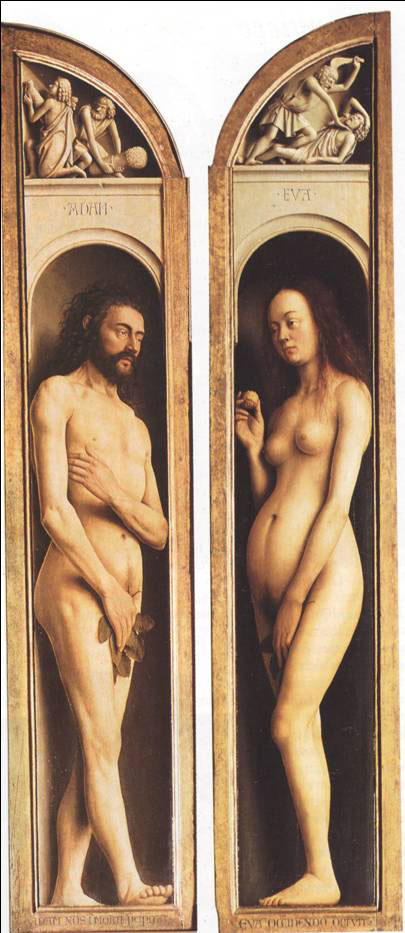
The central nude (Athena) appears in the drawn copy to have clear bikini marks, whereas Rubens’ goddesses of course are immortal and have no marks of the sun at all. While for example, the clearly human Adam in the van Eyck brothers Ghent altarpiece has worked in the fields and his burnt head and arms are testament to his lowliness.

The van Eycks: 'The Ghent Altarpiece, detail'. 1432 tempera and oil on panel

Sun tan as a desirable attribute doesn’t start till the early Twentieth Century.

So, skin, the action on Steen takes place on a surface light by raking light, the more one looks at it, again perhaps the triangulation of viewer’s viewpoint, the more this looks the skin of an old man, no longer taut, odd risings of hair in the folds.

That grouping of oak and silver birch in the foreground, they really do look like the subsequent tree paintings of artists like Ruisdael, Hobbema and Constable, a line you can trace back to Pieter Bruegel the Elder and back further to woodcuts from Titian. The tops of the trees, billowing forms are tinged with pink as are the grey clouds in the top left and fronted with thick creamy white. A similar palette to that around Discord in the storm clouds in the other Judgement of Paris to our right, the later one: 1632-5.

Peter Paul Rubens: 'The Judgement of Paris', 1632-5. Oil on Panel. National Gallery, London

Huge billowing shapes, dramatic lighting, powerful form, this upper right section of Steen is slightly different to the climactic conditions and tree-scape across the autumnal, linear composition below. Rubens is gussying up the scene a bit, he can’t help it, all those years of grand istorias for the powerful; it has become a habit. The isolated intense focus on others areas, the abrupt changes in scale, show an artist working on bits that interest him, no need to harmonise the composition.

Today seems to be young and old day in the National Gallery, huge fleets of little children, all pigtails and holding hands are ushered through with much shushing and repeated directions. Amongst the excited little beings are the old, with sticks and grey jackets and  audio guides and armfuls of gallery pamphlets; fretful that they are in front of the wrong painting as they press buttons 9, 4 and 3. I am suddenly surrounded by an unnumbered horde of small, very small children all with their ‘Kerbcraft Walking Bus’ fluorescent tabards, their joy is overwhelming, their need to sit on the bench equally so; time to go. 

Peter Paul Rubens: 'A View of Het Steen in the Early Morning', 1636. Oil on Oak. Oil on oak.131 x 229.cm. National Gallery, London

Thinking further about those clouds and the trees in the foreground, their derivation and their future effect (although this was less in the Netherlands, the major influence would be on artists like Constable,Het Steen was owned by Sir George Beaumont, Constable’s patron). I have been reading the catalogue for a National Gallery Exhibition on ‘Dutch Landscape, the Early Years, Haarlem and Amsterdam 1590-1650’ published in 1986, National Gallery Publications, London. A show which centred on the development of work directly from nature; a process that characterises Dutch landscape drawings, prints and paintings in the seventeenth century.

Rubens was though, a Flemish artist, Italianate, learned, and devoted to istoria. The growing 16th century Dutch landscape tradition, developing around Haarlem, based itself on nature/ observation, the ‘extensive landscape’ a correlation between marine and landscape painting particular to the newly reclaimed Dutch landscape. These artists, inspired by the marine painters like the splendidly named Vroom, closely observed wind, cloud types and the effects of light. Unlike the Flemish:

“These [Rubens’] clouds are an arbitrary backdrop and are scarcely recognisable in meteorological terms” J E Thomas, Geographical Magazine 51.7 April 1979, quoted in ‘Dutch Landscape’ page 79.

“the marine painters observations of the sky ensured that in Dutch Landscapes and marine paintings sunlight always falls from the same direction [as the wind], Rubens’ ‘artistic licence’ in showing shadows falling from opposite directions in the same landscape would have been unthinkable for a contemporary Dutch artist’

In fact the light and shadows fall in Steen is reasonably consistent from top right to bottom left. There is no strong wind but a gentle East to West breeze, following the line of the clouds would seem believable. The painting that Russell is referring to in this second reference is the ‘Return from the Harvest’ in the Galleria Pitti, in which the shadows cast the peasants in the foreground run at right angles to the source of light.

By the way, can I recommend the Hay in Art Website www.hayinart.com which does exactly what it says, in great detail; indispensable.

This double light is not down to incompetence, or lack of knowledge, it is the traditional role of the artist to transcend the natural.

“It is by this that Rubens proves himself great and shows to the world that he, with a free spirit stands above Nature and treats her to his higher purposes” Goethe, conversation with Eckermann, in discussion over Return from the Harvest where Goethe uses the double light as an illustration of Rubens’ greatness, rather than Russell’s approach which tries to indicate Rubens’ indifference at best.

To point out where Rubens/ Flemish landscape and the emerging Dutch tradition meet, it would be worth mentioning Carel van Mander. van Mander’s treatise on painting, (Het Schilderboeck) published in the Netherlands in 1606, and went into great detail about art, artists and translated Ovid’s Metamorphoses. Chapter 8 was exclusively on landscape, parts of it seem relevant to Het Steen, for example:

“4: note, first of all, how over there the bride of old Tithonus rises from her saffron bed to announce the approach of the torch of day, and see how the four piebald horses soaked with water, rise panting from the shallows of the Ocean. See how the little purple clouds become tinged with pinkish red and how beautifully Eurus’ bright home is adorned ready receive Phoebus…see there in front of us, hunters are walking with their dogs through the green dewy fields: see how that trodden dew turns a lighter tone of green, showing their footprints, and so giving their route home. (Let the landscape recede smoothly into the distance, or let it gradually merge into the sky)”

From ‘Dutch Landscape, the Early Years, Haarlem and Amsterdam 1590-1650’ published in 1986, National Gallery Publications, London page 36.

There is a distinct similarity between these stock figures from classical myth and the role of the genre figures that people Steen’s foreground, certainly the horse/ cart drawing of the sun across the sky motif. A coincidence? A wry reworking of classical themes? Probably, these references were, after all, part of the trade of any literate 17th century artist across Europe. Had Rubens read van Mander? What is more relevant perhaps, is that these references had nothing to do with the new Dutch landscape style that was appearing, on his doorstep as it where, some 100 miles away from Het Steen.

It would be tempting to say that old man was learning new radicalism, by working directly from nature for example. Certainly this is a recognisable landscape, but, all the marks of composition, of his higher purpose, of studio bound painting, are here. Het Steen is framed, by the group of trees that also frame the house. The hunter, fallen tree arrangement makes the traditional the diagonal, foreground repoussoir element, characteristic of Flemish landscape painting.

“First of all it is important to show clear contrast in the foreground, as it pushes the other planes into the background. Ensure something large is painted in the foreground as was done by Bruegel and other great artists who are acclaimed for their contribution to landscape painting. Since they often place enormous tree-trunks in the foreground let us enthusiastically strive to follow their example.”

van Mander quoted in From ‘Dutch Landscape, the Early Years, Haarlem and Amsterdam 1590-1650’ published in 1986, National Gallery Publications, London page 38.

The Steen pictorial space is divided up into the traditional brown foreground, green mid and blue background. Yes, there is evidence of farming, of quotidian purpose that you can see in drawings especially by artists like Coninxloo. Rubens’ painting contains the field boundaries, the milkmaid etc. But, the centrality of the hunter makes it clear; this is a landscape for recreation. And, lastly there is the high view, the recognizable method for constructing the Antwerp landscape style that you can trace back to Patinir and the early sixteenth century.

So, back to the trees.

Van Mander wrote that the changes in the representation of trees in art in the Netherlands, was down to Coninxloo, because of him Netherlandish trees in art became leafier. Coninxloo  was an artist who specialised in dense forest landscapes, a subject and style that according to Christopher Brown in the Dutch Landscape Introduction, (‘Dutch Landscape, the Early Years, Haarlem and Amsterdam 1590-1650’ published in 1986, National Gallery Publications, London page 17) you can trace back to Pieter Bruegel the elder, and his son Jan Brueghel the Elder. Pieter had in his turn taken his inspiration from woodcuts after Titian, Campagnola and Muziano, i.e. from art, from higher purpose, not from life. 

Rubens’ little group of tall foreground trees, growing at angles, overlapping one another, with recognisably different foliage, and the foreground tree stump; this compositional form is pure Flemish landscape tradition. A tradition that Rubens had already conquered on his return to Antwerp from Italy, in his groups of landscape painted 1614-25. Paintings that seem to celebrate lushness, fertility and his identification with his native country. A return to prosperity after war. In the horribly complex history of the Netherlands, this was a period of powerful Counter Reformation, lots of work for a Catholic history painter newly returned from Italy, e.g. the Raising of the Cross for Antwerp Cathedral, 1610-11.

The landscape painting that makes all this clear is ‘Milkmaids with Cattle in a Landscape: ‘The Farm at Lacken’, 1618, oil on Panel, The Royal Collection.
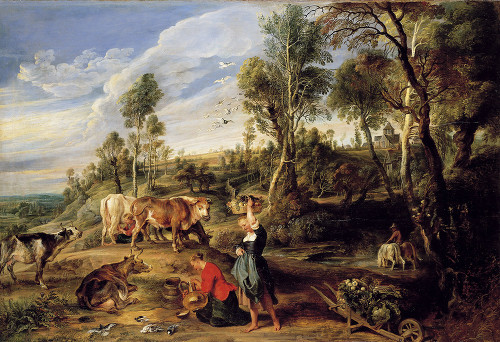
Rubens: 'Milkmaids with Cattle in a Landscape: 'The Farm at Laeken', 1618. Oil on Panel, The Royal Collection, London

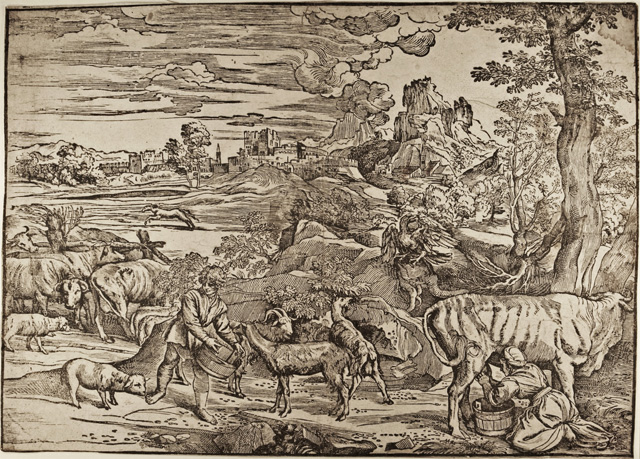
 Notice that there is some formal similarity between the arrangement of the right hand branches on the birch in the clump above the figure with the cornucopia of fruit and veg on her head and the right hand birch in the Steen foreground. To further emphasise our theme about the derivation of, and intentions behind these compositions, Christopher Brown in ‘Making and Meaning: Rubens Landscapes’, points out that this composition loosely owes something to a Titian woodcut (Landscape with a Milkmaid 1525).
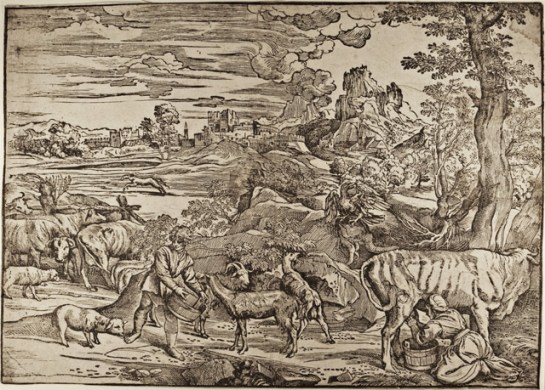
Boldrini (after Titian) Landscape with a Milkmaid 1525. woodcut, British Museum

And, he goes deeper to show that the church, just visible top right, was a key centre of Marian worship and nationalist associations. In other words there are strong connections between this painting of prosperity and peace, the power of the Catholic Church and the Archdukes Albert and Isabella, Rubens was their court artist. Do we find our trees in Het Steen pointing us in any of these directions? No, the context is different. There is of course the same brass jug, here for containing milk, in ‘the Watering Place’ of 1620 for, presumably, water and in ‘Landscape with a Rainbow’ (generally assumed to be the companion piece to Het Steen) where it is also on a head, either water or milk. A Rubensian shape for indicating plenty/ fecundity/ prosperity, i.e. peace?

Peter Paul Rubens: 'A View of Het Steen in the Early Morning', 1636. Oil on Oak. Oil on oak.131 x 229.cm. National Gallery, London

http://www.nationalgallery.org.uk/paintings/peter-paul-rubens-a-view-of-het-steen-in-the-early-morning
Het Steen

At the National Gallery for a brief moment.

Looking at this painting very closely, what intrigues is the evident process; stages shown not hidden under seamless layers of glazes. Rubens laid in thick white last, probably Cremnitz White, ie Lead White ground with Walnut Oil rather than Linseed Oil to stop yellowing with age. Lead Whites were extremely poisonous, traditionally used for underpaint, stiffer and drier than Flake White which has a bit of Zinc in it. Certainly these laid in areas are thicker and show the brush, possibly palette knife,  that laid on the impasto.
He then washed in a translucent glaze of a drab yellow around the trees in the grown out hedge going from the centre foreground off to the right for example. Or, a reddish brown on the overlaid impasto around the overgrown fruit tree centre foreground. The function of these rough, lighter areas is to provide depth and background behind brambles and trees, to foreground them.
What is odd, is the inaccuracy of this foregrounding, it is not characteristic bravura and Rubensian vigour. These are great horizontal streaks that go right over very carefully painted passages; roughly delineating the oversized fowl for example. That central tree is painted in detail and  with enormous care, it is probably taken from, what looks an en plein air, drawing made in 1616 of a Wild Cherry Tree with Brambles and Weeds

Rubens: 'Study of Wild Cherry Tree with Brambles and Weeds', Courtauld Galleries, London

 The Courtauld Institute, London, although they call it ‘a Study of Blackthorn with Bramble and other Plants’, unlike Christopher Brown in the National Gallery’s ‘Making and Meaning Ruben’s Landscapes’ who goes for the Cherry Tree appellation).
It is as though Rubens had given the task of foregrounding this tree to an untrained, but enthusiastic child. It reminds me of my own attempts, when very young, to help my father with one of his own paintings. My thick muddy brushstrokes lapped around his careful shapes; the leg of a dog against a white background. This painting hung as a personal reproach on a wall in our house for most of my childhood.
When you look closely, the whole of Het Steen is marked by unevenness, small thick autonomous impasto on the left, the windows, the horses tack. Or, beautifully painted thistles amongst rough brown splashes. Or, extreme differences of scale; the vast fowl and cows as big as trees – why?
It is Friday evening, late opening. An elderly couple, white, very English, rather proper in beige linen are very asleep on the bench in front of Het Steen. Next to them a large Asian family are really enjoying a worksheet on the painting: how many cows; can you spot the man fishing; what is on the cart? Dad engages with great vigour, then sneaks in a quick phone call whilst the attendant is not looking. Troops of Russians march past, it is too late in the day for the huge coach parties of unattended European schoolchildren.