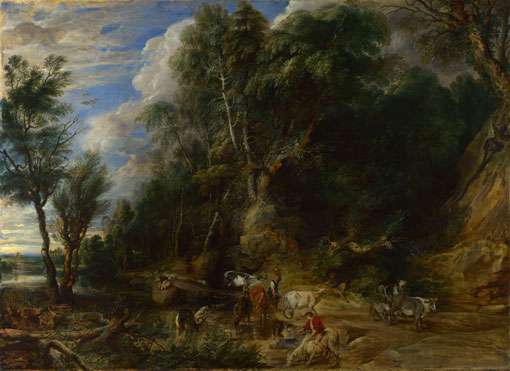
Peter Paul Rubens: 'A View of Het Steen in the Early Morning', 1636. Oil on Oak. Oil on oak.131 x 229.cm. National Gallery, London

Is this a moral landscape? I have been reading ‘Gainsborough’s Vision’ by Amal Asfour and Paul Williamson (Liverpool University Press, 1999) in which the authors describe the role of the emblem in Gainsborough’s landscapes. Emblems were moral tales told through images, always accompanied by a descriptive text. An important Dutch form, travelling to Gainsborough through the Calvinist/ nonconformist tradition. A key early source was Otto van Veen: ‘Amorum Emblemata’ (1608) and the ‘Amoris Divini Emblemata’ (1615)
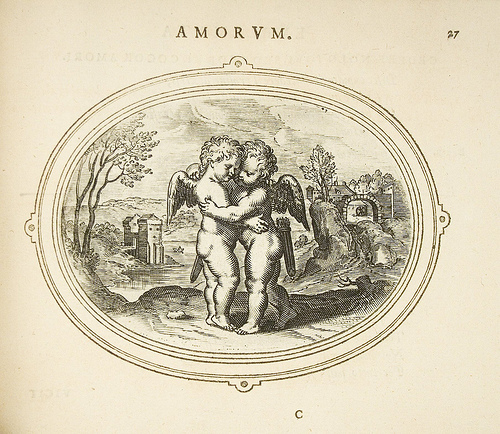
Otto van Veen: 'Amoris Finis Est' Amorum Emblemata 1608

“Van Veen is faithful to what can be termed a northern style of imagery – a detailed and naturalistic rendition of landscape settings. He presents a moral dilemma in a more or less realistic, rather than as an idealistic, single quality”  

(Gainsborough’s Vision page 82)

Rubens was apprenticed to Van Veen, and would have absorbed the tradition. Despite the different scale, materials and function, in Het Steen we have some of the possible elements of an emblem: the cart; the hunter; the house and the elegant bystanders. But:

1/ we don’t have any improving text

2/ Calvinist/ Christian images of agriculture tend to refer to husbanding the land as post Fall/ post Edenic toil:

‘In the sweat of thy face shalt thou eat bread, till thou return unto the ground; for out of it wast thou taken: for dust thou art, and unto dust shalt thou return.”

Often shown through the image of a thistle:

‘Cursed is the ground for thy sake; in sorrow shalt thou eat of it all the days of thy life. Thorns also and thistles shall it bring forth to thee; and thou shalt eat the herb of the field’

There are no thistles, some brambles of a fairly beneficent kind, they act as a cover to the hunter, but no obvious thistles. More importantly there is no ploughing, no evidence of turning the cursed ground, not a ploughed field in sight; it is pasture as far as the eye can see. The only work seems to be the bucolic acts of milking/ hunting and riding a cart. There are no crops, apart from milk and the wild fruit on the tree.

The hunter: in 17th century emblems, the hunter tends to be a reference to Cupid, eg Philip Ayres: Emblemata Amatoria, and ‘The Hunter Caught by his Own Game’, Actaeon changed into a Stag, that sort of thing.
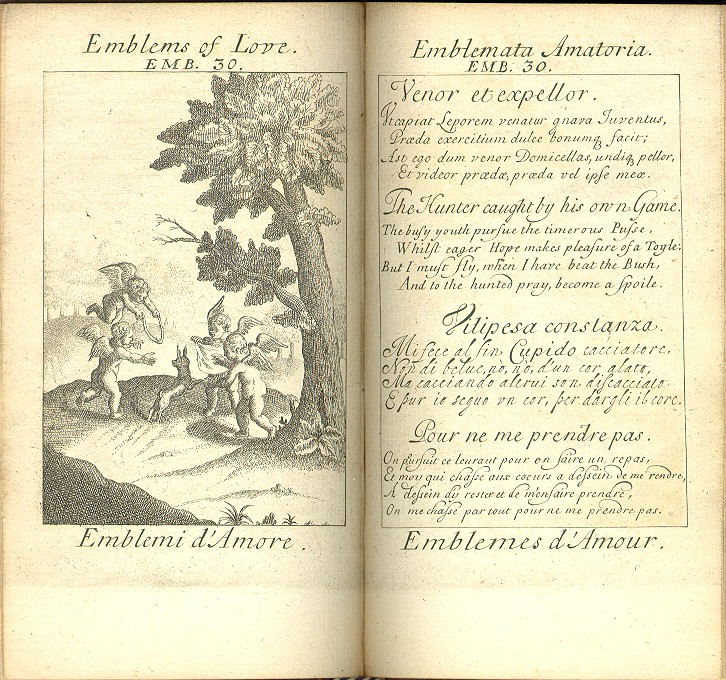
Philip Ayres: 'The Hunter Caught by his own Game', Emblemata Amatoria, 1683

Frankly, most of the emblems tend to refer to getting love/ sex wrong, the same use that Gainsborough makes of them as well. Nor is Rubens’ man a metaphorical hunter searching for some other form of meaning. The deer on the cart would lead us to think about stag hunting, the pursuit of the aristocracy. Apparently Rubens did not hunt himself, and problems with arthritis and gout during the five or so years that lived at Het Steen would have limited his mobility.

Can we construct a moral tale out of these elements? Not, I would suggest without some heavy guidance from the composition and the authorial voice, Rubens was after all on the wrong side of the Catholic/ Calvinist divide. Despite early work with van Veen, the Counter Reformation/ Classical tradition is likely to be his source; Virgil’s Georgics, not Genesis. You can, as Asfour and Williamson do, plausibly connect Gainsborough landscapes to morally improving tales, can’t quite make that connection here.

Thomas Gainsborough: 'Landscape with a Woodcutter Courting a Milkmaid', 1755 (Tavistock Estates)

Next to me on the bench, a father and his daughter, she is 6 or 7 maybe, are going through a worksheet on the painting. They carefully read the question together, she skips to the image and points out the number of birds, people, where the sun rises or whatever. She is entirely dressed in shades of pink, with a diamante necklace and those trainers that light up when you walk. They stay looking at the painting, counting off the questions for a very long time, completely absorbed. Longer even than the Chinese tour groups in front of the right hand ‘Judgement of Paris’; today they are mostly dressed in lightweight tweed.

We could advance the theory that, at the end of his life, Rubens is celebrating God’s creativity with his own. But there is no obvious evidence of Christian agency here, no attributes or idealism of the humanist inspired Roman Catholic for example. No old bearded man in a bed sheet appears to bless us all, no youthful Apollonian sun-god races across the sky either. This, then, is all materialism: I own; I observe; I deserve, because I am worth it (which of course Rubens was).

A kinesthetic learner, the term we have been taught to use, is being urged by his mother to complete the Het Steen worksheet. The small boy, Dutch at a guess, is whirling his arms around his head, sucking the toggles of his fleece, jumping from foot to foot, trying to pull his mother’s pony tail, pointing at the ducks in the sky and shouting; all at once. To my right, the whining conversation between the two guards has become much louder. The man on the bench behind me is starting to snore and another, very large Chinese tour group is bearing down on the naked threesome to judge them for themselves; time to go.

Leonardo da Vinci: ‘Mona Lisa’, 1503 -19

I once heard Martin Kemp, the great Leonardo specialist, talk about the geology in background of the Mona Lisa. Apart from surprise at the blackness of the distinguished professors hair, I remember him saying that the artist had been hired to survey the land between Florence and Pisa, to give Florentines a navigable waterway to the sea bypassing their rivals. That survey work, and Leonardo’s analysis of the role of water in changing topography, allowed him to think of time in different ways, to move away from the prescriptive Christian chronology; geological time for example. His proposed route was to go through Prato and Pistoia, although the land behind Leonardo’s portrait of Lisa Gherardini is not an exact portrait of the lakes above the great valley of the Arno, it bears similarities. It allows Leonardo to use the landscape to meditate on the role of time, as well as present the site for a pre combustion engine form of transport, that is now incidentally the route for the A11 from Florence to Pisa.

What transport routes are we looking at in Het Steen?

Peter Paul Rubens: 'A View of Het Steen in the Early Morning', 1636. Oil on Oak. Oil on oak.131 x 229.cm. National Gallery, London

What geology? What time span? Apart from the obvious track leading the horses and cart out to our left, what other forms are here and what do they tell us about Rubens’ thinking? There are tracks in the centre midground, serpentine, leading toward the horizon, lighter in colour than the green and possibly slightly frosted grass that surrounds them. Several tracks seem to come together here, to lead in to the space towards Malines (the town on the horizon). They are not large roads, nor direct.

This is presumably an alluvial plain, laid down over millennia by slow moving rivers, they are not the fast moving lakes of built up water, about to burst their banks and cause tumultuous change as represented by Leonardo. Het Steen is placed in a land where not much changes, not of course true, this was a sector of Europe that had been constantly fought over, the Northern Netherlands were at war with Spain right up until 1648, and we are in the middle of the Thirty Years War. Land reclamation to the north and west was at its peak, new canals being dug constantly, agricultural practices were changing fast to keep pace with growing urbanisation.

Viewing it now, this great flat plain stretching to a low horizon, looks just made for a 21st century motorway system: 6 lanes; gantries; illuminated signs throughout the night; those huge, double European lorries. In fact it has the A1/E19 running from Brussels to Antwerp, which apparently has one of the widest central reservations in Europe (40 metres wide over 31 km since you ask)

The hunter in the foreground, the stock figure, he is trying to move to his right, to go around the tree trunk, through the thickest part of the brambles to shoot the oversized ducks behind. Surely, his quickest path would be to his left? Or so our elevated viewpoint would seem to indicate. It would be easier to shoot the ducks from the left hand side of the trunk, he could just hit them with his great long barrel in fact.

“It must be fairly late”

“In the day?”

“No, in the History of Art, you look at that Renaissance painting over there and the trees aren’t half as green”

“True”

“What’s the best way to get to our hotel anyway?”

The brown foreground of the painting ends at a very strong horizontal line, tilted down slightly to the left. One’s eye first notices it at the right where it is marked by a drainage ditch, the field boundary for the cow field with the milkmaid, although there are more cows in the field beyond as well. The pure sunshine continues across the midground, a line of sunlight ends just in front of the house. This lets Rubens spotlight the house, placing it on a boundary edge, the left corner of sunlight exactly touches the left hand end of the mansion.

The later Judgement of Paris to my right is a constant draw for Chinese visitors, in huge numbers. They stand today in Burberry scarves, usually their leader has one of those microphone affairs, they never stay long, they have an itinerary to follow.

I’m intrigued to know where the rustic wooden bridge would lead anyone to. If it is for the milkmaid approaching the cows in the next field but one, then two questions occur:

  1. Would the bridge bear her weight and that of the milk she will carry? Presumably in another of the brass jugs like that on the cart, and the same balanced on the head of the girl in Landscape with a Rainbow, the companion piece to this (see previous post). If you look closely at the smudges of paint, the milmaid would appear to have something on her back with a highlight, a jug strapped there? The bridge is flimsy with only one handrail, in a list of ‘Bridges in Art’ (Hiroshige, copied by van Gogh; Monet; Sisley; Constable; Turner; Stella; there is of course a bridge in Mona Lisa, on the right, just where her clothing swirls across her bare shoulder; that poem by McGonagall, the Tay Bridge Disaster etc. Any more? I refuse to sing Bridge over Troubled Water in the National Gallery) in that list, this little wooden span is not the most convincing.
  2. The milkmaid would have to cross another bridgeless ditch to get from her cows to this one, is that right? Then she would have a long walk round the wrong way to the house. That route would take her to the front and the drawbridge as well. Would servants go in that way? Was the drawbridge the only way over the moat around Het Steen? Perhaps there was a loading place for milk and the cart, by the tall foreground trees? Evidence of growing rural industry?

The last time I was here, someone was drawing the earlier Judgement of Paris in pencil. Today, an elderly man, quite scruffy in a grubby brown jacket, trainers, battered grey rucksack old jeans is drawing Minerva from the same painting. She is the figure with her back to us, with armour at her feet. It is a copy with a high degree of accuracy, and he is making it on an Ipad. Minerva, in the digital drawing, is completely isolated on a pale blue grey background. The digital drawing has a definite sense of texture from the ‘tooth’ of a virtual surface, Ingres paper is the name of the physical paper with equivalent qualities.

I see all this as I leave, finding my own path past the Turners and Constables, all that power and paint as thick as the painted skeins of cloth on Lisa Gheradini; seized moments of meteorological time.


To the Wallace Collection to see Rubens’ Landscape with a Rainbow’ , 1636.

Peter Paul Rubens: 'Landscape with a Rainbow', 1636. Oil on Panel. The Wallace Collection, London

the companion to Het Steen. It is much less finished, look at the way the yellow blocking between the legs of the cart horses on the left has entirely covered the second horse, it has not been corrected; Rubens never got round to it. Underpainting and drawing clearly showing through.

Strong diagonal from middle right across the ground plane towards the centre. A surprisingly incoherent composition, not quite clear where the central pond begins or ends. It is in the centre of the painting, but is just a vague hole.

Very little accuracy in the trees, oak like, but without the precision of the birches and the oak in the Steen foreground. In the left mid-ground of Rainbow there is a vaguely birch like copse, some clarity in the background recession.

Carefully painted cattle and ducks, brown foreground, green mid, blue background seen from a slightly elevated viewpoint but not as high as Steen. Without the house we have less of the arrogance,, or showing off, that characterises Steen. Rainbow is far more of a genre painting about countryside activities i.e. Haymaking, bringing in the cattle, no doubt killing the ducks; activities in the Brabant. The ground plane rises relatively steeply from below our feet to a midpoint at the grown out hedgerow.

Is the rainbow a sign of the covenant, God will not break his promise? A sign of peace (relevant of course to Rubens own position), look at the way our eye is drawn from the dark right towards the brighter left. Is the rainbow a symbolic form in common with the genre figures?

In the National Gallery in front of Het Steen

Peter Paul Rubens: 'A View of Het Steen in the Early Morning', 1636. Oil on Oak. Oil on oak.131 x 229.cm. National Gallery, London

There is perhaps a compositional similarity between Steen and Rainbow, in that both have a dark diagonally composed foreground element in roughly the same place; a standard Flemish landscape component after all. The Rainbow haystack corresponds approximately with the position of the house, but only just; positions of plenty?

Looking again at the Steen foreground clump of trees, might that dominant tree on the left be a pine rather than an oak? Native pine has lower branches that come out at a 45 degree angle, in oaks they tend to be higher up and at 90 degrees to the trunk. But, it can’t be, the leaves are bulging groups of flora, not short dark needles at all.

The Rainbow figures owe more to The Watering Place, 1622

Peter Paul Rubens: 'The Watering Place', 1622. Oil on Panel, The National Gallery, London

than they do to Het Steen. The Watering Place is on the opposite wall to het Steen, it is a far more finished painting than either of the two later works. Specimen pollarded willows, edged with dark glazes and trembling waves of Italianate leaves on Northern European tree trunks. Bruegel like rocks and tree formations, elevated viewpoint and the usual colour division to the composition. Genre figures including peasant with brass pitcher on head and shepherd playing flute under the tree (lots of references to Virgil: Tityrus lying under a spreading beech wooing the muse on a slender reed etc) None of that obviousness in Steen, which is an ostensibly contemporary scene in which the season is established as much through light and colour as through content. Autumn, ie harvest time, is established by content and activity rather than through depiction and observation.

It is toward the end of the day in the National Gallery. Sino-Italian day by the look of it: elegant; elderly; attenuated Italian couples and younger, plumper Chinese family groups. The elderly Italian man next to me on the bench, in light brown wool jacket, grey trousers, slip on brown leather shoes, light smell of woody eau de toilette, has been asleep on the corner seat of the bench the whole time I have been here. The colour of his jacket almost exactly matches the bottom right glazing over the underpainting of Het Steen. A woman, in folds of fine grey wool, with tumbling hair full of gold highlights and gold necklaces, re-appears to wake him up; lots of whispered Italian. Is gold an autumnal colour?

http://www.tate.org.uk/modern/exhibitions/gerhardrichter/default.shtm

There was something flat about this exhibition, why were the slightly separate exhibition of large squeegee paintings (the ‘Cage’) the most engaging works on show?

If, you decide early on that your model, your source material, will be photographs then you will be, of necessity, negotiating a narrow band of pictorial space. Noticeably, in this very large show full of some very large work, once young Gerhard had sorted out his methodology: the black and white photo; the brushed across technique; the careful grisaille in oil paint, it doesn’t change much. True there are colour works, some fully modulated, but the palette is often restricted; usually the red end of the spectrum. Nonetheless, I think we can say, after this big retrospective, that Richter’s focus is grey paintings made from flat, processed, monochromatic image. Note it’s not work about the processes of photography, unlike the Tacita Dean downstairs for example.

No matter how much he might play with it, the umbilical link between photo and manipulated image is always strong and unbroken. We see statements in paint, rather than development, no on-going narrative of the artist’s growth, none of the Romantic struggle that can make the weary viewer empathise with rooms of beautifully applied grisaille. That is why the ‘Cage’ paintings hold more interest; we can see Mr G responding to materials, each squeegee stroke depends on the paint layer below, how it adheres or how it pulls away. In these paintings, aesthetic or materials based decisions are made constantly, each one depending on the decisions made before; development, the narrative of the work and the artists’ relationship to it.

That development creates conceptual as well as narrative depth, ideas taking root in the layered surface, a form (very shallow I grant you) of pictorial depth. Whereas the photograph based work deliberately resists that form of entry, they are mirrors, literally so in one room, that reflect back your own shallowness. It is not that visual depth is denied, it wasn’t there in the first place. Is that flatness (a rather different form of flatness to the conceptually laden Greenbergian approach) therefore a suitable metaphor for approaching Richter’s work? Are we just looking at surface decoration? He vigorously refutes any meaningful depth to his Baader-Meinhoff paintings for example. Pursuing this further, in an interview with Nicholas Serota in Time Out Magazine Richter says:

“…art shows us how to see things that are constructive and good, and to be an active part of that.

NS: So it gives structure to the world?

GR: Yes, comfort, hope, so it makes sense to be a part of that”

Not far away from that other painter of the comforting decorative surface, Matisse and his armchair for tired businessmen. Can this really be the case? Do we just flatter our own reflections when we come to view Richter? Can Richter just be the new taupe? These were the questions I came away with, big retrospectives put artists work under severe scrutiny, Has Richter stood up to it?

Peter Paul Rubens: 'A View of Het Steen in the Early Morning', 1636. Oil on Oak. Oil on oak.131 x 229.cm. National Gallery, London

Perhaps, because autumn is really starting to get going outside, the autumnal colours of the foreground seem particularly strong. The browns, in fact a translucent wash (looking a bit like a Sienna, though probably an umber with a touch of yellow) over thicker white underpaint with sludgier greens and umbers mixed on to the underpainting. This site, along with the National Gallery site itself, is helpful

Painting materials of Peter Paul Rubens: http://www.lalaragimov.com/research

Norman Bryson in ‘Vision and Painting’ (Macmillan, London 1983) talks at some length about the triangulation between the artist’s viewpoint, the viewers’ and the vanishing point. Stressing the importance of what happens, or is presumed to happen, this side of the picture plane. It is difficult to be both the artist and the artist as viewer but, we know that this painting was made for his own pleasure, possibly to display his own success to the powerful, but for Rubens’ pleasure nonetheless. I.e. an autumn scene for a man in his own September days, fact closer to November as he died four years later. Is it therefore too fanciful to make associations between the rumpled, creased, worn ground plane as it moves from the cart at bottom left to the rising sun top right and skin. Steen is after all, flanked in the National Gallery by two versions of the Judgement of Paris, young female skin by the yard.

Next to me on the bench in front of these three paintings a youngish art student in a flowery red summer dress is making a tonal study of the earlier Judgement (on the left from 1597-9)

Peter Paul Rubens: 'The Judgement of Paris', 1597-9. Oil on Panel. The National Gallery, London

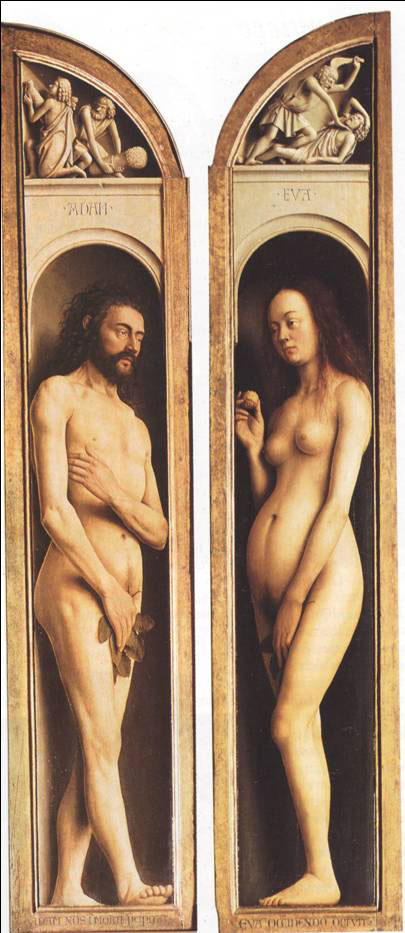
The central nude (Athena) appears in the drawn copy to have clear bikini marks, whereas Rubens’ goddesses of course are immortal and have no marks of the sun at all. While for example, the clearly human Adam in the van Eyck brothers Ghent altarpiece has worked in the fields and his burnt head and arms are testament to his lowliness.

The van Eycks: 'The Ghent Altarpiece, detail'. 1432 tempera and oil on panel

Sun tan as a desirable attribute doesn’t start till the early Twentieth Century.

So, skin, the action on Steen takes place on a surface light by raking light, the more one looks at it, again perhaps the triangulation of viewer’s viewpoint, the more this looks the skin of an old man, no longer taut, odd risings of hair in the folds.

That grouping of oak and silver birch in the foreground, they really do look like the subsequent tree paintings of artists like Ruisdael, Hobbema and Constable, a line you can trace back to Pieter Bruegel the Elder and back further to woodcuts from Titian. The tops of the trees, billowing forms are tinged with pink as are the grey clouds in the top left and fronted with thick creamy white. A similar palette to that around Discord in the storm clouds in the other Judgement of Paris to our right, the later one: 1632-5.

Peter Paul Rubens: 'The Judgement of Paris', 1632-5. Oil on Panel. National Gallery, London

Huge billowing shapes, dramatic lighting, powerful form, this upper right section of Steen is slightly different to the climactic conditions and tree-scape across the autumnal, linear composition below. Rubens is gussying up the scene a bit, he can’t help it, all those years of grand istorias for the powerful; it has become a habit. The isolated intense focus on others areas, the abrupt changes in scale, show an artist working on bits that interest him, no need to harmonise the composition.

Today seems to be young and old day in the National Gallery, huge fleets of little children, all pigtails and holding hands are ushered through with much shushing and repeated directions. Amongst the excited little beings are the old, with sticks and grey jackets and  audio guides and armfuls of gallery pamphlets; fretful that they are in front of the wrong painting as they press buttons 9, 4 and 3. I am suddenly surrounded by an unnumbered horde of small, very small children all with their ‘Kerbcraft Walking Bus’ fluorescent tabards, their joy is overwhelming, their need to sit on the bench equally so; time to go. 

Peter Paul Rubens: 'A View of Het Steen in the Early Morning', 1636. Oil on Oak. Oil on oak.131 x 229.cm. National Gallery, London

Thinking further about those clouds and the trees in the foreground, their derivation and their future effect (although this was less in the Netherlands, the major influence would be on artists like Constable,Het Steen was owned by Sir George Beaumont, Constable’s patron). I have been reading the catalogue for a National Gallery Exhibition on ‘Dutch Landscape, the Early Years, Haarlem and Amsterdam 1590-1650’ published in 1986, National Gallery Publications, London. A show which centred on the development of work directly from nature; a process that characterises Dutch landscape drawings, prints and paintings in the seventeenth century.

Rubens was though, a Flemish artist, Italianate, learned, and devoted to istoria. The growing 16th century Dutch landscape tradition, developing around Haarlem, based itself on nature/ observation, the ‘extensive landscape’ a correlation between marine and landscape painting particular to the newly reclaimed Dutch landscape. These artists, inspired by the marine painters like the splendidly named Vroom, closely observed wind, cloud types and the effects of light. Unlike the Flemish:

“These [Rubens’] clouds are an arbitrary backdrop and are scarcely recognisable in meteorological terms” J E Thomas, Geographical Magazine 51.7 April 1979, quoted in ‘Dutch Landscape’ page 79.

“the marine painters observations of the sky ensured that in Dutch Landscapes and marine paintings sunlight always falls from the same direction [as the wind], Rubens’ ‘artistic licence’ in showing shadows falling from opposite directions in the same landscape would have been unthinkable for a contemporary Dutch artist’

In fact the light and shadows fall in Steen is reasonably consistent from top right to bottom left. There is no strong wind but a gentle East to West breeze, following the line of the clouds would seem believable. The painting that Russell is referring to in this second reference is the ‘Return from the Harvest’ in the Galleria Pitti, in which the shadows cast the peasants in the foreground run at right angles to the source of light.

By the way, can I recommend the Hay in Art Website www.hayinart.com which does exactly what it says, in great detail; indispensable.

This double light is not down to incompetence, or lack of knowledge, it is the traditional role of the artist to transcend the natural.

“It is by this that Rubens proves himself great and shows to the world that he, with a free spirit stands above Nature and treats her to his higher purposes” Goethe, conversation with Eckermann, in discussion over Return from the Harvest where Goethe uses the double light as an illustration of Rubens’ greatness, rather than Russell’s approach which tries to indicate Rubens’ indifference at best.

To point out where Rubens/ Flemish landscape and the emerging Dutch tradition meet, it would be worth mentioning Carel van Mander. van Mander’s treatise on painting, (Het Schilderboeck) published in the Netherlands in 1606, and went into great detail about art, artists and translated Ovid’s Metamorphoses. Chapter 8 was exclusively on landscape, parts of it seem relevant to Het Steen, for example:

“4: note, first of all, how over there the bride of old Tithonus rises from her saffron bed to announce the approach of the torch of day, and see how the four piebald horses soaked with water, rise panting from the shallows of the Ocean. See how the little purple clouds become tinged with pinkish red and how beautifully Eurus’ bright home is adorned ready receive Phoebus…see there in front of us, hunters are walking with their dogs through the green dewy fields: see how that trodden dew turns a lighter tone of green, showing their footprints, and so giving their route home. (Let the landscape recede smoothly into the distance, or let it gradually merge into the sky)”

From ‘Dutch Landscape, the Early Years, Haarlem and Amsterdam 1590-1650’ published in 1986, National Gallery Publications, London page 36.

There is a distinct similarity between these stock figures from classical myth and the role of the genre figures that people Steen’s foreground, certainly the horse/ cart drawing of the sun across the sky motif. A coincidence? A wry reworking of classical themes? Probably, these references were, after all, part of the trade of any literate 17th century artist across Europe. Had Rubens read van Mander? What is more relevant perhaps, is that these references had nothing to do with the new Dutch landscape style that was appearing, on his doorstep as it where, some 100 miles away from Het Steen.

It would be tempting to say that old man was learning new radicalism, by working directly from nature for example. Certainly this is a recognisable landscape, but, all the marks of composition, of his higher purpose, of studio bound painting, are here. Het Steen is framed, by the group of trees that also frame the house. The hunter, fallen tree arrangement makes the traditional the diagonal, foreground repoussoir element, characteristic of Flemish landscape painting.

“First of all it is important to show clear contrast in the foreground, as it pushes the other planes into the background. Ensure something large is painted in the foreground as was done by Bruegel and other great artists who are acclaimed for their contribution to landscape painting. Since they often place enormous tree-trunks in the foreground let us enthusiastically strive to follow their example.”

van Mander quoted in From ‘Dutch Landscape, the Early Years, Haarlem and Amsterdam 1590-1650’ published in 1986, National Gallery Publications, London page 38.

The Steen pictorial space is divided up into the traditional brown foreground, green mid and blue background. Yes, there is evidence of farming, of quotidian purpose that you can see in drawings especially by artists like Coninxloo. Rubens’ painting contains the field boundaries, the milkmaid etc. But, the centrality of the hunter makes it clear; this is a landscape for recreation. And, lastly there is the high view, the recognizable method for constructing the Antwerp landscape style that you can trace back to Patinir and the early sixteenth century.

So, back to the trees.

Van Mander wrote that the changes in the representation of trees in art in the Netherlands, was down to Coninxloo, because of him Netherlandish trees in art became leafier. Coninxloo  was an artist who specialised in dense forest landscapes, a subject and style that according to Christopher Brown in the Dutch Landscape Introduction, (‘Dutch Landscape, the Early Years, Haarlem and Amsterdam 1590-1650’ published in 1986, National Gallery Publications, London page 17) you can trace back to Pieter Bruegel the elder, and his son Jan Brueghel the Elder. Pieter had in his turn taken his inspiration from woodcuts after Titian, Campagnola and Muziano, i.e. from art, from higher purpose, not from life. 

Rubens’ little group of tall foreground trees, growing at angles, overlapping one another, with recognisably different foliage, and the foreground tree stump; this compositional form is pure Flemish landscape tradition. A tradition that Rubens had already conquered on his return to Antwerp from Italy, in his groups of landscape painted 1614-25. Paintings that seem to celebrate lushness, fertility and his identification with his native country. A return to prosperity after war. In the horribly complex history of the Netherlands, this was a period of powerful Counter Reformation, lots of work for a Catholic history painter newly returned from Italy, e.g. the Raising of the Cross for Antwerp Cathedral, 1610-11.

The landscape painting that makes all this clear is ‘Milkmaids with Cattle in a Landscape: ‘The Farm at Lacken’, 1618, oil on Panel, The Royal Collection.

Rubens: 'Milkmaids with Cattle in a Landscape: 'The Farm at Laeken', 1618. Oil on Panel, The Royal Collection, London

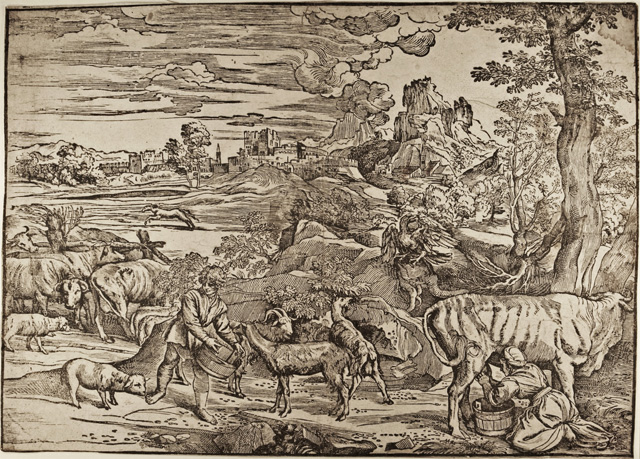
 Notice that there is some formal similarity between the arrangement of the right hand branches on the birch in the clump above the figure with the cornucopia of fruit and veg on her head and the right hand birch in the Steen foreground. To further emphasise our theme about the derivation of, and intentions behind these compositions, Christopher Brown in ‘Making and Meaning: Rubens Landscapes’, points out that this composition loosely owes something to a Titian woodcut (Landscape with a Milkmaid 1525).

Boldrini (after Titian) Landscape with a Milkmaid 1525. woodcut, British Museum

And, he goes deeper to show that the church, just visible top right, was a key centre of Marian worship and nationalist associations. In other words there are strong connections between this painting of prosperity and peace, the power of the Catholic Church and the Archdukes Albert and Isabella, Rubens was their court artist. Do we find our trees in Het Steen pointing us in any of these directions? No, the context is different. There is of course the same brass jug, here for containing milk, in ‘the Watering Place’ of 1620 for, presumably, water and in ‘Landscape with a Rainbow’ (generally assumed to be the companion piece to Het Steen) where it is also on a head, either water or milk. A Rubensian shape for indicating plenty/ fecundity/ prosperity, i.e. peace?

 I have spent some time on commuter trains in Southern England recently. Apart from hearing one side of many phone conversations

“Have you still got all your biscuits left?…I haven’t coughed for two weeks, I eat an onion every night that’s whats done it…Friday tomorrow, how good is that?’

it has prompted further thought about our physical relationship to the picture plane. There is a fine image by Ravillious of a carriage that illustrates what I mean.

Eric Ravilious: ‘Train Landscape’, 1939. Watercolour on Paper

 A watercolour view from the corner of a railway carriage; the very old type without corridors, with slam shut doors and a flat, vertical sliding window. A landscape is joined up behind the three frames of the train windows, in the left hand pane, the Westbury Horse, a chalk figure carved into the Sussex downs. In the other two windows the shapes made by the hedges echo the patterns of the seat upholstery. There are possibly 4 zones here, the three windows and the empty carriage itself. The central leather strap is the key to this painting, in these old trains this belt holds down and closes the window. Above each window pane, are blind pulls that can be pulled down to entirely block out the scene. These closed windows make a distance between the artist and the view, he is secluded in this carriage and can see ancient Britain in the left hand pane; from a mechanical form of transport he observes the old method, the horse. The other two windows show Britain then but the locked window keeps it out. What it also locks out is how much Britain was changing in the first half of the twentieth century; urbanisation for example. The heavy wooden surrounds of the train windows stress privacy and the past.

We live in a different world; the young woman opposite me is half way through a long story about how her duvet caught light when she was seven. “I didn’t smoke then, still don’t now” and how her mum didn’t believe she could smell smoke. The recipient of her call clearly doesn’t believe it either, the story takes much repetition to get the details right. I leave as she is going through the look on the neighbours face when her and mother pushed the burning bed clothes out of the bedroom window.

Eric R’s painting, made just after the start of the Second World War, apart from the combination of the past (the White Horse) and a slightly romantic view of the present (the fields and the Sussex Downs) doesn’t include the war. Should art always show what is happening at the time? if yes, how should this be done, if no what are the various functions of art that we can see happening in this painting?

“Hello…Yes…On the train…Did you say Queen Mary?…No, no, no, no… If it was the Queen Mary I would have done it…no, goodbye”

Ravilous was a wood engraver and made designs for Wedgewood Pottery, engraving and pottery designs demand a hard line and sharp edged shapes. You can see this in his approach to this image, for instance on the cross hatching on the door, an engraving method to indicate tone. But there is more to it, if you look into Eric R’s life a bit you will find that he married one of his students from Eastbourne college, where he taught wood engraving. Eileen Lucy Garwood, called Tirzah, Eric taught her wood engraving and she was exhibiting her work in London galleries within a year or two; they are interesting, witty images. Sadly, she seems to have stopped completely when they got married in 1930, meaningful in itself, but there is more. One of her engravings, is called, ‘The Train Journey’ it has some strong similarities to her husband’s later image, and differences, the occupants is the most obvious comparison. Tirzah’s engraving is detailed, about human relationships and their relationship to us. The girl turning to us is thought by Olive Cook to be Tirzah.

Tirzah Garwood: ‘The Train Journey’, Wood Engraving, 1929-30

See Olive Cook

http://www.weepingash.co.uk/index.php?option=com_content&view=article&id=208%3Athe-art-of-tirzah-garwood&catid=35%3Aes&Itemid=5&limitstart=2

And also Adventures in the Print Trade

http://adventuresintheprinttrade.blogspot.com/2010/02/whats-in-name.html


Eric Ravilious: 'Train Landscape', 1939. Watercolour on Paper

The seating now, cramps the viewer/ passenger into a right angle view, it is restricted by upright seats and reflections, the glass is angled and catches the light in ways that make seeing the landscape difficult.  The windows must lean in at about 3 or 4 degrees, double glazed, they could be designed to catch everything inside, the overhead lights, reflections of self; staring blankly. Which means that I can concentrate on making the grey plastic table really squeak and listen carefully to the woman opposite detailing her night out, up to the point where ‘we drunk another go of them drinks’.


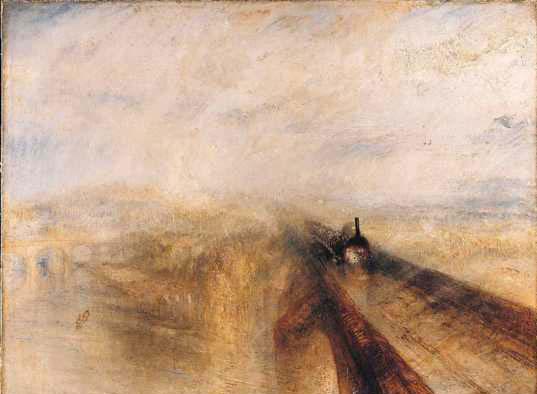
J.M.W.Turner: 'Rain, Steam and Speed, The Great Western Railway', 1844

Turner’s: ‘Rain, Steam, and Speed – The Great Western Railway’ might claim a place here, but the impulse is fundamentally different. In Turners world we are in and of the landscape, we are outside the carriage, we are a pure experiencing being. This was one of the first works of art about the artist’s direct experience of landscape. A strand that will come to dominate art about land from Turner onwards, modernity or not. Turner is supposed to have leant out of the carriage window with his sketchbook to draw the storm…

“As for the manner in which “The Speed” is done, of that the less said the better, only it is a positive fact there is a steam coach going at fifty miles an hour. The world has never seen anything like this picture”

From a Lady Simon:

“In the coach seated opposite her, was an elderly gentleman, short and stout, with a red face and a curious prominent nose. The weather was very wild, and by and by a violent storm swept over the country, blotting out the sunshine and the blue sky, and hanging like a pall over the landscape. The old gentleman seemed strangely excited at this, jumping up to open the window, craning his neck out and calling to her to come and observe a curious effect of light”

Notice the hare: speed. Notice the plough: from the old country dance “speed the plough”

It would be impossible to stick my head out of the window I am looking at.  Above is a narrow band of glass that can be tilted inwards for ventilation, thick and heavy square section better suited to a tank. Below is a broad glazed band, I’m intrigued to know why the bottom un-opening part of the window has a stick on shaded element surrounding it. Smaller black dots successively giving way to larger, then a black border. It has no obvious function as device for keeping out sunlight. Squashed into a two seat berth, parallel to the window, knees jammed against the seat in front. Turning the head through 90 degrees to look through the window squarely is uncomfortable. So, one looks at a 45 degree angle just where the upright reflection of the window seat in front bisects the view. I can just catch the reflection of the man opposite, working on his computer, balanced on the little table sticking into the six seat bay. His phone is balanced on the machine and his coffee is between his knees; a worrying placement.

Ravilious constructs his pictorial space so that we appear to be just off a central axis of symmetry, sitting on the near seat on the right. The window on the door shows a slight area of the jamb indicating the position of the viewer. But, the landscape looks, to me anyway as though we are exactly perpendicular to it, It is certainly planimetric, the downs on the horizon and the plough lines in the foreground, running parallel to the horizontal elements of the framing window.

On my morning train, a short man got on to our crowded carriage, wanting to sit in the middle seat of the six bay arrangement. He was carrying his neat black computer bag, a full length suit bag, a newspaper and a cup of coffee. His movements, as the train swayed through points and curves, were elegant, but he missed his intended seat, almost landing in the lap of several of the suited seated men. They neither looked at him, nor moved. It took some time; at last he sat and grinned happily. Throughout this choreography no one spoke or acknowledged his feat.

Eric Ravilious: 'Train Landscape', 1939. Watercolour on Paper

The painted landscape is entirely static, yet seen from a moving vehicle. Ravilious never learnt to drive, he bought a return ticket and shuttled between two stations to keep drawing the view. This would have been a steam train, note the lack of steam or suggestion of movement.

On my train this morning, the actual landscape behind my current picture plane is a combination of horizontal blur, darker towards the ground, yellow highlight at about eye level, sky above, and then clearer focus in the middle distance. The blur is not that unclear, this is a South Eastern train, they don’t go that quickly. Inside, the constant announcements are always preceded by the two tones, more reminiscent of 1970’s children’s programmes than, for example, Italian railway stations of that period: ‘binario uno’ and all.

‘Train Landscape’ was made at the start of 1940, the first year of the Second World War. Not long after Eric Ravillious made this painting, the chalk figures were covered up to prevent them being used to help enemy navigation. Ravilious became a war artist with the Royal Air Force and died during an air sea rescue in Iceland in 1942.

He painted several images of chalk figures besides the White Horse, The Long Man of Wilmington and the Cerne Abbas giant for example. The internal picture plane of Train Landscape shows simultaneous images from different time periods in the different areas of pictorial space. Ravilious divides time up like a cartoon strip, the theme of representing time past, time present and time future, featuring heavily in a heavily contested present.

Symbols of Englishness and defiance, or an evocation of the man-made in a natural setting? Almost on the railway line I use, but not quite, is another white horse. Mark Wallinger’s art commission to mark the Ebbsfleet International station in north Kent.

A giant sculpture of a white horse standing 50 metres high, but it’s not the rearing horse of Kent, this is a static figure.  According to Wallinger, Ebbsfleet marks the end of the horse-rearing downland country; this was where the Anglo Saxon heroes Hengist (Stallion) and Horsa (Horse) arrived to fight the Picts around 455 AD.

Wallinger: “I think at the back of my mind I had that Eric Ravilious painting Train Landscape (1940) looking out from a third-class railway carriage at a white horse on a distant hill.”

http://www.telegraph.co.uk/culture/art/4613060/Mark-Wallinger-the-inspiration-behind-my-horse.html

 The man behind has his head against the upright of my seat, he is breathing heavily, rustlings are coming from his paper bag. The woman next to me is busy on her laptop:

“Computer Purchases: QAAS Portsmouth: 1 x Labroud Refrigerator (DMG to quote on mapping for comparison with Labroud on commissioning) etc, etc. “

Sun low in the sky, shadows emphasising the flatness of the ground plane as it marches away from the train. The major commuter train from London on a Friday evening. It is, unusually, almost completely silent. A cough, a sniff, the turn of a page of the Metro or the Standard, but that is all; apart from the constant announcements and the rustling man.

Eric Ravilious: 'Train Landscape', 1939. Watercolour on Paper

Does sitting in the carriage now, have the same evocation, either of Englishness, or future collapse? Perhaps the increasing disintegration of capitalism and the re-introduction of feudalism, or so it feels reading the morning paper? Listening to the suited and booted man in front discussing his meeting schedule with someone, clearly his junior, merely makes me glad we are not in the old two bench dog carriage. The clue to the difference between painted image and life on the 7.16 am is in the relationship to the exterior. In the Ravillious we are parallel to the internal picture plane, in a semi private world. In the modern train we are not. Ravillious’ world perhaps owes a debt to earlier imagery.  In John Tenniel’s: ‘Alice on the Train’, From ‘Alice Through the Looking Glass’

John Tenniel: 'Alice on the Train' wood engraving, 1872

or Leopold Egg: ‘The Travelling Companions’, 1862 both of which use the same frontal format, parallel to the picture plane, symetricality etc.

Augustus Leopold Egg: 'The Travelling Companions',1862 Birmingham City Museums


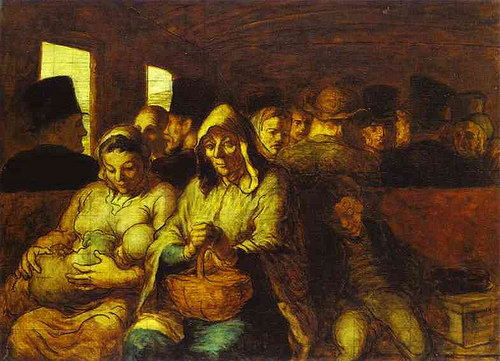
The carriage is now a public space, focussing down a tubular formthat enforces the single viewpoint perspective aspect, reinforces the notion that we meaningfully speed towards our destination. Unlike the steam era images that often stress the privacy of the first class carriage. Compare this with, for example, Daumier’s Third Class carriage, a density of rumpled lines and close tones, raw humanity.

Honore Daumier: 'The Third Class Carriage', 1863-65. Oil On canvas. Metropolitan, New York


Train Landscape is a third class carriage, you can tell this by the letter three on the door. But the number seems very big, it stands out. Earlier Cubists had used text to stress modernity, although this doesn’t look quite like that.