
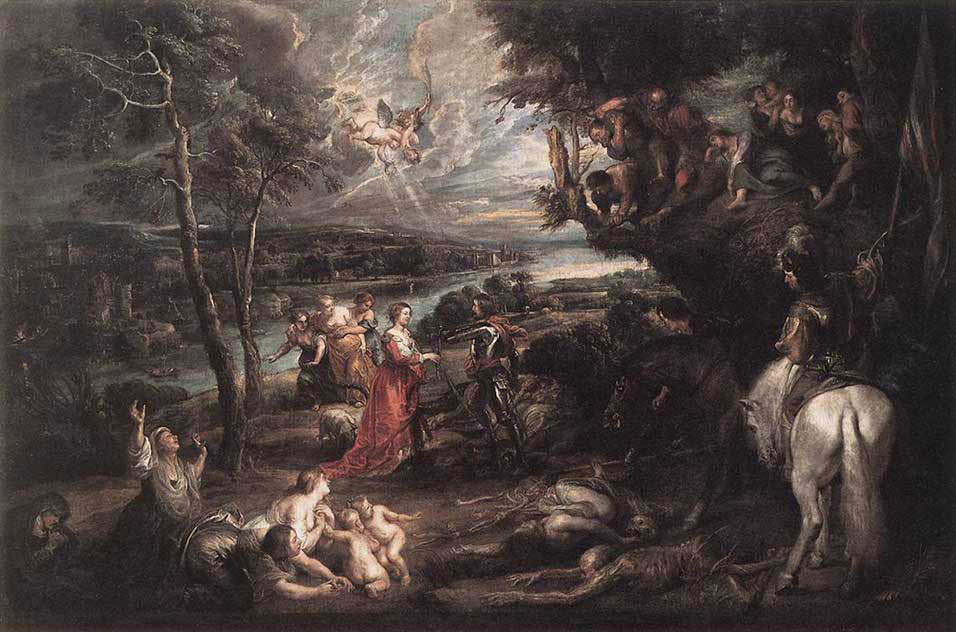
Peter Paul Rubens: 'A View of Het Steen in the Early Morning', 1636. Oil on Oak. Oil on oak.131 x 229.cm. National Gallery, London
“Shrines to me embody the essence of what I do. I put significant artefacts in a special place for us to contemplate upon…As humans I think how we look at art has developed from the way we look upon gods, altars and relics in shrines and sacred spaces”
Grayson Perry wall text from ‘The Tomb of the Unknown Craftsman’ British Museum.
My memory of Catholic worshippers in front of shrines, is that they (usually women) either make a quick bob, cross themselves and move on or, they kneel for a long time in silent contemplation, sometimes accompanied by quiet recitation. The characteristics of Room 29 of the National Gallery, London, in front of the Rubens ensemble (the two Judgements of Paris and Het Steen) are movement and discussion. Everyone is transit, pairs and groups stop, point and discuss key features. I suppose it depends on what our relationship with the gods might be – amused tolerance, or wariness perhaps
Cavafy wrote about that relationship:
One of Their Gods
When one of them moved through the marketplace of Selefkia
just as it was getting dark—
moved like a young man, tall, extremely handsome,
with the joy of being immortal in his eyes,
with his black and perfumed hair—
the people going by would gaze at him,
and one would ask the other if he knew him,
if he was a Greek from Syria, or a stranger.
But some who looked more carefully
would understand and step aside;
and as he disappeared under the arcades,
among the shadows and the evening lights,
going toward the quarter that lives
only at night, with orgies and debauchery,
with every kind of intoxication and desire,
they would wonder which of Them it could be,
and for what suspicious pleasure
he had come down into the streets of Selefkia
from the August Celestial Mansions.
Or, do we in the North still feel Judaeo Christian awe, respect and fear? Is perhaps this constant movement a form of penance, moving between the Stations of the Cross?
The Gallery is unusually quiet this afternoon, the visitors mostly elderly. Sometimes when I am here in front of this Rubens collection, it is the landscape that draws attention, today it is the two sets of nudes.
“I’ve got to have a sit down; it tires you out all this lot”
I suppose that, as an individual devotee in front of an icon, it’s visual representation is not important. St Cecilia is St Cecilia or St Luke is St Luke is St Luke. You need to check that you are standing in front of the right one, you make your obeisance and the job is done. Equivalently, you walk the rooms of the National Gallery, glance at the labels to check, genuflect and walk on.
The elderly couple on the bench next to me have been here for some time. He is asleep and she has been reading the index of a large London A to Z, with apparent interest, since she sat down. Every now and then, she will turn to a different section of the maps as though to check what she has read. She is wearing a bright red fleece with ‘Nike, Just Do It’ written on it. The winged, wreathed, youthful Greek goddess of victory spurs on this tired figure, draped in contemporary leisure wear, to greater feats of cartographic research as her companion, firmly in the drowsy hall of Somnus (from Ovid), slips further under the influence of Morpheus .
Cavafy wrote ‘One of Their Gods’ in 1917, thinking about that and the Greek Pantheon around me, leads to other responses to classicism. In ‘Quattro Centro’ way back in the 1930’s, Adrian Stokes (the art critic and painter) inspired by travels through Italy, made a distinction between carving and modelling. Art that has been ‘carved’ appears to work into the medium, (any medium, not just stone) to find new forms and imagery. As opposed to art that has been ‘modelled’, ie adding and moulding together that which is already known. Het Steen is clearly ‘modelled’; you can see how Rubens has worked his vast knowledge of pictorial space, of the hairy roundness of large vegetal forms, of the role, direction and intensity of light sources across a grand plane. A modelled space, his shaping hands have smoothed plastic forms with great sophistication and vigour.
Two identically tall, enormously rounded, wonderfully crumpled viewers appear in front of the later ‘Judgement’. The lighting is such, that the painting and wall are lit up like a theatre set, these two are in silhouette and seem to outdo Rubens’ nudes with the plump pear shapes of their lower halves. But, it is the exact line across the top of these viewers heads and the almost exactly similar shapes of those heads that is most striking.
Hypnos has released his hold on my companion, he wakes up
“Come along then dear, we can’t sit here all day enjoying ourselves”
People stand for a regulation amount of time in front of each painting, then briskly move on to the next. It reminds me of that early Twentieth Century diet fad called Fletcherism, (after Horace Fletcher, splendidly nicknamed ‘The Great Masticator’) when eaters had to chew each mouthful of food 32 times before swallowing; looking at paintings and 32 chews seem to share the same level of enjoyment.
Or, perhaps we should view Perrys’ description of significant artefacts from a more utilitarian, economic, even traditionally Marxist standpoint. I suspect that Perry, like me, believes that the primary significance of these objects should come from their manufacture by artists. Their value comes from the shaping eye and hand (carving or modelling) of the maker and a complex relationship with context. I suspect that for the majority of viewers in museum, the significance of these works, their value, is primarily monetary. In essence when visiting a museum we are worshipping objects that matter because they are worth something, quite a lot of financial something. We are genuflecting in front of capital, validated by culture no doubt, but ultimately this constant foot traffic moves between the Stations of Croesus, genuflecting in front of shrines to celebrity cults and the goddess Verisimilitude.
Two young boys with padded jackets shrugged down over their shoulders have started to recreate the dance from Thriller, worshipping a different sort of cultural icon, one of Them from the August Celestial Mansions; time to go.

 whitemarkarts