Archive

Landscape Art

To the Wallace Collection to see Rubens’ Landscape with a Rainbow’ , 1636.

Peter Paul Rubens: 'Landscape with a Rainbow', 1636. Oil on Panel. The Wallace Collection, London

the companion to Het Steen. It is much less finished, look at the way the yellow blocking between the legs of the cart horses on the left has entirely covered the second horse, it has not been corrected; Rubens never got round to it. Underpainting and drawing clearly showing through.

Strong diagonal from middle right across the ground plane towards the centre. A surprisingly incoherent composition, not quite clear where the central pond begins or ends. It is in the centre of the painting, but is just a vague hole.

Very little accuracy in the trees, oak like, but without the precision of the birches and the oak in the Steen foreground. In the left mid-ground of Rainbow there is a vaguely birch like copse, some clarity in the background recession.

Carefully painted cattle and ducks, brown foreground, green mid, blue background seen from a slightly elevated viewpoint but not as high as Steen. Without the house we have less of the arrogance,, or showing off, that characterises Steen. Rainbow is far more of a genre painting about countryside activities i.e. Haymaking, bringing in the cattle, no doubt killing the ducks; activities in the Brabant. The ground plane rises relatively steeply from below our feet to a midpoint at the grown out hedgerow.

Is the rainbow a sign of the covenant, God will not break his promise? A sign of peace (relevant of course to Rubens own position), look at the way our eye is drawn from the dark right towards the brighter left. Is the rainbow a symbolic form in common with the genre figures?

In the National Gallery in front of Het Steen

Peter Paul Rubens: 'A View of Het Steen in the Early Morning', 1636. Oil on Oak. Oil on oak.131 x 229.cm. National Gallery, London

There is perhaps a compositional similarity between Steen and Rainbow, in that both have a dark diagonally composed foreground element in roughly the same place; a standard Flemish landscape component after all. The Rainbow haystack corresponds approximately with the position of the house, but only just; positions of plenty?

Looking again at the Steen foreground clump of trees, might that dominant tree on the left be a pine rather than an oak? Native pine has lower branches that come out at a 45 degree angle, in oaks they tend to be higher up and at 90 degrees to the trunk. But, it can’t be, the leaves are bulging groups of flora, not short dark needles at all.

The Rainbow figures owe more to The Watering Place, 1622
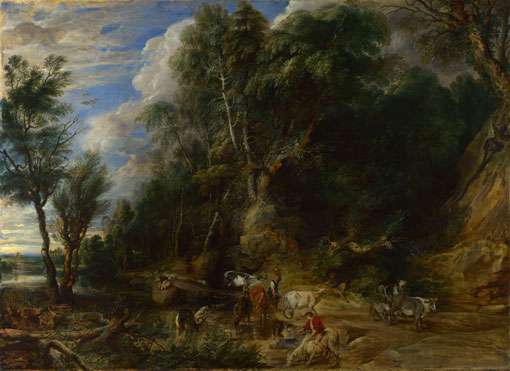
Peter Paul Rubens: 'The Watering Place', 1622. Oil on Panel, The National Gallery, London

than they do to Het Steen. The Watering Place is on the opposite wall to het Steen, it is a far more finished painting than either of the two later works. Specimen pollarded willows, edged with dark glazes and trembling waves of Italianate leaves on Northern European tree trunks. Bruegel like rocks and tree formations, elevated viewpoint and the usual colour division to the composition. Genre figures including peasant with brass pitcher on head and shepherd playing flute under the tree (lots of references to Virgil: Tityrus lying under a spreading beech wooing the muse on a slender reed etc) None of that obviousness in Steen, which is an ostensibly contemporary scene in which the season is established as much through light and colour as through content. Autumn, ie harvest time, is established by content and activity rather than through depiction and observation.

It is toward the end of the day in the National Gallery. Sino-Italian day by the look of it: elegant; elderly; attenuated Italian couples and younger, plumper Chinese family groups. The elderly Italian man next to me on the bench, in light brown wool jacket, grey trousers, slip on brown leather shoes, light smell of woody eau de toilette, has been asleep on the corner seat of the bench the whole time I have been here. The colour of his jacket almost exactly matches the bottom right glazing over the underpainting of Het Steen. A woman, in folds of fine grey wool, with tumbling hair full of gold highlights and gold necklaces, re-appears to wake him up; lots of whispered Italian. Is gold an autumnal colour?

A fully immersive art experience in every sense. It starts with online booking, then a woman in wellies and clipboard ticking off names, in front of a large rusted metal door in a carpark at the back of a warehouses just of Kingsland High Road, East London. You have to walk past a McDonalds and all the excitement of Hackney street life to get there. ‘There’ is Edgelands, the car park is one of several hemmed in blank urban spaces, derelict and graffitied (including oddly a memorial to a Chechen freedom fighter). In the distance the sound of Ridley Road market (“come on love don’t be shy, everything for a paand”) around the wastes are stacks of cardboard for rough sleepers. But we must go; our group of slightly baffled art enthusiasts are being hurried through the door by a tall figure in black with a strange voice.
Down steep stairs into darkness, dampness and oddness. We are recruits for a job with Bunker PLC apparently. We fill out application forms in almost complete darkness, chivvied by strange figures with headtorches, who fit waterproof slippers over our shoes, later we will get into full waterproof ponchos. Scientific glass vessels full of beautiful, crystallised plant life provide light. We watch the company film, full of appropriate corporate cliché, in another room, hurried down many dark, wet mouldy corridors from low ceilinged space to space. We find out more about the company, set up after cataclysmic climatic events in 2012 (we are in the future now). Life evolves underground: human pollination; urban vertical farming; genetic modification by plunging the hands deep into bloody chest cavities; a hands on art work then.  The combination of film/ sci fi/ dystopia/ comic references echoes throughout the hour underground and in every one of the rooms; crystallised books by Ballard in one room, references to Tarkovsky on a white board in another. The conviction by the actor/ artists is total, as is the whole set up.
The usual fear of role play promotes the wish to see this art work on many levels. As a walk through film, a theatrical polemic about climate change, an artwork that derives from performance and installation traditions of the 1960’s. I suppose you could say that critique has been implicit within performance art since Oldenburg’s anti materialist Happenings and is certainly present here. You could also point out that a future in which nothing works is a common feature of much contemporary art work. Noticeably none of these futures involves digital technology, imagine Blade Runner without all the toys, or the replicants for that matter.
But you could also say that what links many of these works is a common understanding of the role of time within the artwork and in the way that the viewer encounters it. There is more to this than the simple process of setting the work in the future, as seen in both ‘Bunker PLC’ and ‘whiteonwhite’ (see previous post).  Could we say that, in using an overarching narrative: the role of this imaginary corporation in a future society that has undergone cataclysmic change; the search for meaning by a geophysicist in a post Soviet city, both works fluently create sequenced packages of time that are apparently linear, but are in fact circular? Time that appears ‘representational’, in that it is subject to the usual chronological rules that exist this side of the picture plane: diurnal (A diurnal cycle is any pattern that recurs every 24 hours as a result of one full rotation of the Earth).But time that is in fact subject to systems set up by the artist/s.
In the Bunker, although our narrative packages are physically divided by rooms in which the different activities occur, including the relaxation room/ bar at the end where loud music is played at us. Drinks, by the way, have been served throughout in different forms, there is a level of humour/ wit/ fun in this work that is admirable and adds to the sense of understanding this on many levels. Although the way we move through the scenarios appears linear, they could work in any direction. I did try to move away from one room, only to be approached by a very fierce actor/ artist squeaking “Task? Task? Have you completed your Task?” at me; impressively staying in character throughout. In ‘Bunker PLC’, in common with ‘whiteonwhite’, we make the overarching narrative complete in our reaction to the sequences of activity we participate in, and the connections we make between them and what we know of the outside world.
How does that fit into what I have been struggling with in my encounters with an earlier art work (Het Steen, see earlier posts)? We left the notion that art needs to be a physical object behind in the 1970’s. Nonetheless, the way we encounter, for example the glued together boards covered with green and brown paint that is called ‘A View of Het Steen in the Early Morning’, bears more similarities with these two recent works than you might think. Granted they are not art objects, In an art object, traditionally a flat piece of static painting, time can be encapsulated in the ways in which the artist has laid material on the surface: slowly drawn line; thick violent gestural paint; visibly layered surfaces etc. Time can also be manipulated conceptually ‘through the picture plane’ as it were, on the other side of the Albertian window. So, for example in Het Steen we see the horse pulling the cart with its two occupants to our left, the sun will rise, the hunter will shoot the ducks on the far side of the fallen tree. In other words the representations are presented for us to read as mental images that we can happily accept as a narrative sequence subject to the usual rules of diurnal time.
As I think I have established in earlier post, it is how you traverse the mental image of the landscape that tells the viewer about the qualities of that landscape. ‘Bunker Plc’ the artwork is both a physical landscape – a Second World War bunker- and a conceptual landscape- ‘Bunker Plc’. We traverse the conceptual landscape according to the rules we are given by the imagined protagonists. So what have we established? That these works (‘Bunker PLC’, ‘whiteonwhite’) are also ‘landscape’ in that they involve traversing a landscape (physically and conceptually). They involve presenting time, on the far side of the ‘picture plane’, as a diurnal chronological process sequenced through traditional narrative structures. But, beneath the immediately visible layers of pictorial space, in the formal features of the composition so to speak, are far more complex, contemporary, non linear time based processes. Playing with stories is as old as humankind, it’s fascinating to see how artists are now working with them in such a multilayered referential and, crucially, easily accessible manner.
It occurs to me as a postscript that: Het Steen, like most painting is the work of a single ego, and as many post Pollock (Griselda not Jackson) will point out, white and inevitably male. Whereas both Bunker Plc and whiteonwhite are collaborative works, film is inevitably so and such a substantial installation must have demanded continuous negotiation. Both contemporary works seem to be largely put together by women, Eve Sussman as well as the rufus corporation for ‘whiteonwhite’ and Jo Shaw & Olivia Bellas, as well as the other women artists and actors involved in Bunker Plc.

Peter Paul Rubens: 'A View of Het Steen in the Early Morning', 1636. Oil on Oak. Oil on oak.131 x 229.cm. National Gallery, London

http://www.nationalgallery.org.uk/paintings/peter-paul-rubens-a-view-of-het-steen-in-the-early-morning
Het Steen

The behaviour of gallery goers is endlessly fascinating. Apart from the usual schoolchildren (poorly behaved and French today) others trudge through the galleries, is this a form of nomadism? A pilgrimage? Something dutiful, done with little interest, the journey is the penance, the reward comes at the end. Although some are clearly fascinated and will stand entranced. Is gallery going a useful space to think about life outside the gallery?
Woman on cart has red blouse/ shirt and blue dress; contrasting complementaries. Only just noticed that the man driving the cart is actually on top of his horse, not on the right of the woman as I had always assumed. He (looking vaguely like a younger Rubens, with the hat to hide his baldness) is sitting on some sort of saddle and the two horses have a heavy bridle between them to pull the two wheeled cart; a fairly agricultural affair. She sits on hay with the brass jug (by the way there is a very similar jug in an equivalent late landscape ‘Landscape with a Rainbow’ 1635,

Rubens: 'Landscape with a Rainbow', 1636. The Wallace Collection, London

a peasant balances it on her head). In front of her is the deer.