Archive

Art Seen

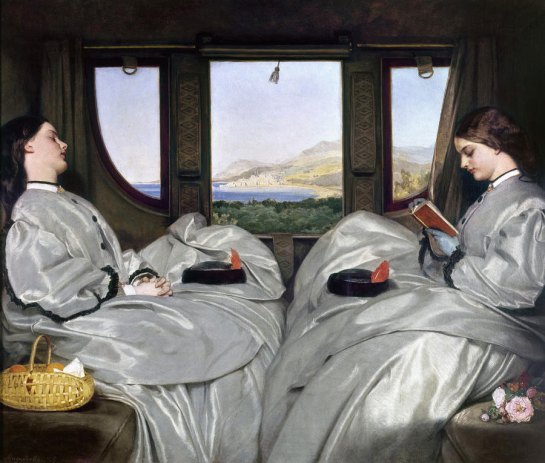
Augustus Leopold Egg: ‘The Travelling Companions’, 1862 oil on panel. 65 x 79 cm. Birmingham Museum and Art Gallery
To Birmingham to see the ‘Lost in Lace’ exhibition, I would highly recommend it, some fascinating textile work, beautifully curated by Professor Lesley Millar. Also to the multicultural festival outside the Museum, threatened by the appalling English Defense League, staging ‘a static march’. A static march involves drunk, shaven headed uglies bussed in to stand outside pubs shouting, whilst wrapping themselves in the Union Jack and, oddly, the Star of David; anti-Muslim activists getting together apparently. Strange for those of us who marched against similar far right thugs in the 1970’s, I remember the largest shouts then were viciously anti-Semitic.

Next to the Rotunda, before you go into the Lost in Lace exhibition, is a small collection of original Victorian lace that puts the later work in a very useful context. On my way across the space I came across this painting, by the wonderfully named Augustus Leopold Egg. I had previously thought about ‘The Travelling Companions’ in relation to Eric Ravilious’ ‘Train Landscape’ (see ‘Railing Against It’ in previous posts) and notions of the Internal Picture Plane. I think it is worth looking at again.

Egg was part of the circle around Dadd , Egg knew Holman Hunt well, though not as a formal member of the Pre Raphaelite group. ‘The Travelling Companions’ is a relatively late Egg painting and contains some affinities with the PRB aims, in the care of the observation work for example, but it doesn’t share Hunts exact, opaque technique and tiny brushwork. Neither does this have the ponderous, thumping morality of Egg’s earlier work, eg his triptych, ‘Past and Present’, 1858. As you might expect from a friend of Dickens, there is still a didactic nature to ‘The Travelling Companions’.

It is smaller than reproductions lead you to imagine (653 mm x 787 mm) and, painted in 1862, very much at home amongst the Victoriana of the Birmingham Museum & Art Gallery,

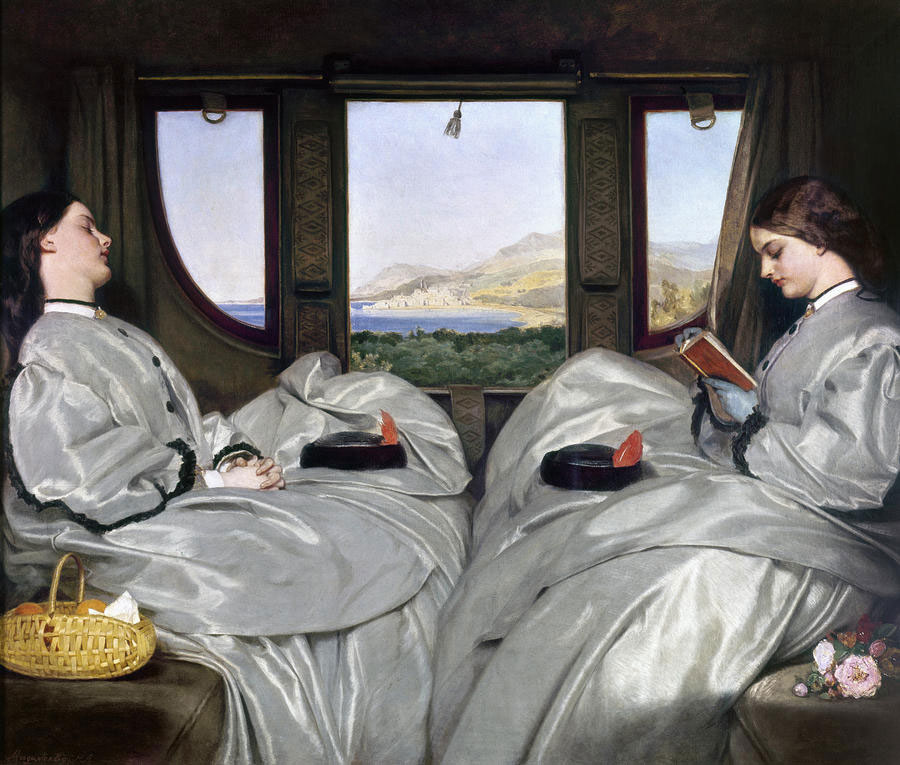
The companions themselves are almost identical, their symmetricality is stressed by the position of us the viewer; directly between them. They are wearing identical but, given the amount of cloth, presumably handmade dresses. It reminds me of a set for a photo shoot in which one half of the carriage has been cut away to fit in the crew and the camera. In the original Victorian carriages the bench seats were parallel, so our viewing position is either from outside or just inside the opposite window. A later image by Tenniel for ‘Alice through the Looking Glass’, clearly based on Egg, demonstrates that there was some sort of external running board used by conductors.

John Tenniel: ‘Alice on the Train’, engraving, 1872

Are we in that position? Judging by the lack of framing furniture, we can assume not. Are we then a fellow passenger, standing to leave? Again there is nosupporting evidence, the train is not arriving anywhere for example. Neither is there room for us as a potential passenger, those huge grey silk dresses squeeze out any other occupants. This is a private, almost domestic space, oddly for such a dislocated experience as travel. We see from a formal rather than an obviously anecdotal position. We see the inside of the carriage and the view beyond from the authorial voice; we are being shown something for a reason.

That exact symmetrically immediately demands a sort of spot the ball/ what’s the difference approach from the viewer, the precision of the technique allows the viewer to make those sort of observations. The obvious differences are:

  1. 1.    The view outside
  2. 2.    The women, who are they?
  3. 3.    One reading/ one sleeping The book versus dream
  4. 4.    The hats
  5. 5.    The gloves, or lack of
  6. 6.    The basket/ flowers
  7. 7.    The hair

Where are they going? Where have they come from? The triptych of the internal picture plane (the carriage window), it is exactly parallel to the picture plane itself. The framing of the view allows us to think of this secondary picture plane in pictorial terms, although Egg was not a landscape painter. Technically it both provides visual interest and relieves the claustrophobia of the small hot carriage; by doing so of course it reinforces the closed nature of this small dark space. That view also explains the lighting; it comes from the opposite set of windows.

The internal picture plane is a familiar device, probably Northern European in origin. The view through a window in Ghent, or fruit trees in a garden and sky beyond; a framed view that refers to images; the act of looking at and through them in the Albertian sense. That interest develops, when van Eyck placed a mirror on the back wall of the painted space in the Arnolfini Portrait, how did that extra pictorial space affect the image perceptually and intellectually? Velasquez immediately springs to mind. Enough of the surface of this painted area, within the bounds of the work, needs to be visible for it to be called an internal picture plane; it needs to be more than an object or an attribute. That plane has to create imaginary pictorial depth that is probably analogous to, but in some way separate from, the homogenous space of the major picture plane that must surround and enclose it for this pictorial element to work. The new space inside, as it were, the existing pictorial space, has to be at least as powerful as the original. It has to be a convincing fiction that keeps all the characteristics of a convincing fiction (autonomy, agency etc), whilst living within another fiction, hence the enjoyment in painting paintings within paintings.
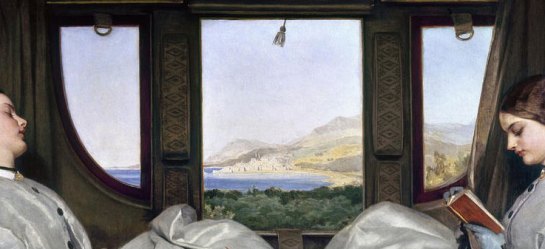
Augustus Leopold Egg: ‘The Travelling Companions’, 1862. Detail

Note that the view inside our view of ‘The Travelling Companions’ is entirely static, the only sense of movement is in the slight sway of the tassel. The view is different through each panel. The curtain on the right has been slightly drawn to shade the book. The blue of the sky on the right is a shade or two deeper than in the other two panels. The curve of the outside window panels echoes the curves of the two girls, on the left the sleeper is just a little more slumped, her window is free of curtain so we get the full 45 degree curve and a small, almost abstract residue of horizontal sea with a slight froth of land on top.

There is a small white town on the edge of the bay, on the land that points like an arrow toward the left hand panel. This is apparently a view of Menton, on the border between France and Italy. Given that the composition of the painting features the crumpled border between two figures and a clear vertical axis, are we meant to assume something here? Menton had only just moved from the control of Sardinia to France, though there seems no obvious reference to this, nor that the city is famous for its lemons, nor that menton is the French for chin. Nor, oddly that Webb Ellis, the ‘inventor of Rugby’ was living in the town at the time Egg made this painting and died there ten years later. Also, and tangentially relevant, in 1892, Charles Spurgeon, died there. Spurgeon the British Baptist preacher was the most popular London minister of the nineteenth century, crowds of 6,000 came each Sunday to his Metropolitan Tabernacle.

I am not suggesting that the city in this view is a religious reference, but these people were here for a reason: TB. In 1861, James Henry Bennet, a Manchester doctor, and TB sufferer, published ‘Mentone and the Riviera as a Winter Climate’ suggesting Menton as suitable place for a tuberculosis cure. The book was very popular, the wealthy wintered here, and died here. That is the view we can see through the window, are these two suffering from TB? Clearly not, they seem the picture of health. But, that city on the shore, is it therefore a guarantor of health, of happiness? It is certainly a white city, although not quite a shining city on a hill.  Egg himself was a chronic asthmatic that was why he travelled to places like the French Riviera, although he would die from asthma in Algeria. But, from this and his other paintings, he does not seem to be an overtly autobiographical painter, Egg had visited Mentone, with Dickens and Wilkie Collins. This view is about the two girls, not necessarily about medicalised death in sunny places. Travel is though, supposed to be good for you, broaden the mind and all that.

As in any English painting, their class matters, they are in a first class compartment, we assume that, given the nationality of the artist, they are English travelers. We are looking at the upper middle class tourist moving away from the grey light of home to the bright sunlight of the south. From the later 1830s, the genre of tourism diversified, the middle class entry into a European space formerly inhabited by the elite, Egg illustrates the sudden and modern rise of mass travel. But, see how little very little attention they pay to that view, it is for us the viewer. The companions are getting their inspiration from books or from dreaming.

What is she reading, is it a popular novel? A Bible? Or similar? Or a guide book? Even close up you can’t read a title, it not a yellow backed popular novel (cost about two shillings), sold to through railway bookstalls eg WH Smiths, neither is it a Bible.

A woman reading in art has, usually, a set of meanings attached: ‘Magdalen reading’ by Rogier van der Weyden, from the 1430’s, or the Virgin Mary often in the Madonna and Child composition with Christ riffling the pages of her book. Often these images remind us that she wrote as well as read, eg Botticellis ‘The Madonna of the Magnificat’ 1483,
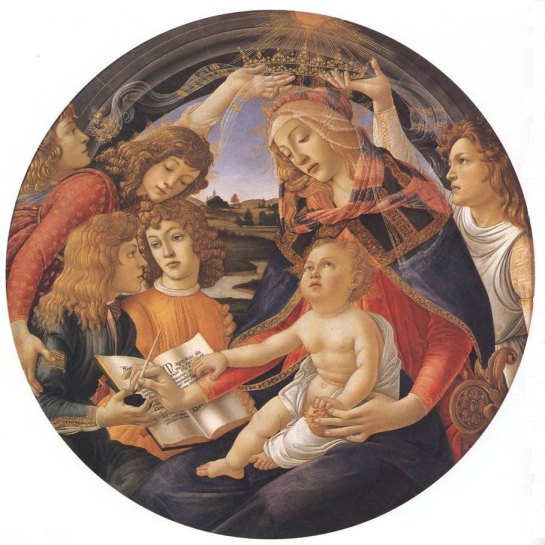
Botticelli: ‘Madonna of the Magnificat’, 1483

where we can see the pen and ink as well as the book. This view of women reading is a sacred search for knowledge, it would have been easy to rearrange the composition to give the reading girl a halo from the window behind, the drawing of the curtain deliberately closes down that possibility.

There is another result of reading, a different sort of passion that turns up in illustrations of Dante, Paolo and Francesca’s reading of Lancelot and Guinevere leads to adultery (‘that day we read no more’), for example: Rossetti’s ‘Paolo and Francesca da Rimini, 1855,
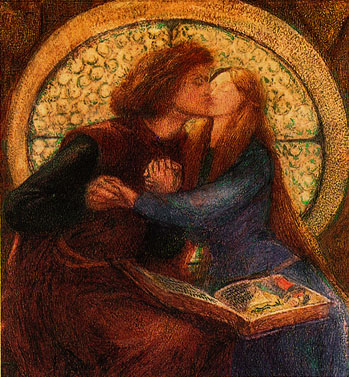
Dante Gabriel Rossetti: ‘Paolo and Francesca’, 1855

the couple have the book on their lap. But, they are a couple and these are two identical women; the identification, or the implication anyway, doesn’t fit. Neither does our reader seem stirred to any other than, at the most, contemplation. What sort of future might she be contemplating? Or what sort of past might she be reading about?

The first Murray guide was published in 1836 (A Handbook for Travellers on the Continent) and the first Baedeker in English (On the Rhine) in 1861. Murray’s, were traditionally cloth covered in a characteristic red that faded, (Baedeker copying the same colour system from 1861 onwards). They had gold writing on the upper front cover, if you look very hard at the faded red book in the painting there is an ovoid smear where that writing might sit. Murray’s were known for their quotations from Byron, ie high toned. The first Murray handbook on Northern Italy was published in 1842, written by Sir Francis Palgrave father of the Golden Treasury man, after severe criticism from Ruskin (over the correct hierarchy of Renaissance painters) that edition was upgraded in 1846; so you get some idea of the clientele. They were also expensive; apparently costing the equivalent a labourer’s weekly wage.

So, the figure on the right is reading a literary travel guide to art and architecture, a handbook that was also one of the first guides to modern travel (railways and steamships) references easily recognised by contemporaries. We might see the part drawn blind as a gentle assertion by Egg, that looking at the view would be more productive, note that the view behind the reader is a little more detailed and a little more intense. But, as an activity by a young traveller this would be seen as entirely secular, entirely praiseworthy. What would be expected in the circumstances and not really liable to any greater symbolic reading by the contemporary viewer; despite the wilder assertions I have read in some Victorian Studies circles.

Augustus leopold Egg: ‘The Travelling Companions’, 1862 oil on panel. 65 x 79 cm. Birmingham Museum and Art Gallery

The sleeping girl, dreaming into the future as the other reads about the past? Slight flush on cheek of the dreamer, significant? Like images of woman reading, sleeping women in art might lead us to where we are supposed to be.  A ‘Sleeping Beauty’, the beautiful sleeper, who would fall in love with her watcher? In classical terms, any Victorian viewer would think of Sleeping Psyche, the mortal girl watched by Eros as she sleeps. Or sleeping Ariadne, deserted by Theseus on the Island of Naxos, about to be woken by, and fall in love with Bacchus. Or, perhaps Titania waking to fall in love with Bottom:

There sleeps Titania sometime of the night,
Lull’d in these flowers with dances and delight;
And there the snake throws her enamell’d skin,
Weed wide enough to wrap a fairy in

Or that influential and rather strong poem: Keats’: ‘The Eve of St Agnes’, where Porphyro spies on the naked Madeline as she dreams of her future husband and then…

Beyond a mortal man impassion’d far
At these voluptuous accents, he arose
Ethereal, flush’d, and like a throbbing star
Seen mid the sapphire heaven’s deep repose;
Into her dream he melted, as the rose
Blendeth its odour with the violet,–
Solution sweet: meantime the frost-wind blows
Like Love’s alarum pattering the sharp sleet
Against the window-panes; St. Agnes’ moon hath set.

Is our grey dressed dreamer, thinking of this sort of heady stuff, painted and illustrated many times by the younger Pre Raphaelites? Far more likely to be shown inspired by a book of verse I would think, than just lying there with your eyes closed. The underlying theme in all these dreamers is that they are evidently watched by a male viewer, the male gaze mythologised, the male gaze that leads to sexual attack of one sort or another; ‘melting into her dream’ indeed. Is there any visual evidence to support such a reading of a girl with her eyes closed and her hands demurely clasped in her lap. Perhaps.

The hands, note that the reader is wearing gloves, gloves, like hats denote social class. By the way, is there any significance in the placement of the hats, both feathers facing to the right? They seem to exist in order to point to the other minor differences; a sort of signpost. Women should be seen wearing gloves at all times, and although these two fill this carriage, it is still a public space. Realist and Impressionist paintings in Paris, in a few years’ time will make this more evident, look for example at the role of the internal picture plane in other roughly contemporaneous works. For example the mirror in Manet’s ‘Bar at the Folies Bergeres’,

the barmaid’s reddened arms are contrasted with the gloved ladies seen reflected in the mirror, they have the privileged position on the balcony, Suzon the barmaid and probable prostitute does not. Bare armed, bareheaded, staring blankly into the middle distance, the grander world in the mirror is closed to her, unless of course the man we can see reflected on the right hand side is her route out and up; nothing in the rest of the painting makes that
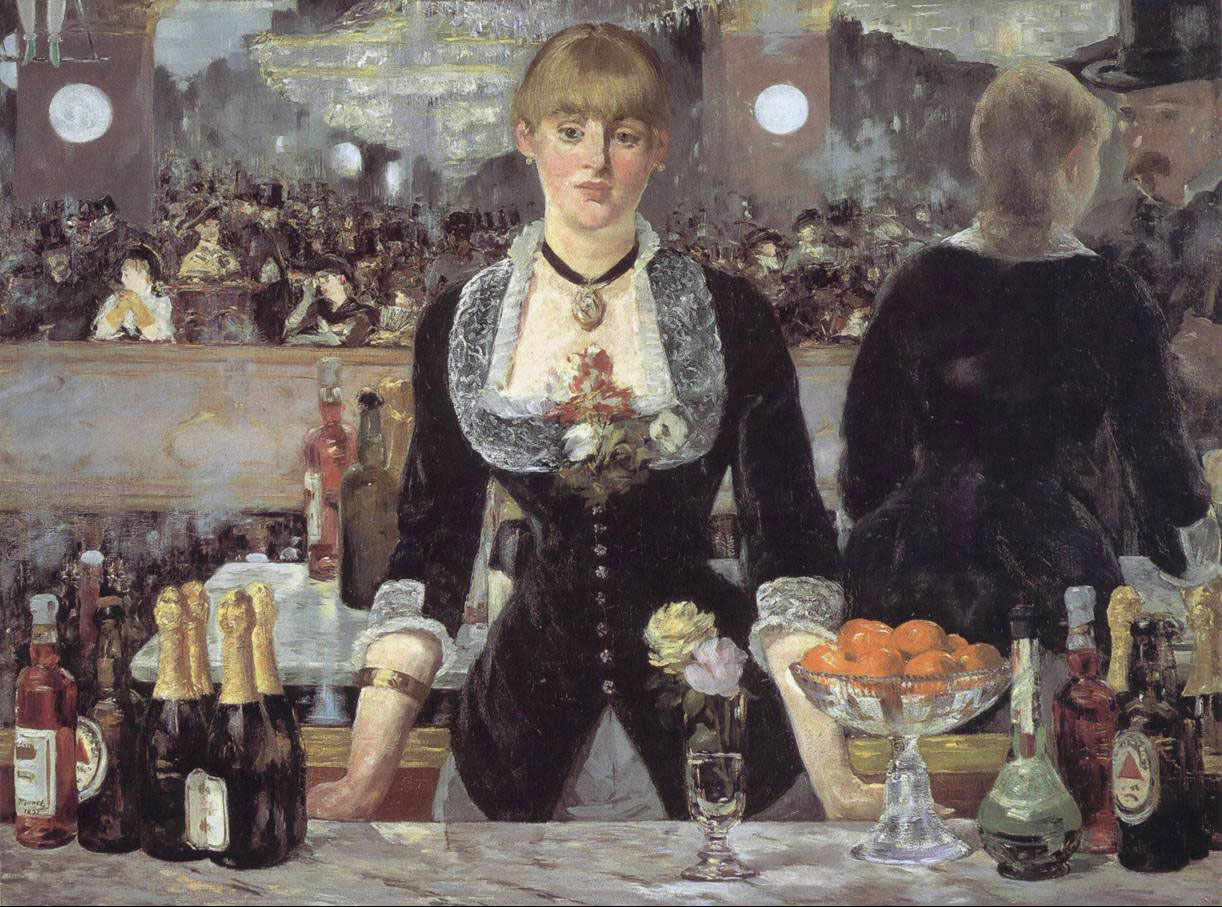
Edouard Manet: ‘The Bar at the Folies-Bergere’, 1881-2, oil on panel

possibility seem anything other than remote.

Holman Hunt uses a mirror in ‘The Awakening Conscience’, from 1853. Like the view in the Travelling Companions it introduces depth into a claustrophobic space.
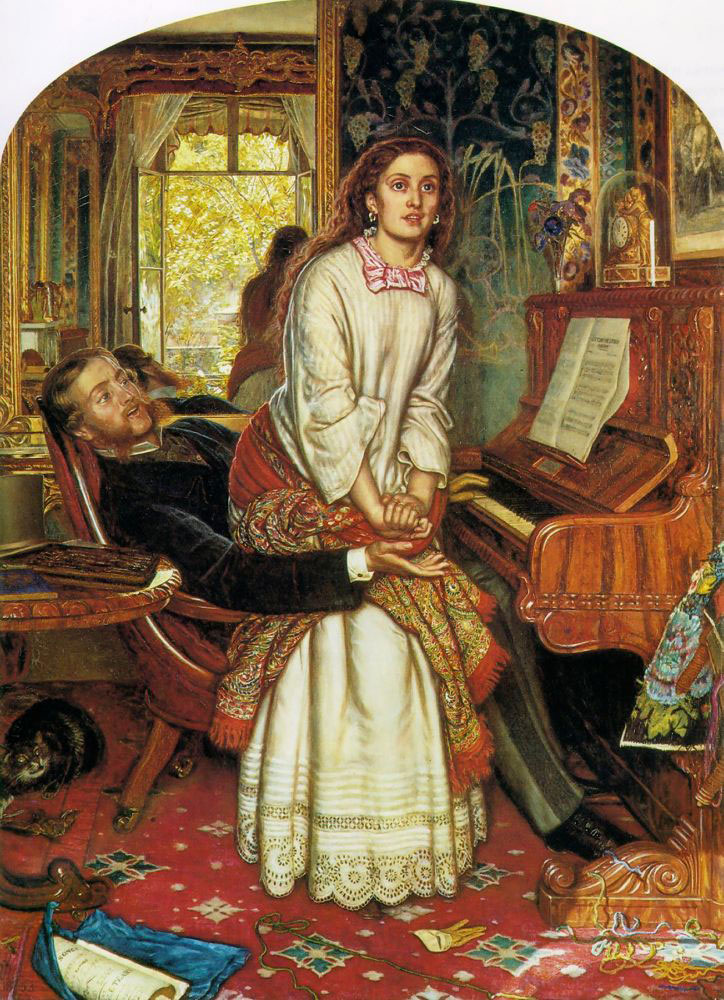
William Holman Hunt: ‘The Awakening Conscience’, 1853, oil on canvas

Like the Manet, the formal relationship between the major and minor pictorial space (bar and mirror/ room and exterior garden) indicates potentialities to the viewer, even if they are not entirely revealed to the female protagonist/s. In ‘The Awakening Conscience’ the mirror reflects the garden that the trapped girl looks towards, as she begins to understand her current state. The kept woman caught, like the cat that traps the mouse under the table. The garden is the possibility of redemption. Note by the way that her un-gloved hands have no wedding ring, despite being alone in a room with a man

The removal of gloves is a licentious act, But, is our dreamer as abandoned as the kept mistress in West London rapidly on her way down the social spiral? Probably not, but there are a couple of other minor clues that all might not be well. Notice that the hair of the dreamer is looser, not quite caught up in the way that the reader seems to have arranged her coiffure. The hair of the dreamer is more noticeable in the preparatory sketch, it is less ordered and covers her ears, even so, the sleeping girls hair is still ‘en cheveux’ as the French put it?  And, if you look very carefully you will notice that the third button down from the top is undone.

Working down the pictorial space we come to the benches on which the girls sit. The dreamer has an open weave basket containing two oranges, possibly the left hand fruit is a peach, difficult to tell. There is also a crumpled piece of paper; tissue to stop the fruit bruising? Or a note? I spent a long time looking at this in Birmingham, but no,  there was no indication either way. Holman Hunt would have filled the paper with miserable song lyrics. Egg is far more subtle. The reader sits beside a perfect posy of flowers, roses possibly, but no evident thorns, the thorns of love etc. Possibly carnations, but the delicate whites, pinks and pale reds, avoiding the over prescriptive language of flowers, still do not speak of intensity or deep passion, this is grace and delicate pleasure.

 As Andrew Graham Dixon points out in (A History of British Art page 166) Egg was a Hogarthian artist, in that his narratives depend on moral choices. But, says Graham Dixon, the protagonists in an Egg painting have genuine choice, in the Hogarthian universe

‘we are all corrupt and therefore all damned inevitably. The moral of Egg’s art is that each moment of time and each human action, is full of alternative possibilities’

Are we looking at a moment of choice here? Graham Dixon would have us believe that Egg has, in effect, shown us the same woman and her two potential personalities. The clue has to be in the view, surely, what we are seeing is Egg setting up possibilities. Unlike his earlier heavily didactic work, and unlike the work of his friend Holman Hunt who, metaphorically speaking, beats you over the head with his intentions, what we have here is a painting designed to be seen on many levels.

Look at that view and the bright sunlight, note that the midground, like the train interior, is dark. There is a distance between the train and the town, we have a way to go yet. What we have here is potentials, it is up to us as modern viewers, a modernity emphasized by the means of travel and the lack of male attendants, to understand where those potentials might lead, and to choose accordingly. As the internal picture plane tells us, even a life in the sun has implications.

Peter Paul Rubens: 'A View of Het Steen in the Early Morning', 1636. Oil on Oak. Oil on oak.131 x 229.cm. National Gallery, London

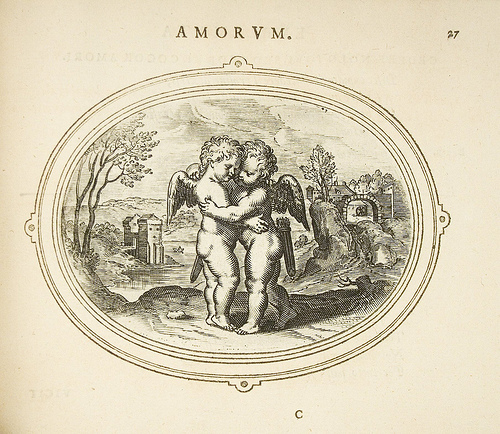
Is this a moral landscape? I have been reading ‘Gainsborough’s Vision’ by Amal Asfour and Paul Williamson (Liverpool University Press, 1999) in which the authors describe the role of the emblem in Gainsborough’s landscapes. Emblems were moral tales told through images, always accompanied by a descriptive text. An important Dutch form, travelling to Gainsborough through the Calvinist/ nonconformist tradition. A key early source was Otto van Veen: ‘Amorum Emblemata’ (1608) and the ‘Amoris Divini Emblemata’ (1615)

Otto van Veen: 'Amoris Finis Est' Amorum Emblemata 1608

“Van Veen is faithful to what can be termed a northern style of imagery – a detailed and naturalistic rendition of landscape settings. He presents a moral dilemma in a more or less realistic, rather than as an idealistic, single quality”  

(Gainsborough’s Vision page 82)

Rubens was apprenticed to Van Veen, and would have absorbed the tradition. Despite the different scale, materials and function, in Het Steen we have some of the possible elements of an emblem: the cart; the hunter; the house and the elegant bystanders. But:

1/ we don’t have any improving text

2/ Calvinist/ Christian images of agriculture tend to refer to husbanding the land as post Fall/ post Edenic toil:

‘In the sweat of thy face shalt thou eat bread, till thou return unto the ground; for out of it wast thou taken: for dust thou art, and unto dust shalt thou return.”

Often shown through the image of a thistle:

‘Cursed is the ground for thy sake; in sorrow shalt thou eat of it all the days of thy life. Thorns also and thistles shall it bring forth to thee; and thou shalt eat the herb of the field’

There are no thistles, some brambles of a fairly beneficent kind, they act as a cover to the hunter, but no obvious thistles. More importantly there is no ploughing, no evidence of turning the cursed ground, not a ploughed field in sight; it is pasture as far as the eye can see. The only work seems to be the bucolic acts of milking/ hunting and riding a cart. There are no crops, apart from milk and the wild fruit on the tree.

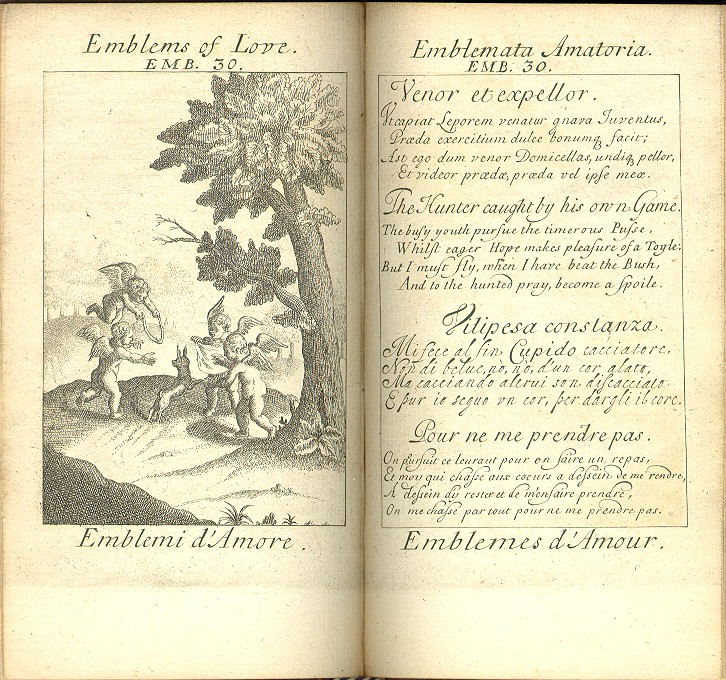
The hunter: in 17th century emblems, the hunter tends to be a reference to Cupid, eg Philip Ayres: Emblemata Amatoria, and ‘The Hunter Caught by his Own Game’, Actaeon changed into a Stag, that sort of thing.

Philip Ayres: 'The Hunter Caught by his own Game', Emblemata Amatoria, 1683

Frankly, most of the emblems tend to refer to getting love/ sex wrong, the same use that Gainsborough makes of them as well. Nor is Rubens’ man a metaphorical hunter searching for some other form of meaning. The deer on the cart would lead us to think about stag hunting, the pursuit of the aristocracy. Apparently Rubens did not hunt himself, and problems with arthritis and gout during the five or so years that lived at Het Steen would have limited his mobility.

Can we construct a moral tale out of these elements? Not, I would suggest without some heavy guidance from the composition and the authorial voice, Rubens was after all on the wrong side of the Catholic/ Calvinist divide. Despite early work with van Veen, the Counter Reformation/ Classical tradition is likely to be his source; Virgil’s Georgics, not Genesis. You can, as Asfour and Williamson do, plausibly connect Gainsborough landscapes to morally improving tales, can’t quite make that connection here.

Thomas Gainsborough: 'Landscape with a Woodcutter Courting a Milkmaid', 1755 (Tavistock Estates)

Next to me on the bench, a father and his daughter, she is 6 or 7 maybe, are going through a worksheet on the painting. They carefully read the question together, she skips to the image and points out the number of birds, people, where the sun rises or whatever. She is entirely dressed in shades of pink, with a diamante necklace and those trainers that light up when you walk. They stay looking at the painting, counting off the questions for a very long time, completely absorbed. Longer even than the Chinese tour groups in front of the right hand ‘Judgement of Paris’; today they are mostly dressed in lightweight tweed.

We could advance the theory that, at the end of his life, Rubens is celebrating God’s creativity with his own. But there is no obvious evidence of Christian agency here, no attributes or idealism of the humanist inspired Roman Catholic for example. No old bearded man in a bed sheet appears to bless us all, no youthful Apollonian sun-god races across the sky either. This, then, is all materialism: I own; I observe; I deserve, because I am worth it (which of course Rubens was).

A kinesthetic learner, the term we have been taught to use, is being urged by his mother to complete the Het Steen worksheet. The small boy, Dutch at a guess, is whirling his arms around his head, sucking the toggles of his fleece, jumping from foot to foot, trying to pull his mother’s pony tail, pointing at the ducks in the sky and shouting; all at once. To my right, the whining conversation between the two guards has become much louder. The man on the bench behind me is starting to snore and another, very large Chinese tour group is bearing down on the naked threesome to judge them for themselves; time to go.

Leonardo da Vinci: ‘Mona Lisa’, 1503 -19

I once heard Martin Kemp, the great Leonardo specialist, talk about the geology in background of the Mona Lisa. Apart from surprise at the blackness of the distinguished professors hair, I remember him saying that the artist had been hired to survey the land between Florence and Pisa, to give Florentines a navigable waterway to the sea bypassing their rivals. That survey work, and Leonardo’s analysis of the role of water in changing topography, allowed him to think of time in different ways, to move away from the prescriptive Christian chronology; geological time for example. His proposed route was to go through Prato and Pistoia, although the land behind Leonardo’s portrait of Lisa Gherardini is not an exact portrait of the lakes above the great valley of the Arno, it bears similarities. It allows Leonardo to use the landscape to meditate on the role of time, as well as present the site for a pre combustion engine form of transport, that is now incidentally the route for the A11 from Florence to Pisa.

What transport routes are we looking at in Het Steen?

Peter Paul Rubens: 'A View of Het Steen in the Early Morning', 1636. Oil on Oak. Oil on oak.131 x 229.cm. National Gallery, London

What geology? What time span? Apart from the obvious track leading the horses and cart out to our left, what other forms are here and what do they tell us about Rubens’ thinking? There are tracks in the centre midground, serpentine, leading toward the horizon, lighter in colour than the green and possibly slightly frosted grass that surrounds them. Several tracks seem to come together here, to lead in to the space towards Malines (the town on the horizon). They are not large roads, nor direct.

This is presumably an alluvial plain, laid down over millennia by slow moving rivers, they are not the fast moving lakes of built up water, about to burst their banks and cause tumultuous change as represented by Leonardo. Het Steen is placed in a land where not much changes, not of course true, this was a sector of Europe that had been constantly fought over, the Northern Netherlands were at war with Spain right up until 1648, and we are in the middle of the Thirty Years War. Land reclamation to the north and west was at its peak, new canals being dug constantly, agricultural practices were changing fast to keep pace with growing urbanisation.

Viewing it now, this great flat plain stretching to a low horizon, looks just made for a 21st century motorway system: 6 lanes; gantries; illuminated signs throughout the night; those huge, double European lorries. In fact it has the A1/E19 running from Brussels to Antwerp, which apparently has one of the widest central reservations in Europe (40 metres wide over 31 km since you ask)

The hunter in the foreground, the stock figure, he is trying to move to his right, to go around the tree trunk, through the thickest part of the brambles to shoot the oversized ducks behind. Surely, his quickest path would be to his left? Or so our elevated viewpoint would seem to indicate. It would be easier to shoot the ducks from the left hand side of the trunk, he could just hit them with his great long barrel in fact.

“It must be fairly late”

“In the day?”

“No, in the History of Art, you look at that Renaissance painting over there and the trees aren’t half as green”

“True”

“What’s the best way to get to our hotel anyway?”

The brown foreground of the painting ends at a very strong horizontal line, tilted down slightly to the left. One’s eye first notices it at the right where it is marked by a drainage ditch, the field boundary for the cow field with the milkmaid, although there are more cows in the field beyond as well. The pure sunshine continues across the midground, a line of sunlight ends just in front of the house. This lets Rubens spotlight the house, placing it on a boundary edge, the left corner of sunlight exactly touches the left hand end of the mansion.

The later Judgement of Paris to my right is a constant draw for Chinese visitors, in huge numbers. They stand today in Burberry scarves, usually their leader has one of those microphone affairs, they never stay long, they have an itinerary to follow.

I’m intrigued to know where the rustic wooden bridge would lead anyone to. If it is for the milkmaid approaching the cows in the next field but one, then two questions occur:

  1. Would the bridge bear her weight and that of the milk she will carry? Presumably in another of the brass jugs like that on the cart, and the same balanced on the head of the girl in Landscape with a Rainbow, the companion piece to this (see previous post). If you look closely at the smudges of paint, the milmaid would appear to have something on her back with a highlight, a jug strapped there? The bridge is flimsy with only one handrail, in a list of ‘Bridges in Art’ (Hiroshige, copied by van Gogh; Monet; Sisley; Constable; Turner; Stella; there is of course a bridge in Mona Lisa, on the right, just where her clothing swirls across her bare shoulder; that poem by McGonagall, the Tay Bridge Disaster etc. Any more? I refuse to sing Bridge over Troubled Water in the National Gallery) in that list, this little wooden span is not the most convincing.
  2. The milkmaid would have to cross another bridgeless ditch to get from her cows to this one, is that right? Then she would have a long walk round the wrong way to the house. That route would take her to the front and the drawbridge as well. Would servants go in that way? Was the drawbridge the only way over the moat around Het Steen? Perhaps there was a loading place for milk and the cart, by the tall foreground trees? Evidence of growing rural industry?

The last time I was here, someone was drawing the earlier Judgement of Paris in pencil. Today, an elderly man, quite scruffy in a grubby brown jacket, trainers, battered grey rucksack old jeans is drawing Minerva from the same painting. She is the figure with her back to us, with armour at her feet. It is a copy with a high degree of accuracy, and he is making it on an Ipad. Minerva, in the digital drawing, is completely isolated on a pale blue grey background. The digital drawing has a definite sense of texture from the ‘tooth’ of a virtual surface, Ingres paper is the name of the physical paper with equivalent qualities.

I see all this as I leave, finding my own path past the Turners and Constables, all that power and paint as thick as the painted skeins of cloth on Lisa Gheradini; seized moments of meteorological time.


To the Wallace Collection to see Rubens’ Landscape with a Rainbow’ , 1636.

Peter Paul Rubens: 'Landscape with a Rainbow', 1636. Oil on Panel. The Wallace Collection, London

the companion to Het Steen. It is much less finished, look at the way the yellow blocking between the legs of the cart horses on the left has entirely covered the second horse, it has not been corrected; Rubens never got round to it. Underpainting and drawing clearly showing through.

Strong diagonal from middle right across the ground plane towards the centre. A surprisingly incoherent composition, not quite clear where the central pond begins or ends. It is in the centre of the painting, but is just a vague hole.

Very little accuracy in the trees, oak like, but without the precision of the birches and the oak in the Steen foreground. In the left mid-ground of Rainbow there is a vaguely birch like copse, some clarity in the background recession.

Carefully painted cattle and ducks, brown foreground, green mid, blue background seen from a slightly elevated viewpoint but not as high as Steen. Without the house we have less of the arrogance,, or showing off, that characterises Steen. Rainbow is far more of a genre painting about countryside activities i.e. Haymaking, bringing in the cattle, no doubt killing the ducks; activities in the Brabant. The ground plane rises relatively steeply from below our feet to a midpoint at the grown out hedgerow.

Is the rainbow a sign of the covenant, God will not break his promise? A sign of peace (relevant of course to Rubens own position), look at the way our eye is drawn from the dark right towards the brighter left. Is the rainbow a symbolic form in common with the genre figures?

In the National Gallery in front of Het Steen

Peter Paul Rubens: 'A View of Het Steen in the Early Morning', 1636. Oil on Oak. Oil on oak.131 x 229.cm. National Gallery, London

There is perhaps a compositional similarity between Steen and Rainbow, in that both have a dark diagonally composed foreground element in roughly the same place; a standard Flemish landscape component after all. The Rainbow haystack corresponds approximately with the position of the house, but only just; positions of plenty?

Looking again at the Steen foreground clump of trees, might that dominant tree on the left be a pine rather than an oak? Native pine has lower branches that come out at a 45 degree angle, in oaks they tend to be higher up and at 90 degrees to the trunk. But, it can’t be, the leaves are bulging groups of flora, not short dark needles at all.

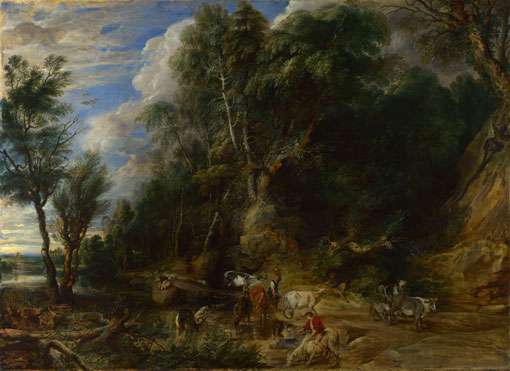
The Rainbow figures owe more to The Watering Place, 1622

Peter Paul Rubens: 'The Watering Place', 1622. Oil on Panel, The National Gallery, London

than they do to Het Steen. The Watering Place is on the opposite wall to het Steen, it is a far more finished painting than either of the two later works. Specimen pollarded willows, edged with dark glazes and trembling waves of Italianate leaves on Northern European tree trunks. Bruegel like rocks and tree formations, elevated viewpoint and the usual colour division to the composition. Genre figures including peasant with brass pitcher on head and shepherd playing flute under the tree (lots of references to Virgil: Tityrus lying under a spreading beech wooing the muse on a slender reed etc) None of that obviousness in Steen, which is an ostensibly contemporary scene in which the season is established as much through light and colour as through content. Autumn, ie harvest time, is established by content and activity rather than through depiction and observation.

It is toward the end of the day in the National Gallery. Sino-Italian day by the look of it: elegant; elderly; attenuated Italian couples and younger, plumper Chinese family groups. The elderly Italian man next to me on the bench, in light brown wool jacket, grey trousers, slip on brown leather shoes, light smell of woody eau de toilette, has been asleep on the corner seat of the bench the whole time I have been here. The colour of his jacket almost exactly matches the bottom right glazing over the underpainting of Het Steen. A woman, in folds of fine grey wool, with tumbling hair full of gold highlights and gold necklaces, re-appears to wake him up; lots of whispered Italian. Is gold an autumnal colour?

Peter Paul Rubens: 'A View of Het Steen in the Early Morning', 1636. Oil on Oak. Oil on oak.131 x 229.cm. National Gallery, London

Perhaps, because autumn is really starting to get going outside, the autumnal colours of the foreground seem particularly strong. The browns, in fact a translucent wash (looking a bit like a Sienna, though probably an umber with a touch of yellow) over thicker white underpaint with sludgier greens and umbers mixed on to the underpainting. This site, along with the National Gallery site itself, is helpful

Painting materials of Peter Paul Rubens: http://www.lalaragimov.com/research

Norman Bryson in ‘Vision and Painting’ (Macmillan, London 1983) talks at some length about the triangulation between the artist’s viewpoint, the viewers’ and the vanishing point. Stressing the importance of what happens, or is presumed to happen, this side of the picture plane. It is difficult to be both the artist and the artist as viewer but, we know that this painting was made for his own pleasure, possibly to display his own success to the powerful, but for Rubens’ pleasure nonetheless. I.e. an autumn scene for a man in his own September days, fact closer to November as he died four years later. Is it therefore too fanciful to make associations between the rumpled, creased, worn ground plane as it moves from the cart at bottom left to the rising sun top right and skin. Steen is after all, flanked in the National Gallery by two versions of the Judgement of Paris, young female skin by the yard.

Next to me on the bench in front of these three paintings a youngish art student in a flowery red summer dress is making a tonal study of the earlier Judgement (on the left from 1597-9)

Peter Paul Rubens: 'The Judgement of Paris', 1597-9. Oil on Panel. The National Gallery, London

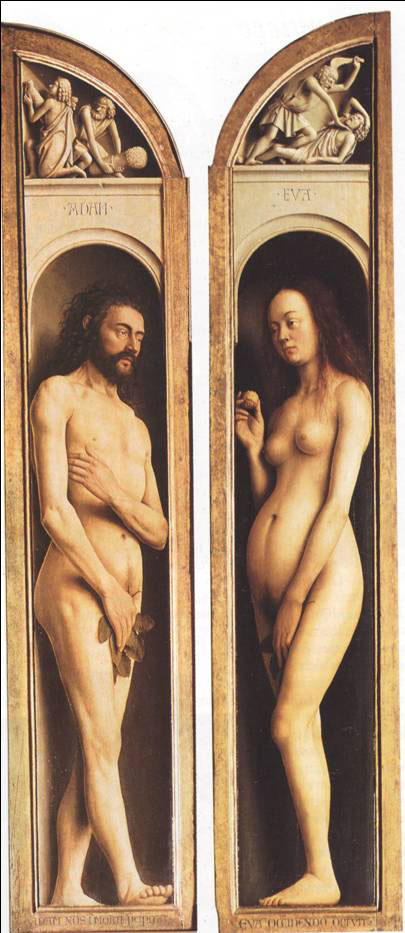
The central nude (Athena) appears in the drawn copy to have clear bikini marks, whereas Rubens’ goddesses of course are immortal and have no marks of the sun at all. While for example, the clearly human Adam in the van Eyck brothers Ghent altarpiece has worked in the fields and his burnt head and arms are testament to his lowliness.

The van Eycks: 'The Ghent Altarpiece, detail'. 1432 tempera and oil on panel

Sun tan as a desirable attribute doesn’t start till the early Twentieth Century.

So, skin, the action on Steen takes place on a surface light by raking light, the more one looks at it, again perhaps the triangulation of viewer’s viewpoint, the more this looks the skin of an old man, no longer taut, odd risings of hair in the folds.

That grouping of oak and silver birch in the foreground, they really do look like the subsequent tree paintings of artists like Ruisdael, Hobbema and Constable, a line you can trace back to Pieter Bruegel the Elder and back further to woodcuts from Titian. The tops of the trees, billowing forms are tinged with pink as are the grey clouds in the top left and fronted with thick creamy white. A similar palette to that around Discord in the storm clouds in the other Judgement of Paris to our right, the later one: 1632-5.

Peter Paul Rubens: 'The Judgement of Paris', 1632-5. Oil on Panel. National Gallery, London

Huge billowing shapes, dramatic lighting, powerful form, this upper right section of Steen is slightly different to the climactic conditions and tree-scape across the autumnal, linear composition below. Rubens is gussying up the scene a bit, he can’t help it, all those years of grand istorias for the powerful; it has become a habit. The isolated intense focus on others areas, the abrupt changes in scale, show an artist working on bits that interest him, no need to harmonise the composition.

Today seems to be young and old day in the National Gallery, huge fleets of little children, all pigtails and holding hands are ushered through with much shushing and repeated directions. Amongst the excited little beings are the old, with sticks and grey jackets and  audio guides and armfuls of gallery pamphlets; fretful that they are in front of the wrong painting as they press buttons 9, 4 and 3. I am suddenly surrounded by an unnumbered horde of small, very small children all with their ‘Kerbcraft Walking Bus’ fluorescent tabards, their joy is overwhelming, their need to sit on the bench equally so; time to go. 

Peter Paul Rubens: 'A View of Het Steen in the Early Morning', 1636. Oil on Oak. Oil on oak.131 x 229.cm. National Gallery, London

Thinking further about those clouds and the trees in the foreground, their derivation and their future effect (although this was less in the Netherlands, the major influence would be on artists like Constable,Het Steen was owned by Sir George Beaumont, Constable’s patron). I have been reading the catalogue for a National Gallery Exhibition on ‘Dutch Landscape, the Early Years, Haarlem and Amsterdam 1590-1650’ published in 1986, National Gallery Publications, London. A show which centred on the development of work directly from nature; a process that characterises Dutch landscape drawings, prints and paintings in the seventeenth century.

Rubens was though, a Flemish artist, Italianate, learned, and devoted to istoria. The growing 16th century Dutch landscape tradition, developing around Haarlem, based itself on nature/ observation, the ‘extensive landscape’ a correlation between marine and landscape painting particular to the newly reclaimed Dutch landscape. These artists, inspired by the marine painters like the splendidly named Vroom, closely observed wind, cloud types and the effects of light. Unlike the Flemish:

“These [Rubens’] clouds are an arbitrary backdrop and are scarcely recognisable in meteorological terms” J E Thomas, Geographical Magazine 51.7 April 1979, quoted in ‘Dutch Landscape’ page 79.

“the marine painters observations of the sky ensured that in Dutch Landscapes and marine paintings sunlight always falls from the same direction [as the wind], Rubens’ ‘artistic licence’ in showing shadows falling from opposite directions in the same landscape would have been unthinkable for a contemporary Dutch artist’

In fact the light and shadows fall in Steen is reasonably consistent from top right to bottom left. There is no strong wind but a gentle East to West breeze, following the line of the clouds would seem believable. The painting that Russell is referring to in this second reference is the ‘Return from the Harvest’ in the Galleria Pitti, in which the shadows cast the peasants in the foreground run at right angles to the source of light.

By the way, can I recommend the Hay in Art Website www.hayinart.com which does exactly what it says, in great detail; indispensable.

This double light is not down to incompetence, or lack of knowledge, it is the traditional role of the artist to transcend the natural.

“It is by this that Rubens proves himself great and shows to the world that he, with a free spirit stands above Nature and treats her to his higher purposes” Goethe, conversation with Eckermann, in discussion over Return from the Harvest where Goethe uses the double light as an illustration of Rubens’ greatness, rather than Russell’s approach which tries to indicate Rubens’ indifference at best.

To point out where Rubens/ Flemish landscape and the emerging Dutch tradition meet, it would be worth mentioning Carel van Mander. van Mander’s treatise on painting, (Het Schilderboeck) published in the Netherlands in 1606, and went into great detail about art, artists and translated Ovid’s Metamorphoses. Chapter 8 was exclusively on landscape, parts of it seem relevant to Het Steen, for example:

“4: note, first of all, how over there the bride of old Tithonus rises from her saffron bed to announce the approach of the torch of day, and see how the four piebald horses soaked with water, rise panting from the shallows of the Ocean. See how the little purple clouds become tinged with pinkish red and how beautifully Eurus’ bright home is adorned ready receive Phoebus…see there in front of us, hunters are walking with their dogs through the green dewy fields: see how that trodden dew turns a lighter tone of green, showing their footprints, and so giving their route home. (Let the landscape recede smoothly into the distance, or let it gradually merge into the sky)”

From ‘Dutch Landscape, the Early Years, Haarlem and Amsterdam 1590-1650’ published in 1986, National Gallery Publications, London page 36.

There is a distinct similarity between these stock figures from classical myth and the role of the genre figures that people Steen’s foreground, certainly the horse/ cart drawing of the sun across the sky motif. A coincidence? A wry reworking of classical themes? Probably, these references were, after all, part of the trade of any literate 17th century artist across Europe. Had Rubens read van Mander? What is more relevant perhaps, is that these references had nothing to do with the new Dutch landscape style that was appearing, on his doorstep as it where, some 100 miles away from Het Steen.

It would be tempting to say that old man was learning new radicalism, by working directly from nature for example. Certainly this is a recognisable landscape, but, all the marks of composition, of his higher purpose, of studio bound painting, are here. Het Steen is framed, by the group of trees that also frame the house. The hunter, fallen tree arrangement makes the traditional the diagonal, foreground repoussoir element, characteristic of Flemish landscape painting.

“First of all it is important to show clear contrast in the foreground, as it pushes the other planes into the background. Ensure something large is painted in the foreground as was done by Bruegel and other great artists who are acclaimed for their contribution to landscape painting. Since they often place enormous tree-trunks in the foreground let us enthusiastically strive to follow their example.”

van Mander quoted in From ‘Dutch Landscape, the Early Years, Haarlem and Amsterdam 1590-1650’ published in 1986, National Gallery Publications, London page 38.

The Steen pictorial space is divided up into the traditional brown foreground, green mid and blue background. Yes, there is evidence of farming, of quotidian purpose that you can see in drawings especially by artists like Coninxloo. Rubens’ painting contains the field boundaries, the milkmaid etc. But, the centrality of the hunter makes it clear; this is a landscape for recreation. And, lastly there is the high view, the recognizable method for constructing the Antwerp landscape style that you can trace back to Patinir and the early sixteenth century.

So, back to the trees.

Van Mander wrote that the changes in the representation of trees in art in the Netherlands, was down to Coninxloo, because of him Netherlandish trees in art became leafier. Coninxloo  was an artist who specialised in dense forest landscapes, a subject and style that according to Christopher Brown in the Dutch Landscape Introduction, (‘Dutch Landscape, the Early Years, Haarlem and Amsterdam 1590-1650’ published in 1986, National Gallery Publications, London page 17) you can trace back to Pieter Bruegel the elder, and his son Jan Brueghel the Elder. Pieter had in his turn taken his inspiration from woodcuts after Titian, Campagnola and Muziano, i.e. from art, from higher purpose, not from life. 

Rubens’ little group of tall foreground trees, growing at angles, overlapping one another, with recognisably different foliage, and the foreground tree stump; this compositional form is pure Flemish landscape tradition. A tradition that Rubens had already conquered on his return to Antwerp from Italy, in his groups of landscape painted 1614-25. Paintings that seem to celebrate lushness, fertility and his identification with his native country. A return to prosperity after war. In the horribly complex history of the Netherlands, this was a period of powerful Counter Reformation, lots of work for a Catholic history painter newly returned from Italy, e.g. the Raising of the Cross for Antwerp Cathedral, 1610-11.

The landscape painting that makes all this clear is ‘Milkmaids with Cattle in a Landscape: ‘The Farm at Lacken’, 1618, oil on Panel, The Royal Collection.

Rubens: 'Milkmaids with Cattle in a Landscape: 'The Farm at Laeken', 1618. Oil on Panel, The Royal Collection, London

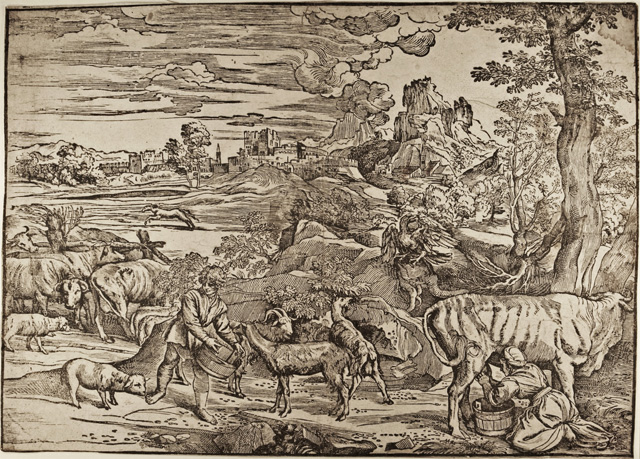
 Notice that there is some formal similarity between the arrangement of the right hand branches on the birch in the clump above the figure with the cornucopia of fruit and veg on her head and the right hand birch in the Steen foreground. To further emphasise our theme about the derivation of, and intentions behind these compositions, Christopher Brown in ‘Making and Meaning: Rubens Landscapes’, points out that this composition loosely owes something to a Titian woodcut (Landscape with a Milkmaid 1525).

Boldrini (after Titian) Landscape with a Milkmaid 1525. woodcut, British Museum

And, he goes deeper to show that the church, just visible top right, was a key centre of Marian worship and nationalist associations. In other words there are strong connections between this painting of prosperity and peace, the power of the Catholic Church and the Archdukes Albert and Isabella, Rubens was their court artist. Do we find our trees in Het Steen pointing us in any of these directions? No, the context is different. There is of course the same brass jug, here for containing milk, in ‘the Watering Place’ of 1620 for, presumably, water and in ‘Landscape with a Rainbow’ (generally assumed to be the companion piece to Het Steen) where it is also on a head, either water or milk. A Rubensian shape for indicating plenty/ fecundity/ prosperity, i.e. peace?

A series of photographs, and video installations. The three screen work, ‘Wintergarden’, is your entrée to all this. Each screen has a tight focus on a concrete balcony, slowly changing details, but the overall form remains the same. These are the pre-fabricated ‘Khrushchyovka’, Soviet mass construction, concrete apartment blocks built in the 1960s onwards, the differently refurbished balconies slowly morphing into each other. The original open balconies were inappropriate for hostile climates, residents blocked them in, using a variety of styles and materials.
‘Each resident, creating a vernacular architecture marked with personal expression from a pre-fabrication. The perfection of the master plan is thus destroyed in a patchwork of humanity.’
Not dissimilar to the 1970’s passion for stone cladding on identical terraces in the UK. A passion now replaced by a vast range of different types of plastic surround double glazing and the ubiquitous satellite dish, accessorized with the biggest 4 x 4 you can’t quite afford afford. ‘Wintergarden’ is fascinating and surprisingly beautiful, not just for lovers of concrete panel construction, they have a slight look of Gaudi about them by the way. The morphing is so slow and careful that it takes a long time to work out what is going on and prompts thoughts about uniform individualism, about how we decorate our nests, about the inevitable fate of grand utopian housing projects. The ‘Khrushchyovka’ were only designed to last for 25 years, but still seem to be functioning; just. Like the British high rise, or deck access flats, what was once so revolutionary, and successful is let down by subsequent bureaucracy. By the way, the mass produced bathroom for these apartments, with a 120 centimetre sitting bath to save space sound fascinating (didn’t Buckminster Fuller’s Dymaxion bathroom in the late 30’s do something similar?). I suppose a series of morphing bathrooms would not have the same minimalist intent as flat panel, moulded concrete parallel to the picture plane.
But, the important work is the ongoing film project: ‘whiteonwhite:algorithmicnoir’. Which is, at first sight, a straightforward narrative about a geophysicist called Holz (similarity to Kurtz?) in a dystopian, post Soviet, City A, trying to work out what is going on around him. City A seems to be a composite of various places, Baku and Almaty, cities in Turkmenistan and Kazakhstan and Latvia, all those places on the edge of vast empty desserts of snow or sand. Many short sections of film shot on an “expedition to unravel utopian promise”. The beauty of edge lands and the different sorts of space they conjure up, from failing city, to sixties hotel rooms or offices to views from train of lands that don’t change from one days journey to the next. The styling keeps returning to Sputnik era Soviet, a photographic recreation of Gagarin’s office is shown elsewhere and seems to pop up here as well.
And that’s the point, the narrative sequence depends, not on the usual Hollywood ‘journey’ but on a ‘serendipity engine’, the screen showing the code is on the left of the installation. This code just endlessly edits the 2,637 clips loaded into it, apparently it never repeats and has no middle or end, no fine resolution and redemption at the end; there is no end. Although the couple of hours that I saw, seemed to move in a fairly believable arc.
Can I claim formal similarities here to Christian Marclay’s ‘The Clock’? That 24 hour film, in which short fragments of traditional film showing clocks/ watches etc are synched to real time. You could for example point out that both films depend on digital technology to sequence tiny sections so precisely. But there must be more going on to link these two contemporaneous works. It might be more useful to think of another element, both films deal in fractured narrative. Usually in narrative film your main task as a viewer is to get busy with the emoting, rather than consider the fundamental processes involved. Like any worthwhile art, in both ‘Clock’ and ‘whiteonwhite’ the possible range of references to other art demands the viewer gets heavily involved in the viewing and (re)making process. Should those, maybe subliminal references to Modernism make one trudge slightly wearily to Greenberg’s famous dictum:
“The essence of Modernism lies, as I see it, in the use of the characteristic methods of a discipline to criticize the discipline itself – not in order to subvert it, but to entrench it more firmly in its area of competence.”
Could we say that, as we see it, as painting has flatness, the key area of competence for film is time? Could that then lead us to say that, the use these videos make of time links them formally, rather than chronologically, via the way the viewer tries to construct narrative? And, if we really want to get stuck into all this revisionist stuff, will all this Modernist talk about time take us (holding our nose perhaps), inevitably to T S Eliot and Burnt Norton,
‘Time present and time past
Are both perhaps present in time future,
And time future contained in time past.
If all time is eternally present
All time is unredeemable’
So, the present and the past are already part of the future but the future is determined by the past. Time is not linear, either in the elite world of the (non PC) Twentieth Century intellectual or in the digitally organised present. Burnt Norton from which this poem takes its name; is a ruin. Ruins as a symbol of the futility of human aspirations. Let us ignore the overt Christian element in late Eliot: the natural order that can only be put right by God, not us: ‘time is unredeemable’ etc. Notice instead the connection to the ruins in progress in ‘whiteonwhite’, and refer to the collapse of the Utopian order that feature in this post Soviet state: City A. Look to the apparent linear narrative that is in fact, as the monitor on the walls tells us, arbitrary. No God controls this, the Utopian God; the future, has died. All we see are fragments, a heap of broken images, remade by the viewer steeped in late capitalist redemption tales; from Georges Melies ‘Le Voyage dans la Lune’ to Star Wars.

Peter Paul Rubens: 'A View of Het Steen in the Early Morning', 1636. Oil on Oak. Oil on oak.131 x 229.cm. National Gallery, London

http://www.nationalgallery.org.uk/paintings/peter-paul-rubens-a-view-of-het-steen-in-the-early-morning
Het Steen

The behaviour of gallery goers is endlessly fascinating. Apart from the usual schoolchildren (poorly behaved and French today) others trudge through the galleries, is this a form of nomadism? A pilgrimage? Something dutiful, done with little interest, the journey is the penance, the reward comes at the end. Although some are clearly fascinated and will stand entranced. Is gallery going a useful space to think about life outside the gallery?
Woman on cart has red blouse/ shirt and blue dress; contrasting complementaries. Only just noticed that the man driving the cart is actually on top of his horse, not on the right of the woman as I had always assumed. He (looking vaguely like a younger Rubens, with the hat to hide his baldness) is sitting on some sort of saddle and the two horses have a heavy bridle between them to pull the two wheeled cart; a fairly agricultural affair. She sits on hay with the brass jug (by the way there is a very similar jug in an equivalent late landscape ‘Landscape with a Rainbow’ 1635,

Rubens: 'Landscape with a Rainbow', 1636. The Wallace Collection, London

a peasant balances it on her head). In front of her is the deer.

Manet : ‘A Bar at the Folies-Bergère’ 1881-2, Courtauld Institute Galleries. 28 4 2011
Link to the image http://www.artandarchitecture.org.uk/images/gallery/dfa40992.html
It has moved. The Courtauld is being refurbished and this Manet has moved to another room, with the usual bench in a slightly different position. Does that change the way one sees such a well known image?
Perhaps. She (the barmaid, Suzon) is not, as I have always assumed, looking blankly, like for example Renoir’s model in ‘La Loge’ next door. In fact Manet’s model is looking slightly downwards, the Madonna of Humility look. But, if we are a man looking at her in the presumed position the angles place the viewer, then she would staring at maybe our chest (where we kept our pocket book) or perhaps lower (to where we keep… etc). Given the general assumption of male customers to the Folies, that the barmaids were willing to supplement their income through prostitution, this would take the layers of themes in this painting one step further. She is more of an active participant than earlier readings have imagined, or do we the male viewer just wish it so? Either way, it is a sorrowful, weary look.
The mirror, notice the impermanence of those things represented e.g. smoke (a return to the Vanitas theme, more on this below), fashion, (the women with the gloves on the balcony) theatre (the trapeze artist). Notice how her presence on this side of the mirror is stressed by her centrality (on the vertical axis) and the pyramidal composition of her form. Notice also that from this new viewing place/ bench the bottles on the bar actually appear empty, without alcoholic contents, certainly see-through. Are they in fact empty bottles just here for display? All is surface in this new world; to see and be seen is all that matters.
The Vanitas Theme. This is Manet’s last major painting, he died in 1883, he was already extremely ill from syphilis and presumably undergoing the hideous cures (‘One night in Venus, a lifetime in Mercury’ as the contemporary rhyme went). Whilst painting this, he was already having difficulty standing to paint and would shortly lose one of his legs. There are many small paintings of peonies in the last years, and a vase of flowers stands on the counter, it is echoed by the corsage in Suzon’s dress. Flowers, smoke, transitory activities, Vanitas would seem to be an obvious theme for a seriously ill man. But if you combine this with looking very carefully at her gaze, the more you look, the more you realise how young she is. Particularly when you oppose her slimness with the thicker waist and middle aged hairdo of her reflection.
In other words the Vanitas theme extends beyond the personal. As always, this is not a painting about Manet the man, it is about what it was like to be a participant in this modern world, and how quickly the only commodity many of those participants had to sell would lose its value; their youth. I recognise the sentiment.